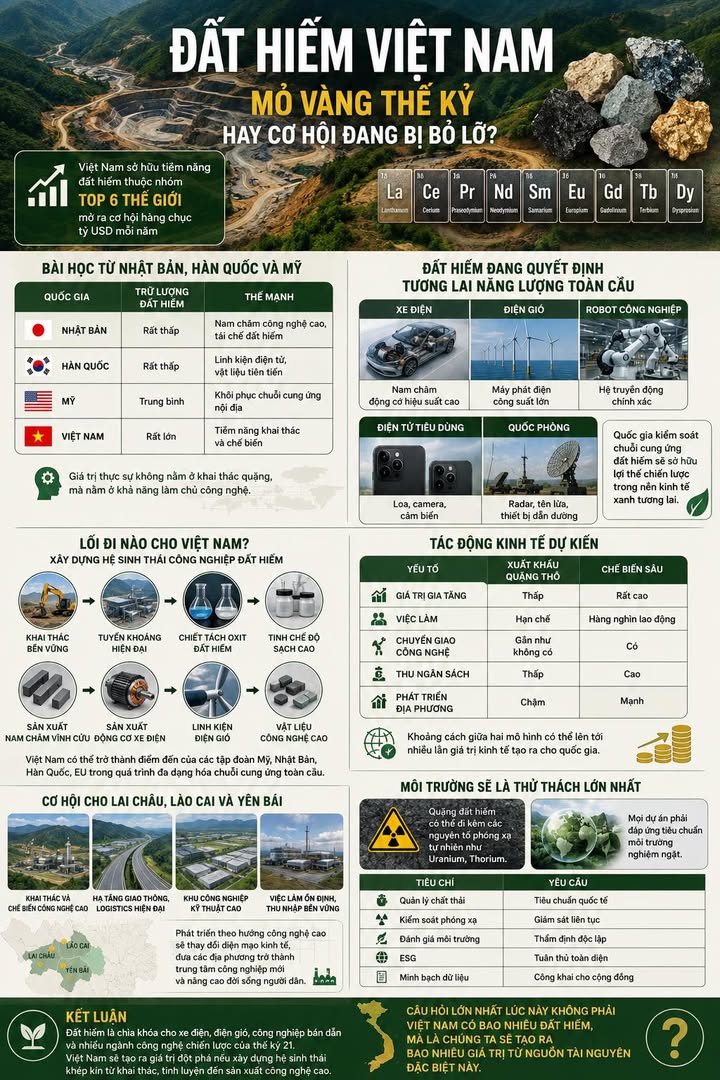
Rare Earth in Vietnam – A Century Gold Mine or a Missed Opportunity?
In the global race toward green energy, electric vehicles, offshore wind power, and semiconductor technology, rare earth elements have emerged as one of the planet's most strategic resources. According to international assessments, Vietnam ranks among the countries with the largest rare earth reserves worldwide, presenting an unprecedented opportunity to deeply participate in the global technology supply chain.
However, world industrial development history has shown a clear reality: the greatest value does not lie in the ore beneath the ground but in the processing, refining, and final product manufacturing technologies.
The Strategic Importance of Rare Earth Elements
Rare earth elements are a group of 17 chemically similar metallic elements that are critical to numerous modern technologies. Despite their name, these elements are relatively abundant in the Earth's crust, but they are rarely found in economically exploitable concentrations. The extraction and processing of these elements present significant technical and environmental challenges, which is why production is concentrated in just a few countries.
As the world transitions to green energy and advanced technologies, the demand for rare earth elements has surged. These elements are essential for permanent magnets, batteries, catalysts, and various electronic components, making them indispensable for the technologies that will define the 21st century.
Lessons from Japan, South Korea, and the United States
Notably, the countries leading in rare earth technology today are not those with the most abundant ore deposits.
| Country | Rare Earth Reserves | Strengths |
|---|---|---|
| Japan | Very low | High-tech permanent magnets, rare earth recycling |
| South Korea | Very low | Electronic components, advanced materials |
| United States | Moderate | Rebuilding domestic supply chain |
| Vietnam | Very large | Potential for mining and processing |
Japan stands as a prime example, with virtually no significant rare earth mines, yet it has become a global center for producing high-tech permanent magnets and electronic components. Meanwhile, the United States is investing billions of dollars to rebuild its rare earth refining and magnet production capabilities to reduce dependence on external sources.
This demonstrates that the true value lies not in mining ore but in mastering the technology.
Rare Earth Elements Shaping the Future of Global Energy
Many strategic industries today directly depend on rare earth elements.
| Application | Role of Rare Earth Elements |
|---|---|
| Electric Vehicles | High-performance motor magnets |
| Offshore Wind Power | Large-capacity generator magnets |
| Industrial Robots | Precision drive systems |
| Consumer Electronics | Speakers, cameras, sensors |
| National Defense | Radar, missiles, guidance systems |
A large-capacity offshore wind turbine may use hundreds of kilograms of rare earth magnets. A modern electric vehicle also requires a significant amount of rare earth elements to optimize motor performance. Therefore, the country that controls the rare earth supply chain will hold a strategic advantage in the future green economy.
Which Path for Vietnam?
Experts suggest that Vietnam should not stop at mining and exporting raw ore.
Instead, the country needs to build a complete industrial ecosystem including:
- Sustainable Mining
- Modern Mineral Processing
- Rare Earth Oxide Extraction
- High-Purity Refining
- Permanent Magnet Production
- Electric Vehicle Motor Manufacturing
- Wind Power Components
- High-Tech Materials
If successfully implemented, Vietnam could become a destination for corporations from the US, Japan, South Korea, and Europe during the global supply chain diversification process.
Projected Economic Impact
| Factor | Raw Ore Export | Deep Processing |
|---|---|---|
| Value Addition | Low | Very High |
| Employment | Limited | Thousands of workers |
| Technology Transfer | Almost none | Yes |
| Budget Revenue | Low | High |
| Local Development | Slow | Strong |
The economic difference between the two models can amount to many multiples in terms of value created for the nation.
Opportunities for Lai Châu, Lào Cai, and Yên Bái
Regions with large rare earth reserves could completely transform their economic landscape if they develop toward high technology. Instead of forming small-scale, scattered mining sites, these areas could become new industrial centers with modern transportation, logistics, power, and service systems.
More importantly, local people would have opportunities to access stable employment in processing and high-tech manufacturing plants rather than depending on risky manual mining operations.
The Environment Will Be the Greatest Challenge
Along with opportunities come significant environmental challenges. Some rare earth ores may contain naturally radioactive elements like Uranium and Thorium. Therefore, all projects must meet strict environmental standards.
| Criterion | Requirements |
|---|---|
| Waste Management | International standards |
| Radiation Control | Continuous monitoring |
| Environmental Assessment | Independent evaluation |
| ESG | Full compliance |
| Data Transparency | Public disclosure |
These are mandatory requirements if Vietnam wants to attract major technology corporations and build public trust.
Conclusion
Rare earth elements are not merely mineral resources. They are the key to the electric vehicle industry, wind power, semiconductor manufacturing, and many other strategic technology sectors of the 21st century.
If Vietnam only exports raw ore, it will miss most of the economic value. However, if it can build an ecosystem from mining and refining to high-tech manufacturing, rare earth elements could become one of the most important growth drivers of the economy for decades to come.
The biggest question now is not how much rare earth Vietnam has, but how much value we can create from this extraordinary resource.