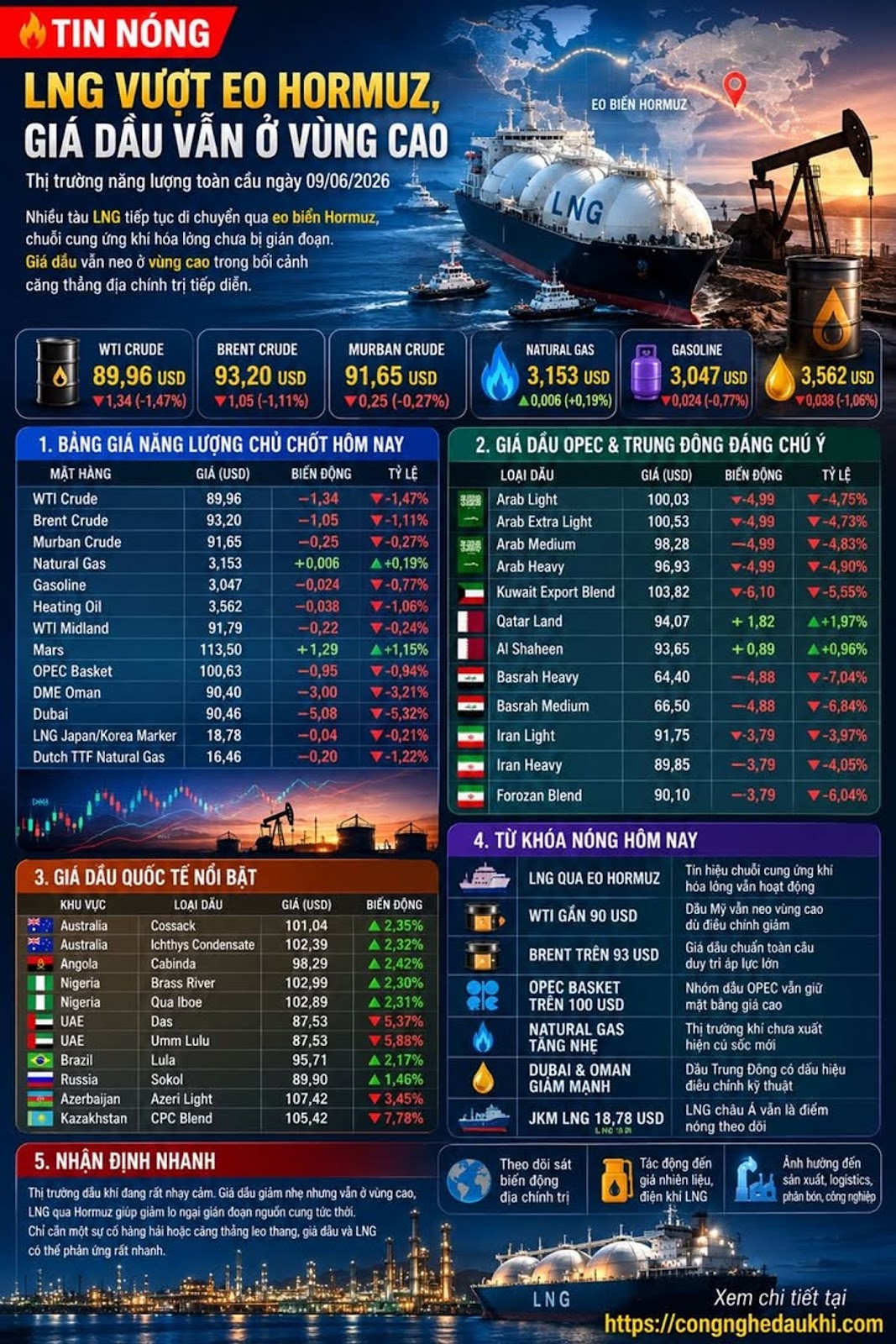
LNG Continues Transit Through Strait of Hormuz as Energy Prices Remain Elevated
Can a single fluctuation at the Strait of Hormuz be sufficient to push global energy prices into a new shock cycle?
The energy market continues to heat up as multiple LNG vessels are reported still moving through the Strait of Hormuz, one of the world's most strategic maritime corridors for crude oil and liquefied natural gas. Despite ongoing geopolitical tensions, the flow of LNG has not been significantly disrupted, indicating that the global energy supply chain is still striving to maintain stable operational rhythm.
In terms of pricing, crude oil remains anchored at high levels. WTI Crude reached $89.96 per barrel, down $1.34, or -1.47%. Brent Crude reached $93.20 per barrel, down $1.05, or -1.11%. Murban Crude reached $91.65 per barrel, down $0.25, or -0.27%. Natural gas reached $3.153, slightly up $0.006, or +0.19%.
1. Key Energy Prices Today
| Commodity | Price | Change | Percentage |
|---|---|---|---|
| WTI Crude | $89.96 | -$1.34 | -1.47% |
| Brent Crude | $93.20 | -$1.05 | -1.11% |
| Murban Crude | $91.65 | -$0.25 | -0.27% |
| Natural Gas | $3.153 | +$0.006 | +0.19% |
| Gasoline | $3.047 | -$0.024 | -0.77% |
| Heating Oil | $3.562 | -$0.038 | -1.06% |
| WTI Midland | $91.79 | -$0.22 | -0.24% |
| Mars | $113.50 | +$1.29 | +1.15% |
| OPEC Basket | $100.63 | -$0.95 | -0.94% |
| DME Oman | $90.40 | -$3.00 | -3.21% |
| Dubai | $90.46 | -$5.08 | -5.32% |
| LNG Japan/Korea Marker | $18.78 | -$0.04 | -0.21% |
| Dutch TTF Natural Gas | $16.46 | -$0.20 | -1.22% |
2. Notable OPEC and Middle East Oil Prices
| Oil Type | Price | Change | Percentage |
|---|---|---|---|
| Arab Light | $100.03 | -$4.99 | -4.75% |
| Arab Extra Light | $100.53 | -$4.99 | -4.73% |
| Arab Medium | $98.28 | -$4.99 | -4.83% |
| Arab Heavy | $96.93 | -$4.99 | -4.90% |
| Kuwait Export Blend | $103.82 | -$6.10 | -5.55% |
| Qatar Land | $94.07 | +$1.82 | +1.97% |
| Al Shaheen | $93.65 | +$0.89 | +0.96% |
| Basrah Heavy | $64.40 | -$4.88 | -7.04% |
| Basrah Medium | $66.50 | -$4.88 | -6.84% |
| Iran Light | $91.75 | -$3.79 | -3.97% |
| Iran Heavy | $89.85 | -$3.79 | -4.05% |
| Forozan Blend | $90.10 | -$3.79 | -4.04% |
3. Prominent International Oil Prices
| Region | Oil Type | Price | Change |
|---|---|---|---|
| Australia | Cossack | $101.04 | +2.35% |
| Australia | Ichthys Condensate | $102.39 | +2.32% |
| Angola | Cabinda | $98.29 | +2.42% |
| Nigeria | Brass River | $102.99 | +2.30% |
| Nigeria | Qua Iboe | $102.89 | +2.31% |
| UAE | Das | $87.53 | -5.37% |
| UAE | Umm Lulu | $87.53 | -5.88% |
| Brazil | Lula | $95.71 | +2.17% |
| Russia | Sokol | $89.90 | +1.46% |
| Azerbaijan | Azeri Light | $107.42 | -3.45% |
| Kazakhstan | CPC Blend | $105.42 | -7.78% |
4. Today's Market Keywords
| Keyword | Market Significance |
|---|---|
| LNG through Hormuz | Indicates that the LNG supply chain is still operational |
| WTI near $90 | American oil remains at high levels despite downward adjustment |
| Brent above $93 | Global benchmark oil maintains significant upward pressure |
| OPEC Basket above $100 | OPEC oil continues to maintain high price levels |
| Natural Gas slight increase | The gas market has not yet shown a new shock |
| Dubai and Oman sharp decline | Middle Eastern oil shows signs of technical correction |
| JKM LNG $18.78 | Asian LNG remains a key monitoring point |
5. Market Analysis
Today's data shows that the oil and gas market is in a highly sensitive state. Major oil contracts have seen slight declines but remain at elevated levels, while LNG continues to transit through Hormuz, helping to alleviate concerns about immediate supply disruptions. However, any maritime incident, shipping restrictions, or escalation of military tensions could cause Brent, WTI, and Asian LNG prices to react very quickly.
The Strait of Hormuz remains a critical chokepoint in global energy markets, with approximately 20% of global oil and a significant portion of LNG passing through this narrow waterway. The continued flow of LNG through this strategic passage provides some comfort to markets that have been on edge due to recent geopolitical tensions in the region.
Despite the current stability, market analysts remain cautious. The price differentials between various benchmarks tell a complex story. While WTI and Brent have shown modest declines, some regional benchmarks like Mars have increased, indicating localized supply concerns or transportation bottlenecks.
For countries like Vietnam, these fluctuations require close monitoring as they directly impact energy import costs, fuel prices, LNG-powered electricity generation, logistics expenses, fertilizer production, and industrial manufacturing. The interconnected nature of global energy markets means that regional tensions can quickly translate into economic impacts worldwide.
Looking ahead, the market will continue to watch developments in the Middle East, production decisions by OPEC+, and global demand trends. The balance between supply security and price stability remains a delicate one, with the Strait of Hormuz serving as a constant reminder of the vulnerabilities in the global energy system.