#OPEC #UAE #ARapXeUt #GiaDau #DiaChinhTri #NangLuongToanCau #PhanTichChuyenSau
⸻
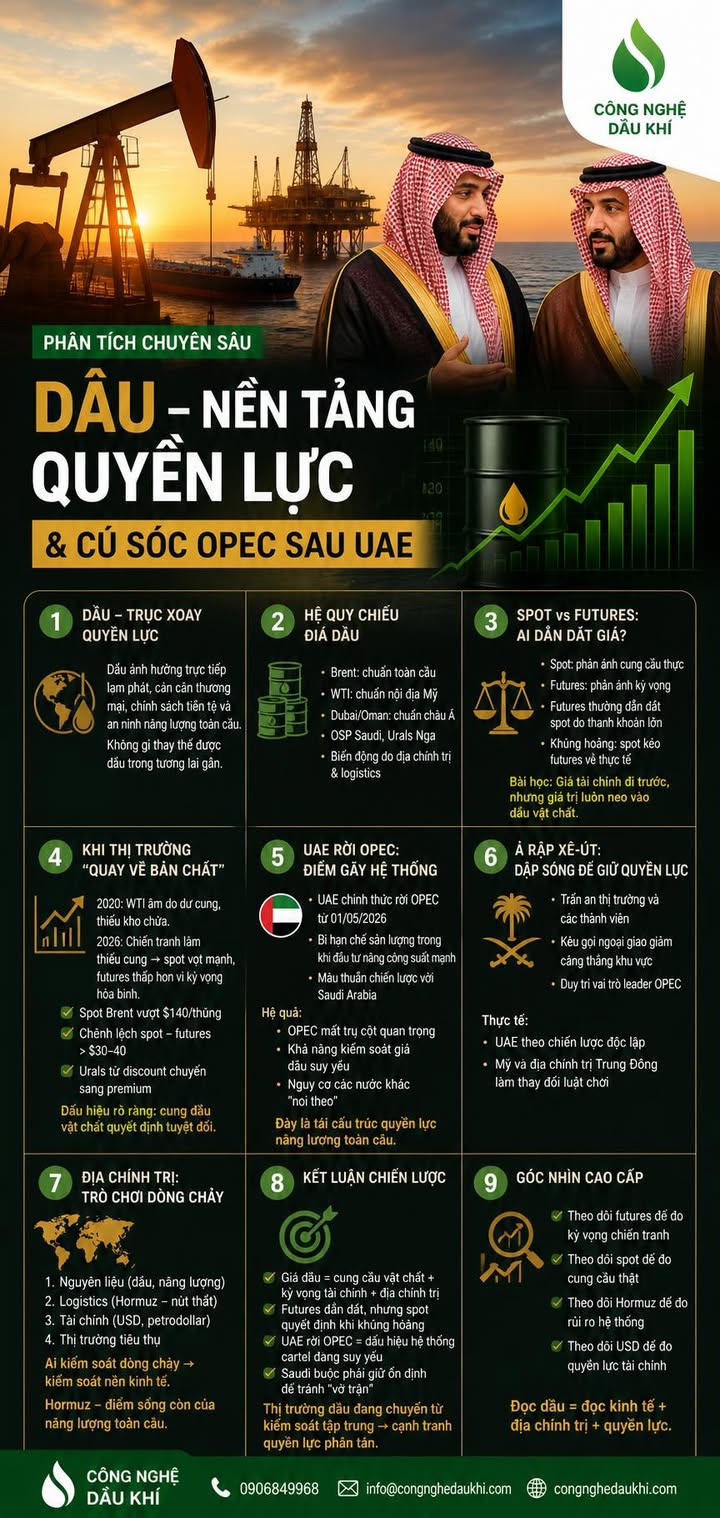
1️⃣ OIL IS NOT JUST A FUEL – IT IS A “POWER PILOT”
Oil is the most important basic commodity of the modern economy: it is both a logistics, transportation, and petrochemical input, and a macro variable that directly affects inflation, trade balance, and monetary policy. Despite the development of renewable energy, oil still cannot be replaced in aviation, shipping, military and energy security. Therefore, oil has always been a core geopolitical tool in international relations.
⸻
2️⃣ OIL PRICE REFERENCE SYSTEM: BRENT – WTI – DUBAI/OIL
The oil market operates around three main standards: Brent (internationalized, global reference), WTI (US standard, influenced by domestic logistics), Dubai/Oman (Asian standard, priced via Platts' MOC). Besides, there is the OSP mechanism of Saudi Aramco and Russia's Urals oil that often discounts according to Brent. These prices fluctuate in correlation, the difference is mainly due to geopolitics and logistics.
⸻
3️⃣ SPOT vs FUTURES: WHO IS “LEADING” PRICES?
Spot is the physical oil price - reflecting actual supply and demand. Futures are expected prices - reflecting forecasts, risks, etcfinancial cash flow.
Paradoxical point: futures are a "child" but often decide spot because of large liquidity, high leverage and faster reflection of expectations. When the market fluctuates, futures lead, spot follows; When a real crisis occurs, spot returns to "pull" futures back to reality.
Lesson: financial prices may be ahead, but value is always anchored in physical oil.
⸻
4️⃣ WHEN THE MARKET "RETURNS TO ESSENCE"
2020: WTI price is negative due to excess supply + lack of storage.
2026: opposite situation - war causes lack of supply → spot spikes sharply, futures lower because of expectations of peace.
Notable phenomena:
• Spot Brent exceeds $140/barrel
• Spot – futures spread > $30–40
• Urals from discount to premium
=> This is a very clear sign: physical oil supply is the absolute decisive factor
⸻
5️⃣ UAE LEAVES OPEC: FRACTURE POINT OF THE SYSTEM
UAE - the third largest producer - officially leaves OPEC from May 1, 2026 
Root cause: limited output while investing heavily in increasing capacity
Strategic conflict with Saudi Arabia - the country wants to keep prices high by cutting production
Consequences:
• OPEC lost an important pillar
• Weakened ability to control oil prices
• The risk of other countries "following suit"
This is not just thateconomics but rather the restructuring of global energy power
⸻
6️⃣ SAUDI ARABIA: "ROUNDING WAVES" TO KEEP POWER ️
Saudi Arabia is having to:
• Reassure the market and members
• Call for diplomacy to reduce regional tensions 
• Maintain the role of OPEC leader
But in reality:
• UAE is following an independent strategy
• America and Middle East geopolitics change the rules of the game 
⸻
7️⃣ GEOPOLITICS: THE REAL GAME IS IN THE FLOW
The core is not just oil, but:
1. Raw materials (oil, energy)
2. Logistics (Hormuz – global bottleneck)
3. Finance (USD, petrodollar)
4. Consumer market
Who controls the flow → controls the economy
The UAE warning Hormuz not to "weaponize" shows that this line is a vital point for global energy.
⸻
8️⃣ STRATEGIC CONCLUSION
• Oil price = result of physical supply and demand + financial expectations + geopolitics
• Futures can lead, but spot decides in times of crisis
• UAE leaves OPEC = sign that the cartel system is weakening
• Saudi Arabia must maintain stability to avoid "collapse"
The oil market is shifting from centralized control → distributed power competition
⸻
9️⃣ PREMIUM VIEW
• Monitor futures to measure war expectations
• Track spot for measurementreal supply and demand
• Monitor Hormuz to measure systemic risk
• Track USD to measure financial power
Reading oil = reading economics + reading geopolitics + reading power
⸻
#giaDau #OPECPlus #UAE #SaudiArabia #Hormuz #NangLuong #TaiChinh #DiaChinhTri #PhanTichSau