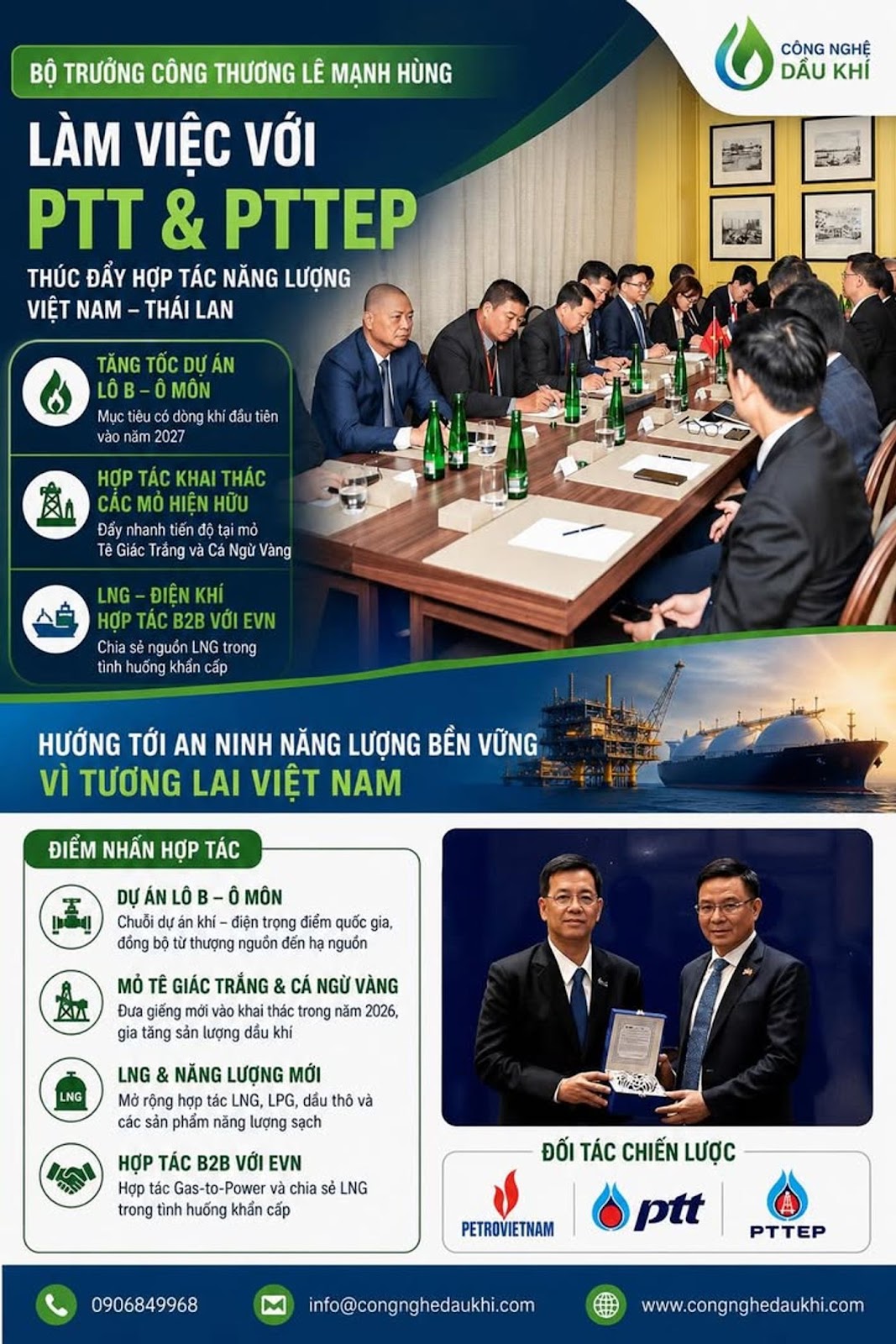
Strategic Energy Partnership: Vietnam Accelerates Lo B - O Mon Super Project with Thai Energy Giants
In a move that could directly impact electricity prices, gas supplies, and energy security for over 100 million Vietnamese citizens for years to come, Vietnam's Minister of Industry and Trade Le Manh Hung recently held crucial working sessions with PTT Public Company Limited (PTT) and PTT Exploration and Production Public Company Limited (PTTEP) in Thailand. This high-level meeting signals Vietnam's strategic push to overcome critical bottlenecks in the Lo B - O Mon project, a cornerstone initiative for national energy security in the coming decade.
Strategic Context: Vietnam's Energy Imperative
Against a backdrop of continuously rising electricity demand, the working sessions between Vietnam's top industry official and Thailand's energy behemoths have garnered significant attention from regional energy circles. This engagement transcends mere diplomatic economic discussions; it represents a strategic maneuver to resolve critical challenges within the Lo B - O Mon gas-to-power project chain, which is positioned as a fundamental pillar for ensuring Vietnam's energy security during its next development phase.
As Vietnam experiences rapid industrialization and economic growth, securing reliable energy sources has become paramount. The nation's electricity demand has been growing at an annual rate of approximately 8-10%, creating urgent needs for new power generation capacity. In this context, the Lo B - O Mon project chain emerges as a critical component of Vietnam's energy strategy.
The Lo B - O Mon Project: A Cornerstone of Energy Security
The Lo B - O Mon project represents an integrated value chain encompassing offshore gas exploration, gas transportation via pipeline systems, and power generation facilities in Vietnam's Mekong Delta region. When completed according to schedule, gas from Lo B will fuel numerous new gas-fired power plants, significantly alleviating electricity shortages during the 2027-2035 period.
Located in the Mekong Delta, one of Vietnam's most economically vital regions, this project is designed to provide stable and cost-effective power to support industrial development while meeting growing electricity demands from households and businesses.
| Overview of Vietnam-Thailand Energy Cooperation | |
|---|---|
| Strategic Value | Partnership between Petrovietnam, PTT, and PTTEP |
| Key Project | Lo B - O Mon |
| Important Target | First gas flow by 2027 |
| Expansion Areas | LNG, LPG, crude oil, gas-fired electricity |
| Power Partner | EVN (Vietnam Electricity) |
| Implementation Region | Vietnam and Southeast Asia |
Technical Specifications and Timeline
The Lo B - O Mon project follows a comprehensive upstream-midstream-downstream development approach. PTTEP serves as the technical partner, bringing extensive experience from operations in the Gulf of Thailand to support the project's implementation and operational phases.
The project's development is structured in phases, with Phase 1B representing the next stage of expansion. The timeline is critical for Vietnam's energy planning, with the first gas flow targeted for 2027.
| Project Component | Target |
|---|---|
| First gas flow | 2027 |
| Next development phase | Phase 1B |
| Implementation chain | Upstream - Midstream - Downstream |
| Technical partner | PTTEP |
| Operational support | Gulf of Thailand experience |
Accelerating Existing Oil and Gas Assets
Beyond the Lo B - O Mon project, Vietnam's Ministry of Industry and Trade has also requested PTTEP's collaboration with Petrovietnam Exploration Production Corporation (PVEP) to expedite development at existing oil and gas fields. This acceleration aims to compensate for the natural decline rates of currently producing fields.
The ministry has identified several priority projects requiring focused attention and resources:
- Te Giac Trang (White Tiger) Field (Block 16-1): Targeting new well production by 2026
- Ca Ngu Vang (Yellowfin Tuna) Field (Block 09-2): Accelerating exploration drilling activities
- Lo B - O Mon Project: Maintaining the 2027 first gas flow target
- New Block Opportunities: Attracting international investment
LNG Cooperation: The Strategic Priority
One of the most significant aspects of the discussions between Vietnam and Thailand's energy companies is the potential expansion of LNG cooperation. PTT has expressed strong interest in broadening LNG collaboration with Vietnam, recognizing the growing importance of this energy source in Asia's transition.
In the context of many Asian nations transitioning to cleaner natural gas and renewable energy, LNG is increasingly viewed as a crucial transitional fuel before achieving low-emission targets. PTT currently operates an extensive global LNG network with numerous port terminals and trading centers worldwide, positioning it as a valuable partner for Vietnam's developing LNG infrastructure.
Vietnam's Energy Mix: Balancing Multiple Sources
Vietnam's energy strategy must balance multiple sources to ensure both economic development and environmental sustainability. The country's current energy mix includes:
| Energy Source | Current Role |
|---|---|
| Coal | Still accounts for a large share of power generation |
| Hydropower | Weather-dependent with seasonal variations |
| LNG | Experiencing strong growth |
| Wind Power | Currently expanding capacity |
| Solar Power | High potential for further development |
| Natural Gas | Stable foundation for power generation |
Direct EVN-PTT Collaboration Potential
Another noteworthy development is PTT's interest in direct collaboration with Vietnam Electricity (EVN) in gas-fired power projects and LNG infrastructure. Such a partnership could establish mechanisms for shared emergency LNG resources among major regional energy enterprises, helping Vietnam mitigate risks of fuel shortages for power generation during periods of global market volatility.
Direct cooperation between EVN and PTT could bring several advantages:
- Access to PTT's global LNG supply chain and trading expertise
- Potential for more competitive LNG pricing through long-term contracts
- Enhanced energy security through diversified supply sources
- Technology transfer in LNG terminal operations and management
Risks and Challenges of Delayed Projects
The acceleration of energy projects like Lo B - O Mon is critical given the potential risks of delays:
| Risk | Potential Impact |
|---|---|
| Gas shortage | Reduced electricity generation capacity |
| LNG shortage | Increased fuel costs for power generation |
| Lo B project delays | Increased pressure on electricity supply |
| Decline in existing field production | Reduced energy security |
| International price volatility | Increased import pressure |
Conclusion: A Strategic Approach to Long-Term Energy Security
The working sessions between Vietnam's Minister of Industry and Trade Le Manh Hung and Thailand's PTT and PTTEP underscore Vietnam's accelerated efforts to ensure long-term energy security. From the Lo B - O Mon project to LNG development, and from traditional oil and gas exploitation to next-generation gas-fired electricity, every current step is directed toward achieving the most critical objective: ensuring sufficient energy for economic growth over the coming decades.
As Vietnam continues its development trajectory, strategic partnerships with established energy companies like PTT and PTTEP become increasingly valuable. These collaborations not only help accelerate critical energy projects but also bring technical expertise, operational experience, and international market access that are essential for building a resilient and sustainable energy future.
The successful implementation of the Lo B - O Mon project and expanded LNG cooperation could position Vietnam as a model for energy security in Southeast Asia, demonstrating how strategic international partnerships can help nations navigate the complex energy transition while maintaining economic growth and industrial development.