Crude Oil Quality in Southeast Asia: Who Holds the Crown as the Region's True "King"?
In the complex world of petroleum, not all crude oils are created equal. While many nations in Southeast Asia have built their economies around oil production, the quality of this "black gold" varies significantly from one country to another. This comprehensive analysis examines the technical specifications that determine crude oil value and reveals which Southeast Asian nations produce the most premium petroleum products.
The Science Behind Crude Oil Value
In the petroleum industry, two critical parameters determine the commercial value of crude oil: API gravity and sulfur content.
API Gravity: This measurement indicates the density of crude oil relative to water. The American Petroleum Institute (API) scale ranges from 10° to over 50°, with higher values representing lighter, more valuable crude.
- Higher API gravity = Lighter crude oil
- Lighter crude = Easier to extract valuable products like gasoline and diesel
- Lighter crude = Lower refining costs
Sulfur Content: This measures the concentration of sulfur compounds in crude oil, which determines whether it's classified as "sweet" (low sulfur) or "sour" (high sulfur).
- Lower sulfur content = Fewer impurities
- Lower sulfur content = Reduced processing costs
- Lower sulfur content = More environmentally friendly
Southeast Asian Crude Oil Quality Comparison
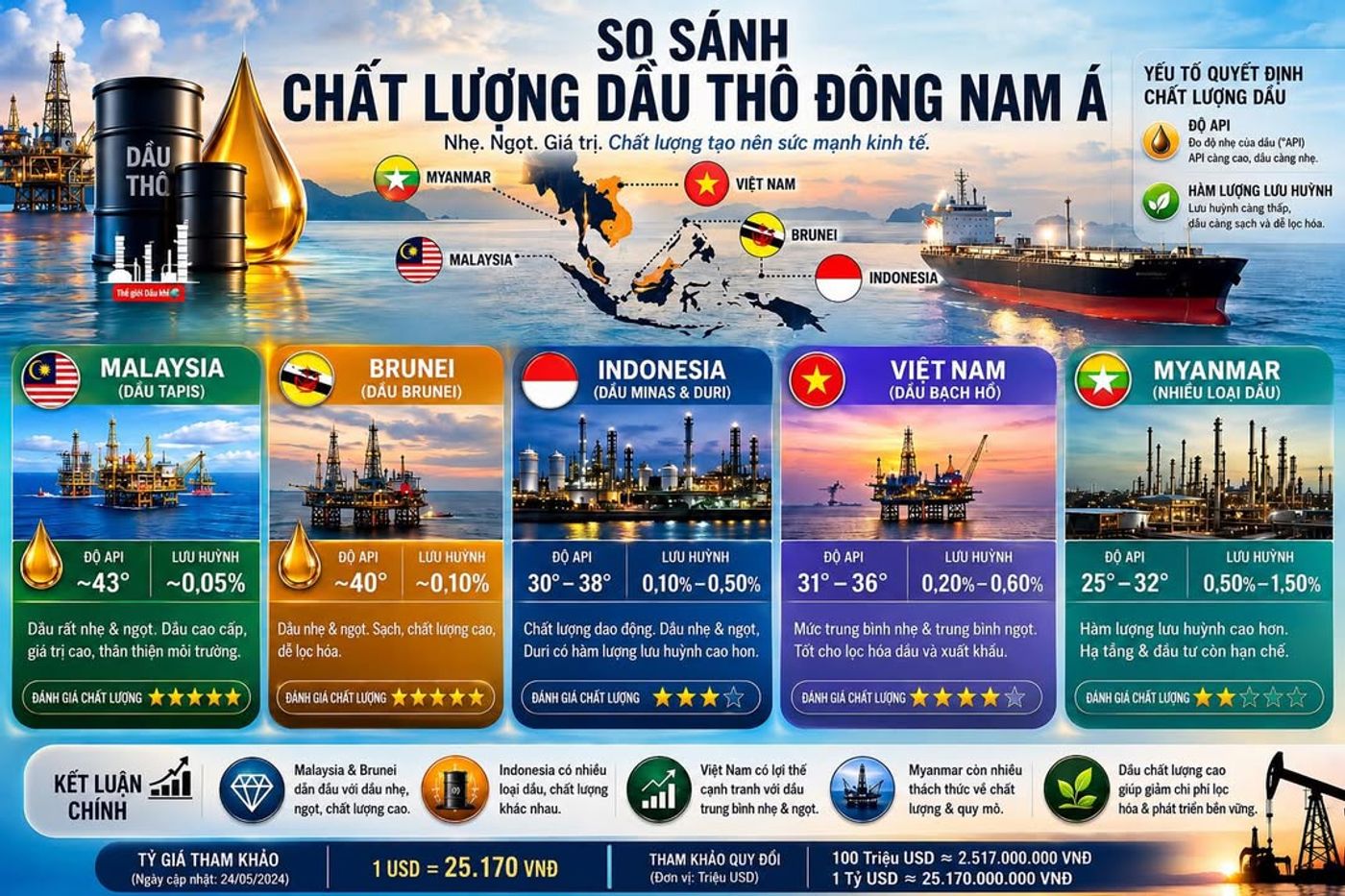
The following table presents a technical comparison of representative crude types from major Southeast Asian oil producers:
| Country | Typical Crude Type | API Gravity | Sulfur Content |
|---|---|---|---|
| Malaysia | Tapis Crude | ~43° | ~0.05% |
| Brunei | Brunei Crude | ~40° | ~0.10% |
| Indonesia | Minas Crude | ~30° | 0.10% - 0.50% |
| Vietnam | Bạch Hổ (White Tiger) | 31° - 36° | 0.20% - 0.60% |
| Myanmar | Various types | 25° - 32° | 0.50% - 1.50% |
Commercial Value Ranking
Based on API gravity and sulfur content, we can rank Southeast Asian crude oils by their commercial value:
| Country | Commercial Value Rating |
|---|---|
| Malaysia | ⭐⭐⭐⭐⭐ |
| Brunei | ⭐⭐⭐⭐⭐ |
| Indonesia | ⭐⭐⭐⭐ |
| Vietnam | ⭐⭐⭐⭐ |
| Myanmar | ⭐⭐ |
Malaysia: The Premium Oil Powerhouse
Malaysia has long been renowned for its Tapis Crude, one of the finest light, sweet crude oils in the world. With an API gravity of approximately 43° and sulfur content below 0.05%, Tapis Crude commands a premium price in international markets, often trading significantly above benchmark crude oils.
The quality of Malaysian crude is so exceptional that it serves as a benchmark for light, sweet crude in Asia. Refineries worldwide highly value Tapis Crude for its high yield of high-value products like gasoline and its relatively low processing requirements.
Brunei: Small Nation, Premium Oil
Despite its relatively small production volumes compared to regional neighbors, Brunei's crude oil quality places it firmly in the top tier of Southeast Asian producers. Brunei Crude, with an API gravity of approximately 40° and sulfur content around 0.10%, is classified as light and sweet.
Refineries particularly favor Bruneian crude due to its high conversion efficiency and the excellent quality of refined products it produces. The consistency of Brunei's crude quality has made it a reliable choice for refineries seeking premium feedstock.
Vietnam's Position in the Regional Oil Landscape
Vietnam's most significant crude oil resource is the Bach Ho (White Tiger) field located in the southern continental shelf. This crude has moderate quality characteristics:
- Strengths:
- Relatively stable quality
- API gravity in the range of 31°-36° (considered medium-light)
- Sulfur content of 0.20%-0.60% (sweeter than many heavy crudes worldwide)
- Well-suited for many Asian refineries
- Limitations:
- When compared to Malaysian Tapis or Bruneian crude, Bach Ho lacks the superior lightness and sweetness
- Typically trades at a discount to premium Asian benchmarks
The Economic Importance of High-Quality Crude
The quality of crude oil directly impacts refinery economics. Consider a refinery processing 100,000 barrels per day:
- Using light, sweet crude can save millions of dollars annually in processing costs
- High-quality crude yields more valuable products like gasoline and diesel
- Lower sulfur content reduces energy consumption during refining
- Less sulfur means lower environmental treatment costs
- Overall, premium crude translates to higher profit margins for refiners
The Future of Southeast Asian Crude Production
While Malaysia and Brunei maintain their positions as producers of premium crude oil, other regional nations are developing strategies to enhance their petroleum value:
- Vietnam: Leveraging strategic geographic location, offshore extraction infrastructure, and modernizing refining technology
- Indonesia: Investing in upgrading its crude quality through enhanced extraction techniques
- Regional Development: New offshore projects and advanced extraction technologies may help elevate the value of crude oil across Southeast Asia
Conclusion: The Evolving Hierarchy of Southeast Asian Crude
Based on current technical specifications and market valuations, Malaysia and Brunei clearly lead Southeast Asia in crude oil quality. Their light, sweet crudes command premium prices and are highly sought after by refineries worldwide.
However, the petroleum landscape is dynamic. Vietnam, with its Bach Ho field and other developing resources, possesses significant potential to enhance its crude oil value through technological advancements and strategic processing partnerships. The ongoing development of Southeast Asia's petroleum resources suggests that the region's crude oil hierarchy may continue to evolve.
As global demand for cleaner energy sources grows and refining technologies advance, the premium on high-quality, low-sulfur crude is likely to increase, potentially reshaping the competitive landscape among Southeast Asia's oil-producing nations.