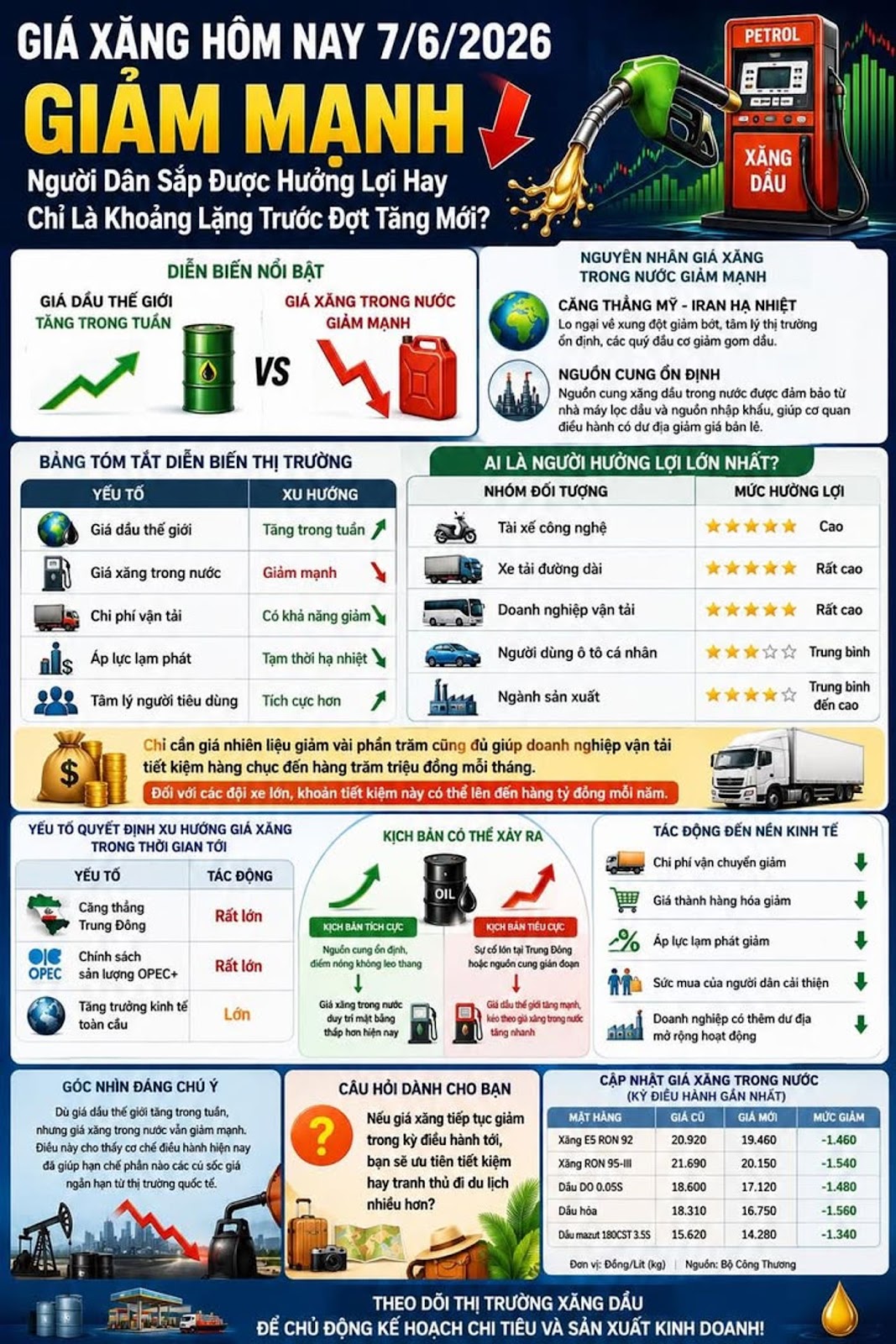
Fuel Prices Drop Sharply on June 7, 2026: Temporary Relief or Prelude to New Increases?
As fuel prices become a focal point for millions of citizens, transport businesses, ride-sharing drivers, and investors, Vietnam's domestic market has recently witnessed a significant decrease in gasoline and diesel prices. This development has created widespread positive sentiment across various sectors. However, this raises critical questions: Is this substantial price reduction signaling the beginning of a deeper downward trend, or will consumers soon witness another shocking reversal in fuel costs?
Current Market Dynamics: Domestic vs. International Trends
Notably, the domestic market's trajectory is moving in the opposite direction of global oil markets. Over the past week, international oil prices have shown an upward trend, yet retail fuel prices in Vietnam have decreased considerably. This divergence is attributed to the domestic price adjustment cycle and stable supply conditions, creating a favorable environment for consumers and businesses alike.
| Factor | Trend |
|---|---|
| Global oil prices | Increased during the week |
| Domestic fuel prices | Significant decrease |
| Transportation costs | Potential reduction |
| Inflationary pressure | Temporarily easing |
| Consumer sentiment | More positive |
Factors Behind the Domestic Fuel Price Reduction
The global energy market has been significantly influenced by geopolitical tensions in the Middle East recently. As concerns about potential conflicts between the United States and Iran appear to be de-escalating, market sentiment has stabilized. Consequently, investment funds have reduced their oil acquisition activities for risk hedging purposes, leading to a cooling of energy prices.
Domestically, the continuous supply of petroleum products from domestic refineries and imported sources has enabled regulatory authorities to reduce retail prices. This stable supply chain has created the necessary space for implementing these price cuts, providing much-needed relief to various sectors of the economy.
Who Benefits Most from Lower Fuel Prices?
The reduction in fuel prices brings advantages to multiple stakeholders across different sectors:
- Logistics companies
- Ride-sharing drivers
- Private vehicle owners
- Passenger transport businesses
- Manufacturing enterprises
| Group | Level of Benefit |
|---|---|
| Ride-sharing drivers | High |
| Long-haul truck operators | Very high |
| Transportation companies | Very high |
| Private car owners | Moderate |
| Manufacturing sector | Moderate to high |
Even a few percentage points decrease in fuel prices can help transportation companies save tens to hundreds of millions of Vietnamese Dong each month. For large vehicle fleets, these savings could amount to billions of Dong annually.
Future Outlook: What to Expect in the Coming Weeks
Industry experts suggest that fuel price trends in the coming weeks will depend on three critical factors:
| Factor | Impact Level |
|---|---|
| Middle East geopolitical tensions | Very significant |
| OPEC+ production policies | Very significant |
| Global economic growth | Significant |
If oil supply continues to remain stable and no major geopolitical escalations occur in the Middle East, domestic fuel prices could potentially maintain their current lower levels. Conversely, any significant disruption in supply or major incident in the Middle East could cause international oil prices to surge rapidly, subsequently driving up domestic fuel costs.
Economic Implications
Fuel prices are consistently recognized as one of the most influential factors affecting social costs. When fuel prices decrease:
- Transportation costs decline
- Product prices decrease
- Inflationary pressures ease
- Consumer purchasing power improves
- Businesses gain more room for operational expansion
This explains why each fuel price adjustment cycle receives special attention from the market, as the effects ripple through various sectors of the economy.
Notable Perspective: Domestic vs. International Divergence
An interesting observation is that despite rising international oil prices, the domestic market has still recorded a significant decrease. This indicates that the current price management mechanism has effectively mitigated some of the short-term shocks from international markets.
Consumers are certainly benefiting in the short term. However, the most significant question remains whether this marks the beginning of a new price reduction cycle or merely a brief pause before the energy market enters a period of greater volatility.
As the next price adjustment period approaches, will you prioritize saving or take the opportunity to travel more frequently?