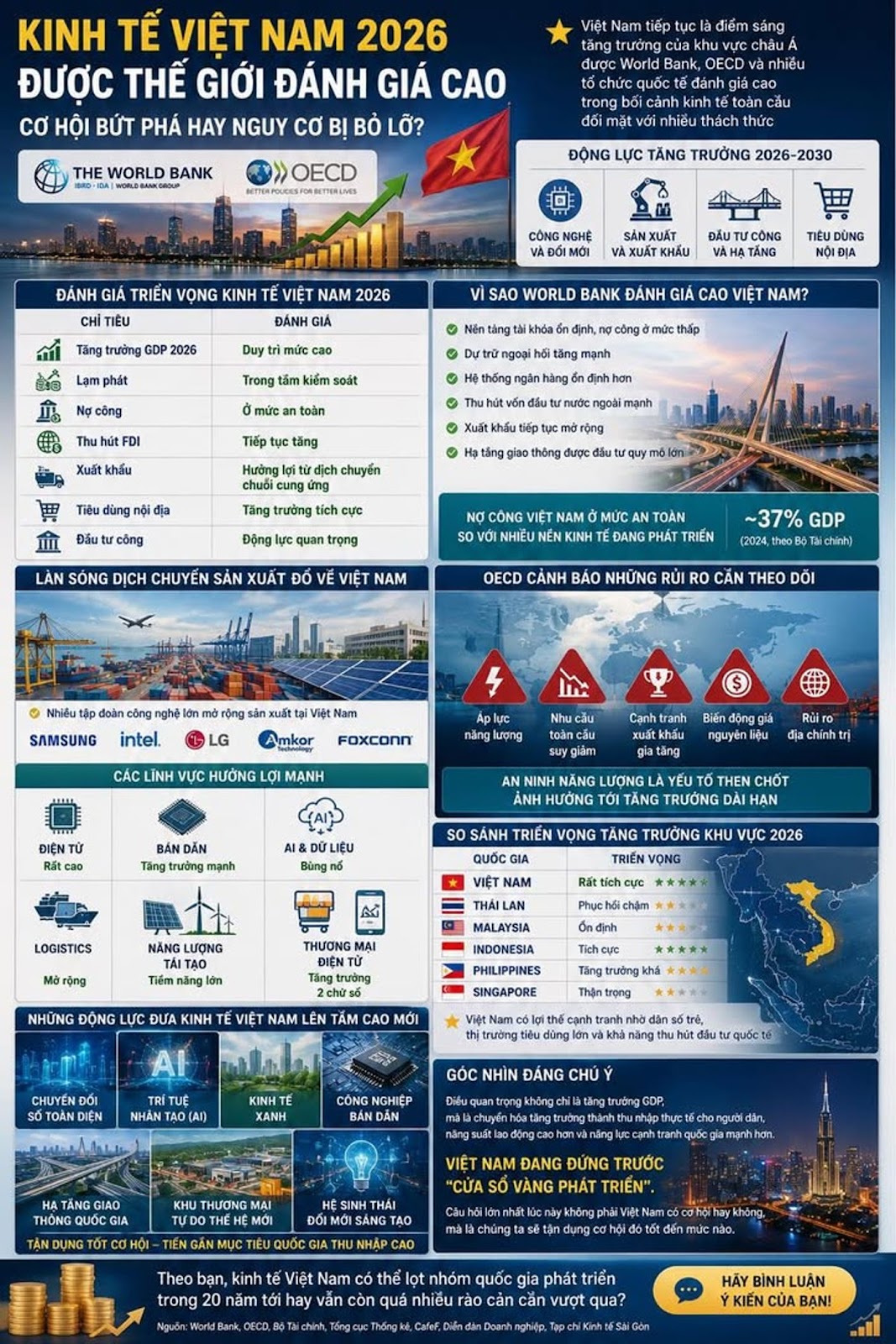
Vietnam's Economy in 2026: High Global Evaluation - Breakthrough Opportunity or Risk of Missing Out?
Can Vietnam become the fastest-growing economy in Southeast Asia in the coming years, or will it miss a golden opportunity as the world enters a new, more intense competitive cycle? Vietnam's economy is becoming the focus of attention for many international financial organizations as it continues to receive positive assessments from the World Bank, OECD, and other global economic institutions. Amid a global economic landscape still facing inflation, geopolitical instability, and energy pressures, Vietnam is still considered one of the outstanding bright spots for growth in the Asian region.
Not only foreign investors but also domestic businesses are expecting the 2026-2030 period to open a new growth cycle driven by technology, manufacturing, exports, and public investment. This comprehensive analysis examines Vietnam's economic prospects, challenges, and opportunities in the evolving global economic landscape.
Global Economic Context
The global economy in 2026 continues to navigate through a complex environment characterized by persistent inflationary pressures, ongoing geopolitical tensions, and energy transition challenges. In this context, Vietnam's relative economic stability and growth trajectory have attracted significant attention from international economists and financial institutions.
While many developed economies struggle with slower growth and emerging markets face various headwinds, Vietnam has demonstrated remarkable resilience and continues to be viewed as an outlier in terms of economic performance among developing nations.
Summary of Vietnam's Economic Outlook Assessment
| Indicator | Assessment |
|---|---|
| 2026 GDP Growth | Maintain high levels |
| Inflation | Under control |
| Public Debt | At safe levels |
| FDI Attraction | Continued increase |
| Exports | Benefiting from supply chain shifts |
| Domestic Consumption | Positive growth |
| Public Investment | Important growth driver |
Why the World Bank Evaluates Vietnam Highly
According to many economic experts, Vietnam's greatest strength currently lies in its stable fiscal foundation. In recent years, Vietnam has maintained a relatively low public debt ratio compared to many developing economies. This factor provides the government with additional fiscal space to support the economy when necessary.
The World Bank and other international institutions have highlighted several key strengths in Vietnam's economic framework:
- ✅ Increasing foreign exchange reserves
- ✅ More stable banking system
- ✅ Strong foreign investment attraction
- ✅ Continued expansion of exports
- ✅ Large-scale investment in transportation infrastructure
These factors have led many international organizations to upgrade their growth forecasts for Vietnam. The country's prudent monetary policy, fiscal discipline, and structural reforms have created a solid foundation for sustainable economic development.
Continuing Wave of Manufacturing Shifts to Vietnam
One of the strongest growth drivers currently is the global supply chain realignment trend. Many major technology corporations continue to expand their manufacturing operations in Vietnam.
| Sector | Outlook |
|---|---|
| Electronics | Very high |
| Semiconductors | Strong growth |
| AI and Data | Explosive |
| Logistics | Expanding |
| Renewable Energy | Large potential |
| E-commerce | Double-digit growth |
This manufacturing shift is particularly benefiting Vietnam's electronics sector, which has become a cornerstone of the economy. The country is increasingly positioning itself as a critical link in global technology supply chains, especially following the diversification strategies implemented by multinational corporations seeking to reduce dependencies on single-country production.
OECD's Continued Warnings on Risks to Monitor
Despite upgrading growth outlooks, the OECD also notes several important challenges that need attention:
- ⚠️ Energy pressures
- ⚠️ Declining global demand
- ⚠️ Increasingly fierce export competition
- ⚠️ Raw material price volatility
- ⚠️ Geopolitical risks
Particularly, the energy security story is being viewed as a factor that could significantly impact growth rates in the coming years. Vietnam's energy transition, balancing economic growth with environmental commitments, presents both challenges and opportunities.
Regional Growth Prospects Comparison
| Country | Outlook |
|---|---|
| Vietnam | Very positive |
| Thailand | Slow recovery |
| Malaysia | Stable |
| Indonesia | Positive |
| Philippines | Quite good growth |
| Singapore | Cautious |
Many experts suggest that Vietnam possesses good competitive advantages thanks to its young population, large consumer market, and ability to attract international investment. The country's demographic dividend, with a working-age population that continues to grow, provides a significant advantage over many regional competitors facing aging populations.
Potential Growth Drivers to Elevate Vietnam's Economy to New Heights
Several key sectors and trends could propel Vietnam's economy to higher levels:
- Comprehensive digital transformation
- Artificial Intelligence (AI)
- Green economy
- Semiconductor industry
- National transportation infrastructure
- New-generation free trade areas
- Upgrading the innovation ecosystem
If Vietnam effectively leverages these opportunities, it can move closer to the goal of becoming a high-income country in the coming decades. The semiconductor industry, in particular, represents a strategic opportunity for Vietnam to move up the value chain from assembly to more complex design and manufacturing processes.
Noteworthy Perspective
What's important is not just how high the GDP growth percentage is, but the ability to transform that growth into real income for people, higher labor productivity, and stronger national competitiveness. Vietnam's economic development is at what many experts call a "golden window of development." The biggest question at this point is not whether Vietnam has opportunities, but how well we will utilize those opportunities.
The quality of growth matters as much as the quantity. Sustainable development that includes environmental protection, social equity, and institutional strengthening will determine whether Vietnam can achieve long-term prosperity rather than short-term gains.
Conclusion: Strategic Imperatives for Vietnam's Economic Future
Vietnam stands at a critical juncture in its economic development journey. The positive assessments from international organizations provide both recognition of past achievements and validation of current policies. However, maintaining this momentum requires strategic focus on several key areas:
- Human capital development: Investing in education, vocational training, and digital skills to prepare the workforce for emerging industries
- Institutional strengthening: Continuing reforms to improve business environment, governance, and regulatory efficiency
- Infrastructure modernization: Accelerating development of digital, transportation, and energy infrastructure
- Environmental sustainability: Balancing growth with climate commitments and green transition
- Regional integration: Maximizing benefits from trade agreements and economic partnerships
The path to high-income status requires more than just favorable external conditions—it demands strategic vision, policy consistency, and collective effort from all stakeholders in Vietnam's economy. With the right approach, Vietnam can indeed leverage its current position to achieve sustainable prosperity and join the ranks of developed nations in the coming decades.
What are your thoughts? Can Vietnam become a developed country within the next 20 years, or are there still too many barriers to overcome? The answer may well depend on the choices and actions taken in this critical period of development.