## Introduction
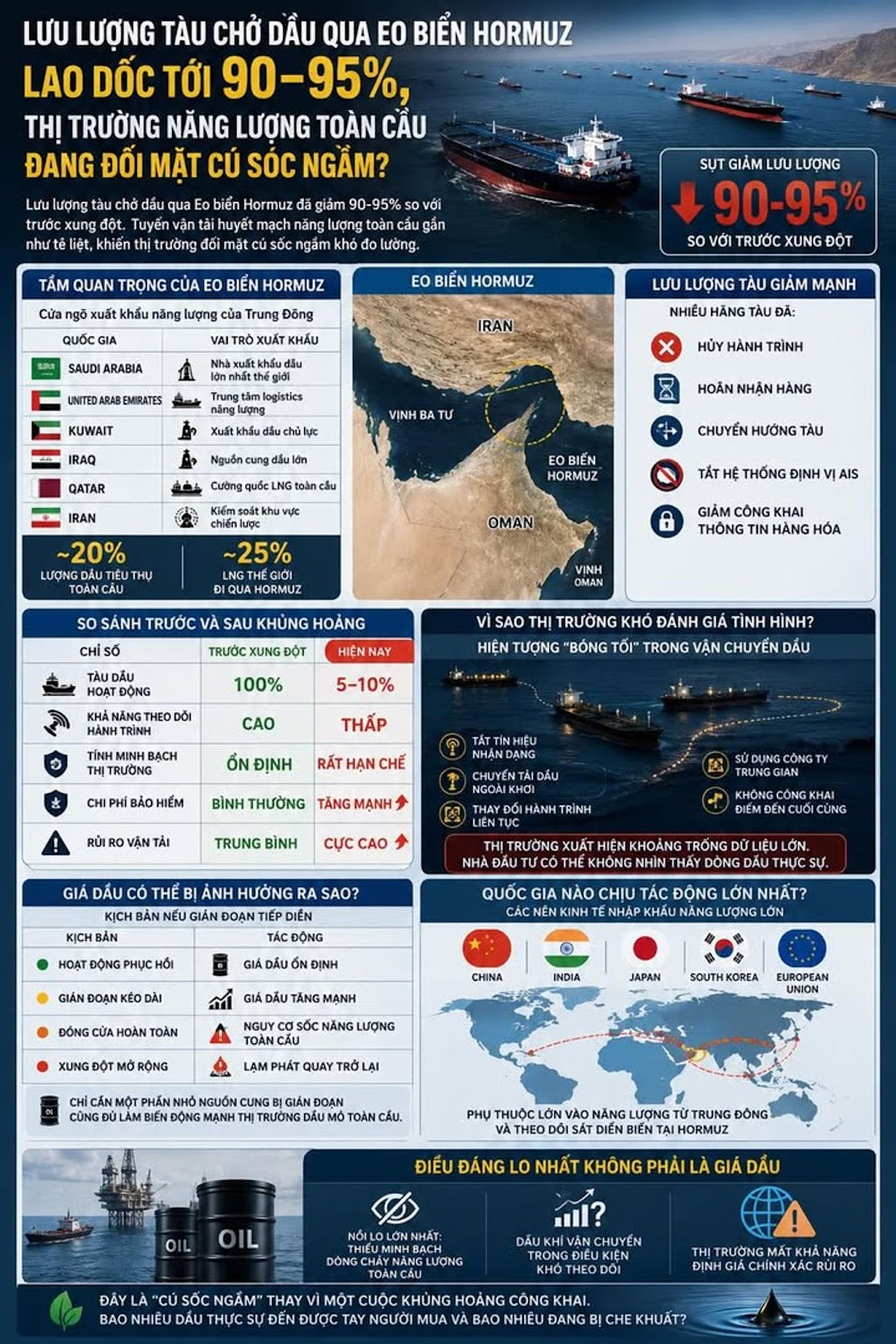
In the complex web of global energy markets, few chokepoints hold as much strategic importance as the Strait of Hormuz. This narrow waterway, often referred to as the world's "energy valve," is currently experiencing an unprecedented crisis, with oil tanker traffic plummeting by an estimated 90-95% compared to pre-conflict levels. As the world focuses on daily oil price fluctuations, a more profound and potentially destabilizing reality is emerging: a massive, largely invisible disruption in global energy flows that could reshape international markets and geopolitical alignments in ways not yet fully understood.
## The Strategic Importance of the Strait of Hormuz
The Strait of Hormuz serves as the maritime gateway for energy exports from the Middle East, connecting the Persian Gulf with the Gulf of Oman and the Arabian Sea. This strategically vital passage, just 21 miles wide at its narrowest point, facilitates the movement of approximately one-third of the world's seaborne traded oil and 25% of global liquefied natural gas (LNG).
### Countries Dependent on Hormuz Exports
The nations utilizing this critical waterway represent some of the most significant energy producers globally:
| Country | Energy Export Significance |
|---|---|
| Saudi Arabia | World's largest oil exporter, accounting for approximately 12% of global production |
| United Arab Emirates | Major energy logistics hub and significant oil producer |
| Kuwait | Crucial oil exporter with approximately 2.5% of global production |
| Iraq | Fast-growing oil producer with approximately 4.5% of global output |
| Qatar | Global LNG powerhouse, leading the world in LNG exports |
| Iran | Controls the eastern flank of the strait; historically significant oil producer |
## Current Crisis: Unprecedented Reduction in Traffic
The current situation in the Strait of Hormuz represents one of the most severe disruptions to global energy flows in modern history. According to international maritime analysts and energy transport specialists, the volume of oil tankers passing through the strait has declined by an astonishing 90-95% compared to pre-conflict levels.
### Operational Changes in Maritime Transport
Recent maritime data reveals that shipping companies have implemented dramatic operational changes:
- Voyage Cancellations: Many scheduled oil transport voyages have been completely canceled
- Cargo Delays: Acceptance of new oil cargoes has been significantly postponed
- Route Diversions: Tankers are being rerouted through alternative, longer maritime passages
- AIS Deactivation: Automatic Identification Systems (AIS) - mandatory tracking systems - are being turned off
- Information Suppression: Details about cargo manifests and destinations are being minimized
The table below illustrates the dramatic transformation of operations in the region:
| Operational Parameter | Pre-Conflict Status | Current Status |
|---|---|---|
| Active Oil Tankers | 100% of fleet operational | 5-10% of fleet active |
| Journey Tracking Capability | High transparency | Low visibility |
| Market Transparency | Stable and predictable | Highly restricted information |
| Standard premiums | Significantly increased rates | |
| Transportation Risks | Manageable levels | Extremely elevated conditions |
Perhaps most concerning to market analysts is the emergence of what they term the "dark fleet" – vessels that continue transporting oil while deliberately obscuring their movements and activities. These ships employ sophisticated techniques to operate beyond the reach of traditional monitoring systems:
- AIS Deactivation: Turning off vessel identification systems to avoid tracking
- Offshore Transfers: Conducting oil transfers at sea to obscure final destinations
- Route Obfuscation: Constantly changing courses to confuse monitoring efforts
- Intermediary Companies: Using complex corporate structures to hide ownership
- Destination Concealment: Withholding information about final delivery points
## Market Implications and Analysis
The near-paralysis in the Strait of Hormuz carries profound implications for global energy markets and economic stability.
### Potential Impact Scenarios
Different scenarios could unfold depending on the duration and severity of the disruption:
| Scenario | Potential Market Impact |
|---|---|
| Operational Recovery | Oil prices stabilize as normal flow resumes |
| Prolonged Disruption | Significant oil price increases as supply tightens |
| Total Closure | Global energy shock with severe price spikes |
| Conflict Escalation |
## Regional Impact Assessment
The consequences of this crisis are not evenly distributed globally. Several nations face particularly significant challenges:
### Major Energy Importers Most Affected
Countries with high energy import dependencies are monitoring the situation with particular concern:
- China: World's largest oil importer, with significant Middle Eastern dependencies
- India: Rapidly growing economy with increasing energy needs
- Japan: Major industrial economy with limited domestic resources
- South Korea: Manufacturing-dependent nation with high energy requirements
- European Union: Diverse bloc with varying energy dependencies but collectively significant import needs
## The Deeper Concern: Market Transparency
While rising oil prices represent a significant concern, market specialists suggest an even more fundamental problem: the erosion of transparency in global energy flows.
When substantial volumes of energy are transported in conditions that resist monitoring, markets lose their ability to accurately price risk. This fundamental breakdown in market mechanics represents what many experts are calling a "hidden energy shock" rather than an overt crisis.
As the world focuses on daily oil price movements, a more fundamental question emerges: how much oil is actually reaching buyers, and how much remains hidden from global surveillance systems? This information gap creates uncertainty that extends far beyond simple price fluctuations to affect strategic decision-making across governments and corporations.
## Future Scenarios and Outlook
The situation in the Strait of Hormuz could evolve in several directions, each with distinct implications for global energy markets:
### Potential Resolution Pathways
Several scenarios might emerge in the coming weeks and months:
1. **Diplomatic Resolution:** International mediation could stabilize the situation and restore normal traffic flows
2. **New Normal:** A "new normal" might emerge with permanently reduced traffic and increased security costs
3. **Escalation:** Further regional escalation could lead to complete closure of the strait
4. **Market Adaptation:** Global markets might adapt through alternative supply routes and energy sources
Each scenario carries different implications for energy prices, supply security, and economic stability worldwide.
## Conclusion: The Hidden Energy Crisis
The near-paralysis in the Strait of Hormuz represents more than a temporary disruption in energy transport. It signals a potential paradigm shift in how global energy markets function, with profound implications for transparency, pricing mechanisms, and supply security.
As the world continues to grapple with the visible impacts of this crisis—manifesting in oil price volatility and supply chain disruptions—the more profound consequences remain largely hidden from view. The "dark fleet" phenomenon and the resulting information gap create a level of uncertainty that traditional market analysis struggles to quantify or address.
In an increasingly interconnected global economy, the ability to monitor and understand energy flows has never been more critical. The current situation in Hormuz challenges this fundamental requirement, potentially reshaping energy markets in ways that will be felt for years to come.
The world may be experiencing not just an energy supply disruption, but a fundamental transformation in how energy is traded, monitored, and secured—a transformation with implications that extend far beyond the oil markets to the broader global economy and geopolitical landscape.