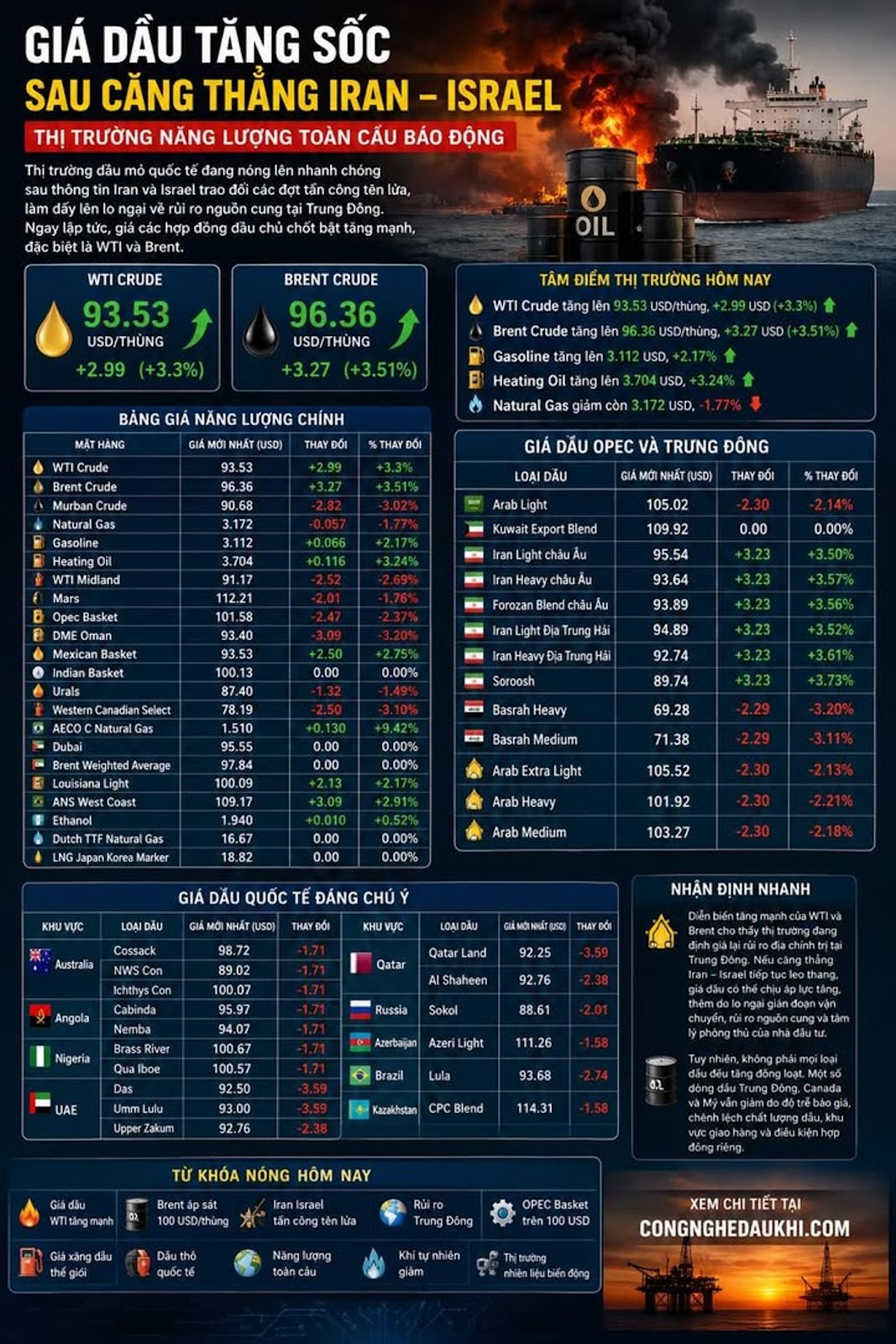
Oil Prices Surge Amid Iran-Israel Tensions, Global Energy Markets on Alert
The global energy market is experiencing significant volatility following recent escalations in tensions between Iran and Israel, with crude oil prices spiking amid concerns over potential supply disruptions in the Middle East. As geopolitical risks intensify, international benchmark oils have seen substantial increases, raising questions about whether oil prices could breach the $100 per barrel threshold and trigger a global fuel price shock.
The market reaction has been swift and pronounced, with West Texas Intermediate (WTI) and Brent crude leading the upward trend. This development comes at a critical time when global energy markets are already navigating complex supply-demand dynamics and economic uncertainties.
Market Snapshot: Today's Key Developments
The immediate market response to the heightened tensions has been reflected across various energy commodities, with crude oil benchmarks showing particularly strong gains:
- WTI Crude surged to $93.53 per barrel, increasing by $2.99 (3.3%)
- Brent Crude climbed to $96.36 per barrel, rising by $3.27 (3.51%)
- Gasoline prices jumped to $3.112, up $0.066 (2.17%)
- Heating Oil increased to $3.704, up $0.116 (3.24%)
Notably, Natural Gas prices moved in the opposite direction, falling to $3.172, a decrease of $0.057 (1.77%), indicating that speculative capital is flowing more heavily into crude oil and liquid fuel products amid the geopolitical tensions.
Major Energy Price Movements
The following table provides a comprehensive overview of price changes across various energy benchmarks:
| Commodity | Latest Price | Change | % Change |
|---|---|---|---|
| WTI Crude | $93.53 | +$2.99 | +3.3% |
| Brent Crude | $96.36 | +$3.27 | +3.51% |
| Murban Crude | $90.68 | -$2.82 | -3.02% |
| Natural Gas | $3.172 | -$0.057 | -1.77% |
| Gasoline | $3.112 | +$0.066 | +2.17% |
| Heating Oil | $3.704 | +$0.116 | +3.24% |
| WTI Midland | $91.17 | -$2.52 | -2.69% |
| Mars | $112.21 | -$2.01 | -1.76% |
| OPEC Basket | $101.58 | -$2.47 | -2.37% |
| DME Oman | $93.40 | -$3.09 | -3.20% |
OPEC and Middle Eastern Oil Prices
The price movements among OPEC and Middle Eastern crude varieties have been mixed, with some benchmarks experiencing declines despite the overall market bullishness:
| Crude Type | Latest Price | Change | % Change |
|---|---|---|---|
| Arab Light | $105.02 | -$2.30 | -2.14% |
| Kuwait Export Blend | $109.92 | $0.00 | 0.00% |
| Iran Light Europe | $95.54 | +$3.23 | +3.50% |
| Iran Heavy Europe | $93.64 | +$3.23 | +3.57% |
| Forozan Blend Europe | $93.89 | +$3.23 | +3.56% |
| Arab Extra Light | $105.52 | -$2.30 | -2.13% |
| Arab Heavy | $101.92 | -$2.30 | -2.21% |
| Arab Medium | $103.27 | -$2.30 | -2.18% |
International Oil Prices of Note
Regional benchmarks have shown varied performance, with some areas experiencing significant price movements while others remained relatively stable:
| Region | Crude Type | Latest Price | Change |
|---|---|---|---|
| Australia | Cossack | $98.72 | -$1.71 |
| Australia | NWS Con | $89.02 | -$1.71 |
| Australia | Ichthys Con | $100.07 | -$1.71 |
| Angola | Cabinda | $95.97 | -$1.71 |
| Nigeria | Brass River | $100.67 | -$1.71 |
| UAE | Das | $92.50 | -$3.59 |
| UAE | Umm Lulu | $93.00 | -$3.59 |
| Qatar | Qatar Land | $92.25 | -$3.59 |
| Russia | Sokol | $88.61 | -$2.01 |
| Azerbaijan | Azeri Light | $111.26 | -$1.58 |
Market Analysis and Implications
The sharp increase in WTI and Brent prices indicates that the market is reassessing geopolitical risk factors in the Middle East. If tensions between Iran and Israel continue to escalate, oil prices could face additional upward pressure due to concerns about potential supply disruptions, transportation interruptions, and investor risk aversion.
"The market is clearly pricing in the risk of wider conflict in the Middle East," said energy analyst Michael Chen. "With approximately 20% of global oil supplies passing through the Strait of Hormuz, any significant disruption could have profound implications for global energy markets."
However, it's noteworthy that not all crude benchmarks have moved in tandem. Some Middle Eastern, Canadian, and American crude varieties have experienced price declines, attributed to factors such as quote lags, quality differentials, regional delivery conditions, and specific contract terms.
Regional Market Variations
The divergence in price movements across different crude benchmarks highlights the complexity of today's oil market:
- Middle Eastern Crudes: While some Iranian grades have seen significant increases (up to 3.73%), other OPEC benchmarks have declined, reflecting regional supply dynamics and specific market conditions.
- North American Grades: WTI has gained ground, but other US benchmarks like WTI Midland and Mars have declined, possibly due to regional supply factors and pipeline constraints.
- European Benchmarks: The Brent benchmark has strengthened significantly, but some European-linked grades have shown weakness, indicating regional demand considerations.
Future Outlook and Considerations
Several factors will likely influence the direction of oil prices in the coming weeks:
- Geopolitical Developments: Further escalation or de-escalation of tensions between Iran and Israel will be a primary market driver.
- OPEC+ Production Decisions: The organization's upcoming meetings regarding production policies could either amplify or mitigate price movements.
- Global Economic Conditions: Economic growth forecasts and energy demand projections will continue to underpin market fundamentals.
- Inventory Levels: Crude and product stock levels in key consuming regions will provide insight into near-term supply-demand balance.
As the situation continues to evolve, market participants are closely monitoring developments in the Middle East while assessing broader economic indicators that could influence energy markets. The current price surge serves as a reminder of how geopolitical events can rapidly impact global energy markets, potentially affecting everything from transportation costs to inflationary pressures worldwide.
Energy security remains a critical concern for nations and industries worldwide, with the current tensions highlighting the vulnerability of global supply chains to regional conflicts. As prices approach psychologically significant levels, policymakers and industry leaders face the challenge of balancing immediate market responses with longer-term energy security strategies.