Vietnam's Vision for ASEAN 2045: Leading Rather Than Following in the Global Arena
At the opening ceremony of the ASEAN Future Forum 2026 held in Hanoi, Prime Minister Le Minh Hung delivered one of the most significant strategic messages from Vietnam in recent years regarding the future of Southeast Asia. The forum marked a pivotal moment in the region's strategic thinking, raising a fundamental question: Is Vietnam seeking merely to participate in global affairs or actively lead in shaping the rules of the 21st century?
The Prime Minister's address transcended conventional goals of economic development or trade growth, emphasizing ASEAN's evolving role in a world undergoing profound restructuring across technology, economics, and power dynamics. This comprehensive vision positions ASEAN not as a passive recipient of global norms but as an active architect of the future.
Key Highlights of the Strategic Vision
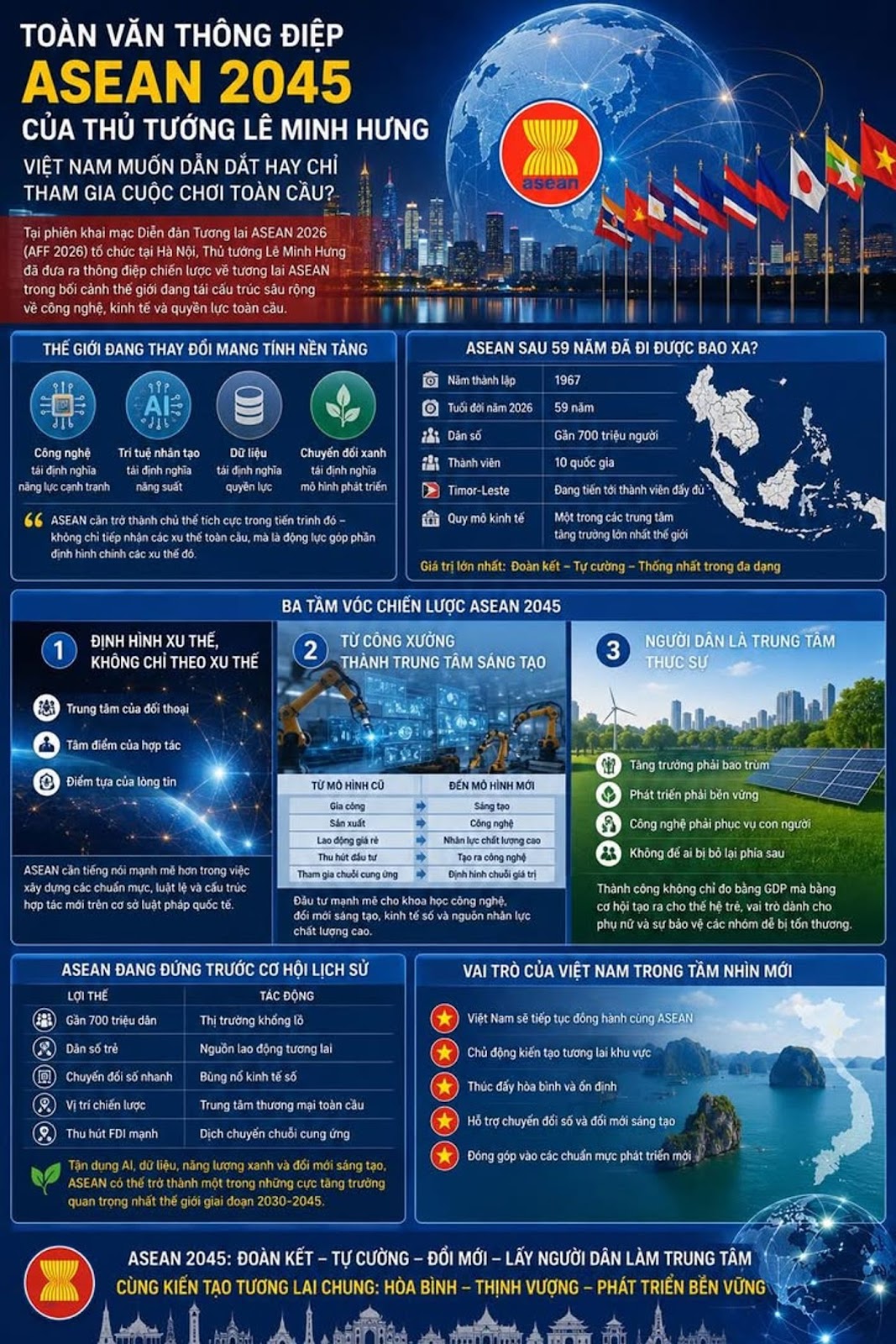
According to Prime Minister Le Minh Hung, the world is witnessing fundamental transformations that are redefining:
- Technology is redefining competitive capabilities
- Artificial intelligence is redefining productivity
- Data is redefining power structures
- Green transformation is redefining development models
This paradigm shift implies that nations confined to mere manufacturing roles risk being left behind in the new global race. The vision calls for a proactive approach to technological advancement and innovation as essential components of future competitiveness.
ASEAN at 59 Years: Achievements and Current Status
As ASEAN approaches its 60th anniversary, the bloc has evolved significantly since its establishment in 1967. The current status of ASEAN reflects remarkable progress:
| Indicator | Status |
|---|---|
| Year of Establishment | 1967 |
| Age in 2026 | 59 years |
| Population | Nearly 700 million people |
| Membership | 10 nations |
| New Member | Timor-Leste progressing to full membership |
| Economic Scale | One of the world's largest growth centers |
What's particularly emphasized is not merely ASEAN's demographic or economic scale but its remarkable ability to maintain unity among nations with vastly different political systems, cultural backgrounds, and levels of development. This diversity, often seen as a challenge, has become ASEAN's distinctive strength in the global arena.
The Three Strategic Dimensions of ASEAN 2045
1. ASEAN: Not Just Following Trends, But Shaping Them
The Prime Minister articulated that ASEAN must evolve to become:
- A center for dialogue
- A focal point for cooperation
- A foundation of trust
In an increasingly intense geopolitical competition among major powers, ASEAN needs a stronger voice in establishing international norms rather than merely accepting rules imposed from outside. This positioning would allow the region to navigate between great powers while maintaining its autonomy and shaping the global agenda.
2. ASEAN: From Manufacturing Hub to Innovation Center
This component represents the most critical aspect of the Prime Minister's vision. For decades, ASEAN has been renowned for:
- Young workforce
- Competitive costs
- Strategic location
- Global manufacturing center
However, Prime Minister Le Minh Hung emphasized that the future belongs to innovative economies, not just manufacturing ones. This shift requires a fundamental transformation in development approaches:
| Old Development Model | New Development Model |
|---|---|
| Assembly/Processing | Innovation |
| Manufacturing | Technology |
| Labor-cost advantage | High-quality human resources |
| Attracting investment | Creating technology |
| Participating in supply chains | Shaping value chains |
This transformation aligns with global trends in artificial intelligence, semiconductors, big data, robotics, and the digital economy that are experiencing explosive growth worldwide. The vision positions ASEAN to move up the value chain rather than remaining in low-value-added production.
3. People Must Be Truly at the Center
One of the most quoted statements from the forum was:
"Success should not be measured solely by GDP, but by the opportunities created for the younger generation, the roles allocated to women, and the protection of vulnerable groups."
This message reflects a global shift in development thinking where:
- Growth must be inclusive
- Development must be sustainable
- Technology must serve humanity
- No one should be left behind
This people-centered approach contrasts with purely economic metrics of success and positions ASEAN as a region that values human development alongside technological advancement.
ASEAN at a Historical Crossroads
Experts evaluate that ASEAN currently possesses rare advantages that could position it for significant growth:
| Advantage | Impact |
|---|---|
| Nearly 700 million population | Huge market potential |
| Young population | Future labor force |
| Rapid digital transformation | Digital economy boom |
| Strategic location | Global trade hub |
| Strong FDI attraction | Supply chain relocation |
If successfully leveraged, AI, data, green energy, and innovation could transform ASEAN into one of the world's most significant growth centers between 2030-2045. This potential represents not just economic opportunity but also a chance to establish a development model that balances technological advancement with human welfare.
Vietnam's Role in the New Vision
The Prime Minister's concluding message clearly outlined Vietnam's commitments:
- Continue to accompany ASEAN
- Proactively shape the region's future
- Promote peace and stability
- Support digital transformation and innovation
- Contribute to new development norms
Notably, the speech emphasized more than economic growth, revealing Vietnam's ambition to help ASEAN become a force capable of influencing global trends in the 21st century. Strategically, ASEAN 2045 is not merely a Southeast Asian story but could become one of the world's most successful regional development models, balancing technology, growth, and human concerns.
The vision presented by Prime Minister Le Minh Hung at the ASEAN Future Forum 2026 represents a significant evolution in Vietnam's regional engagement strategy. Rather than accepting a secondary role in global affairs, Vietnam is positioning itself and ASEAN as active shapers of the future, with technology and innovation at the core of this transformation.
As the world faces unprecedented challenges and opportunities, ASEAN's ability to maintain unity while pursuing ambitious technological and economic goals could determine whether the region fulfills its potential as a leading global force in the decades to come.
The question remains whether ASEAN can leverage its diversity and strategic advantages to become a technology and innovation center comparable to regions like the European Union or East Asia within the next 20 years. The answer may well determine the future trajectory of not just Southeast Asia, but the global order itself.