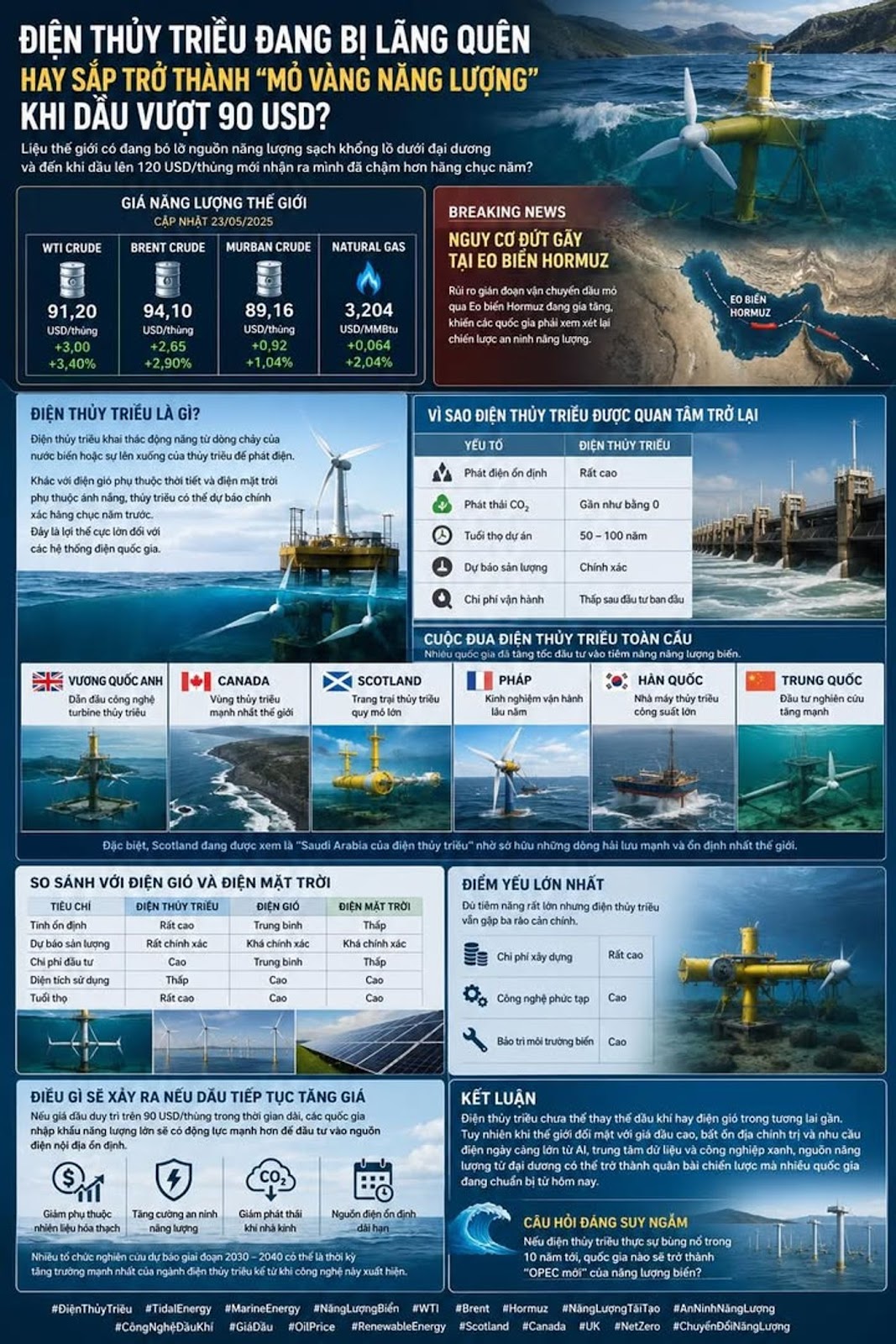
Tidal Energy: Overlooked Resource or the Next Energy Goldmine as Oil Surpasses $90?
As global oil prices continue their upward trajectory, with West Texas Intermediate (WTI) reaching $91.20 per barrel and Brent crude at $94.10, while natural gas climbs to $3.204 per MMBtu, nations worldwide are reassessing their energy security strategies. Meanwhile, new risks in the Strait of Hormuz further complicate the global energy landscape. Amid these challenges, while solar and wind energy capture most headlines, a quietly developing technology over the past decade is returning to the spotlight: tidal energy.
The question arises: Is the world missing out on a massive clean energy source beneath our oceans, and will it take oil prices reaching $120 per barrel for us to realize we've fallen decades behind?
Understanding Tidal Energy
Tidal energy harnesses the kinetic energy from ocean currents or the rise and fall of tides to generate electricity. Unlike wind power, which depends on weather conditions, and solar power, which relies on sunlight, tidal movements can be predicted with precision decades in advance. This represents a significant advantage for national power grid systems.
The technology typically involves underwater turbines similar to wind turbines, but designed to operate in the marine environment. These turbines capture energy from tidal flows or tidal streams, which are created by the gravitational forces of the moon and sun acting on the Earth's oceans.
The Resurgence of Interest in Tidal Energy
Several factors are driving renewed attention to tidal energy as a viable power source:
| Factor | Significance |
|---|---|
| Electricity Generation Stability | Very high - predictable and consistent |
| CO2 Emissions | Nearly zero during operation |
| Project Lifespan | 50 - 100 years |
| Energy Output Forecasting | Highly accurate for years in advance |
| Operational Costs | Low after initial investment |
With oil prices rising sharply and the risk of oil transport disruptions through strategic choke points like the Strait of Hormuz, coastal nations are increasingly seeking more stable domestic energy sources. Tidal energy offers a solution that isn't subject to geopolitical volatility in oil-producing regions.
The Global Race for Tidal Energy
Countries around the world are accelerating investments in tidal energy technology, recognizing its potential as a reliable renewable resource:
| Country | Competitive Advantage |
|---|---|
| United Kingdom | Leading in turbine technology development |
| Canada | World's most powerful tidal resources |
| Scotland | Large-scale tidal farms |
| France | Decades of operational experience |
| South Korea | Large-capacity tidal power plants |
| China | Rapidly increasing research investment |
Scotland, in particular, is being hailed as the "Saudi Arabia of tidal energy" due to possessing some of the world's strongest and most consistent ocean currents. The MeyGen project in Scotland's Pentland Firth, when fully completed, is expected to have a capacity of 398 megawatts, enough to power approximately 175,000 homes.
Tidal Energy vs. Wind and Solar Power
When compared to other renewable energy sources, tidal energy offers distinct advantages and disadvantages:
| Criteria | Tidal Energy | Wind Energy | Solar Energy |
|---|---|---|---|
| Stability | Very high | Medium | Low |
| Output Forecasting | Very accurate | Fairly accurate | Fairly accurate |
| Initial Investment Cost | High | Medium | Low |
| Land/Sea Usage | Low (underwater) | High | High |
| Project Lifespan | Very high (50-100 years) | High (20-25 years) | High (25-30 years) |
These characteristics suggest that tidal energy is less likely to compete directly with wind and solar power but rather serve as a crucial complementary component in future energy systems, particularly for providing baseload power that these intermittent sources cannot consistently deliver.
Significant Challenges Facing Tidal Energy
Despite its tremendous potential, tidal energy faces three major obstacles that have limited its development compared to solar and wind power over the past two decades:
| Challenge | Severity | Description |
|---|---|---|
| Construction Costs | Very High | Underwater installation and marine-grade materials significantly increase expenses |
| Technology Complexity | High | Operating in harsh marine environments requires specialized engineering solutions |
| Marine Environmental Impact | High | Assessing and mitigating effects on marine ecosystems requires careful planning |
These challenges have resulted in slower development of the tidal energy sector compared to solar and wind power over the past two decades. However, technological advancements and increasing environmental awareness are gradually addressing these concerns.
Future Outlook: What Happens If Oil Prices Continue to Rise?
If oil prices remain above $90 per barrel for an extended period, major energy-importing countries will have stronger incentives to invest in stable domestic electricity sources. Tidal energy could benefit significantly from this trend due to its ability to provide continuous electricity with minimal weather dependence and no fuel import requirements.
Several research organizations project that the period 2030-2040 could mark the most significant growth phase for the tidal energy industry since its inception. This acceleration could be driven by:
- Technological advancements reducing installation and maintenance costs
- Increasing carbon pricing making fossil fuels relatively more expensive
- Growing electricity demand from emerging sectors like AI, data centers, and green industries
- Geopolitical tensions affecting traditional energy supply chains
Conclusion
Tidal energy is unlikely to replace oil and gas or wind power in the near future. However, as the world faces high oil prices, geopolitical instability, and growing electricity demand from emerging technologies, ocean-based energy sources could become strategic assets that many nations are preparing for today.
The tidal energy sector remains in its early stages compared to more mature renewable technologies, but its unique characteristics—particularly its predictability and longevity—position it as an essential component of future diversified energy portfolios.
A thought-provoking question emerges: If tidal energy experiences a boom within the next decade, which nation will emerge as the "new OPEC" of marine energy? The answer may well determine global energy leadership in the decades to come.