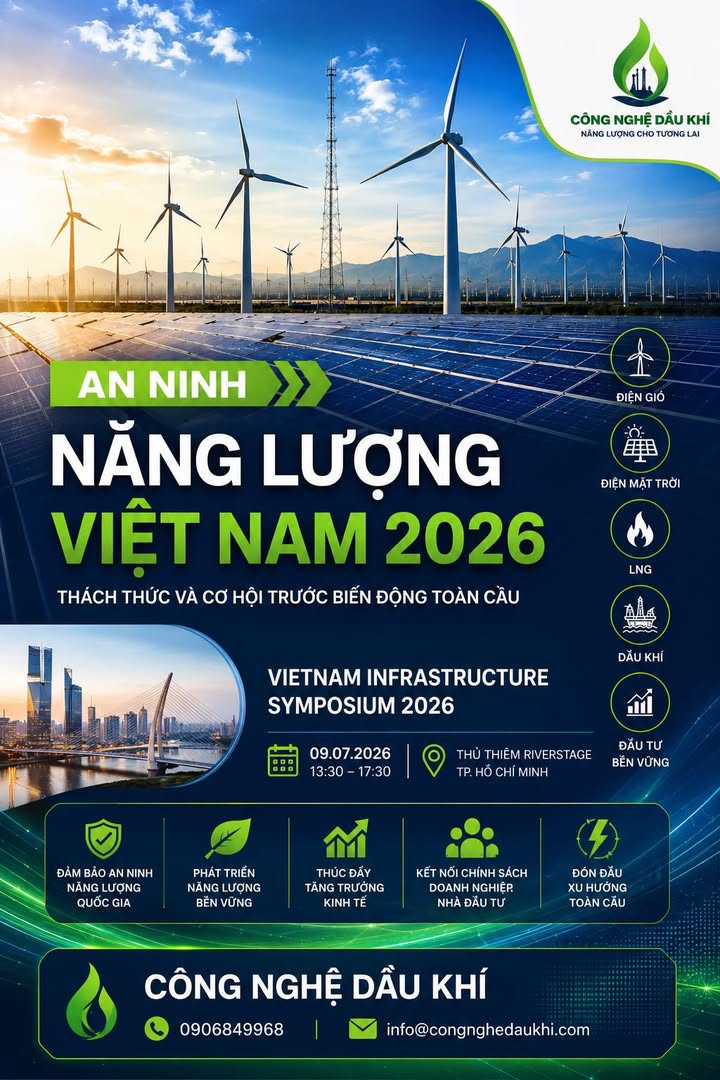
Energy Security in Vietnam: Navigating Global Shocks and Economic Survival Challenges
In an increasingly volatile global landscape, where geopolitical tensions can disrupt energy supplies within weeks, Vietnam faces a critical question: will the nation have sufficient electricity for industrial production and daily life, or risk widespread shortages? This challenge underscores the importance of the upcoming Vietnam Infrastructure Symposium 2026, scheduled for July 9, 2026, from 13:30 to 17:30 at the Thủ Thiêm Riverstage in Ho Chi Minh City.
Organized by Bloomberg Businessweek Vietnam in collaboration with Beacon Media, this prestigious event will bring together policymakers, corporate leaders, and investors to address one of the most pressing issues of our time: national energy security. Against a backdrop of continuous geopolitical conflicts, fluctuating oil and gas prices, and supply chain disruptions, energy security has transcended its traditional boundaries as merely an issue for the electricity or oil and gas sectors. It has become a matter of economic survival, national competitiveness, and social stability.
Why Energy Security Has Become the Hottest Topic of 2026
The past few years have witnessed significant global energy shocks that have reshaped the geopolitical and economic landscape:
- The European energy crisis following the Russia-Ukraine conflict
- Middle East tensions threatening international oil and gas shipping routes
- LNG prices at times skyrocketing to many times their normal levels
- Prolonged droughts reducing hydroelectric output in numerous countries
- Explosive growth in electricity demand driven by AI, data centers, and high-tech manufacturing
For Vietnam, these challenges are particularly daunting as the economy maintains high growth rates and electricity demand continues to rise annually. The intersection of these global pressures with Vietnam's development aspirations creates a complex puzzle that requires urgent attention and innovative solutions.
Vietnam's Energy Landscape in 2026
The current energy situation in Vietnam can be characterized by several key trends:
| Energy Aspect | 2026 Trend |
|---|---|
| Electricity Demand | Strong growth |
| Solar Power | Continued expansion |
| Wind Power | Large-scale investment |
| Imported LNG | Rapid increase |
| Domestic Oil & Gas | Foundational role |
| AI Data Centers | Explosive demand growth |
The development of artificial intelligence and cloud computing has driven unprecedented growth in electricity demand at data centers. This trend is already evident in major economies like the United States, China, Singapore, and others. Vietnam is no exception, as numerous projects in data, AI, and high-tech manufacturing are being implemented across the country, placing additional strain on the energy infrastructure.
The Race Between Traditional and Renewable Energy Sources
One of the key topics of discussion at the upcoming symposium will be the balance between different energy sources. No single energy source possesses the capability to completely replace others. Vietnam's solution in the coming years will likely involve developing a diverse energy structure to enhance resilience against global shocks.
The following table compares the advantages and challenges of various energy sources:
| Energy Source | Advantages | Challenges |
|---|---|---|
| Oil & Gas | Stable, large capacity | Carbon emissions |
| LNG | Flexible, cleaner than coal | Import dependency |
| Wind Power | Green, significant potential | Weather dependency |
| Solar Power | Rapidly decreasing costs | Intermittent supply |
| Hydropower | Low cost | Water dependency |
Key Questions for Vietnam's Energy Future
Several critical questions loom over Vietnam's energy strategy:
- How will Vietnam ensure electricity supply as demand grows exponentially?
- How can the nation balance economic development goals with carbon emission reduction targets?
- What role will LNG play in Vietnam's future energy structure?
- Can offshore wind power become a new billion-dollar industry for Vietnam?
- What investment models will be used to implement the hundreds of trillions of VND in energy infrastructure projects?
Impact on Businesses and Investors
Energy security affects not only power corporations and oil and gas companies but spans across multiple sectors. Electronics, steel, cement, chemical, logistics, and technology industries all directly depend on stable energy supply. Prolonged electricity shortages could cause businesses to lose tens of trillions of VND in revenue, while fuel price fluctuations could completely transform business plans.
The development of AI and data centers has created new demands on the energy sector. These facilities require massive, uninterrupted power supplies, placing additional pressure on Vietnam's energy infrastructure. As Vietnam positions itself as a destination for high-tech manufacturing and digital services, ensuring adequate energy supply becomes not just an operational necessity but a competitive advantage.
The Vietnam Infrastructure Symposium 2026: A Highly Anticipated Business Event
The Vietnam Infrastructure Symposium 2026 is expected to become a crucial forum connecting government agencies, energy companies, investors, and financial institutions. Discussions will not only revolve around electricity, oil and gas, or renewable energy but will expand to include digital infrastructure, logistics, AI, and Vietnam's long-term growth strategy in this new phase.
In an increasingly unstable world, countries that ensure energy security will gain significant advantages in economic growth, investment attraction, and technological development. Vietnam stands at a critical juncture, with an important opportunity to build a more resilient energy system capable of withstanding global fluctuations.
As the symposium approaches, all eyes will be on how Vietnam can navigate these complex energy challenges while maintaining its impressive economic growth trajectory. The solutions developed and implemented in the coming years will not only determine Vietnam's energy security but will also shape its economic future and position in the global landscape.