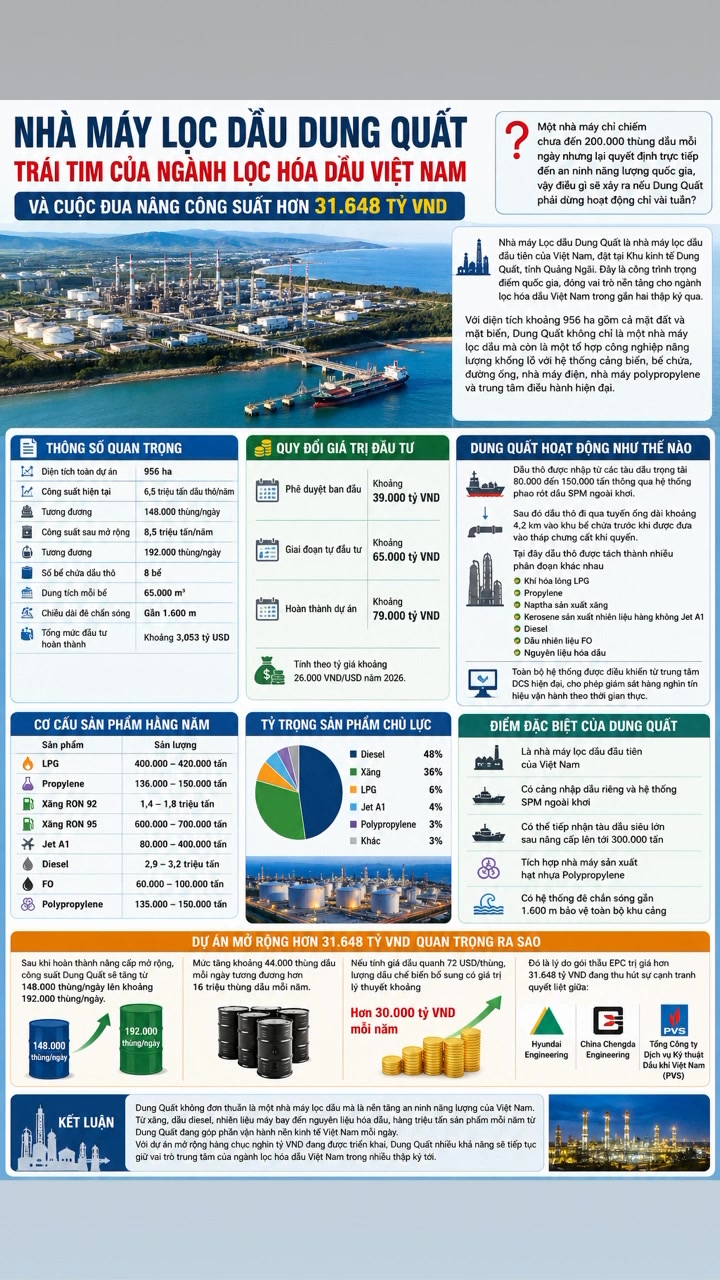
Dung Quat Oil Refinery Upgrade Project: A Critical Investment in Vietnam's Energy Security
The Dung Quat Oil Refinery Upgrade Project represents one of the most significant industrial undertakings in Vietnam's recent history, with total investment exceeding 36.397 trillion VND (approximately $1.45 billion). As the project enters its critical phase, with bids being evaluated for the Engineering, Procurement, and Construction (EPC) package valued at over 31.648 trillion VND (approximately $1.27 billion), the selection of the right contractor becomes paramount to Vietnam's energy security.
Strategic Importance of the Project
The Dung Quat refinery, Vietnam's first and largest oil processing facility, currently operates at a capacity of 148,000 barrels per day. Together with the Nghi Son refinery, these two facilities satisfy approximately 70% of Vietnam's domestic fuel demand. The upgrade project aims to increase Dung Quat's capacity to 171,000 barrels per day—a 15.5% enhancement—while upgrading fuel quality to meet Euro V standards.
With the project targeted for completion by 2028, the timing coincides with increasing global energy volatility and geopolitical tensions in critical supply routes like the Strait of Hormuz. Recent events have demonstrated how quickly energy markets can be disrupted, with Brent crude prices increasing by 8.5% and WTI by 12.2% during Middle East tensions, while diesel prices surged by 36%.
| Dung Quat Refinery Upgrade Project Specifications | |
|---|---|
| Current Capacity | 148,000 barrels per day |
| Post-Upgrade Capacity | 171,000 barrels per day |
| Capacity Increase | +15.5% |
| Total Project Investment | 36.397 trillion VND |
| EPC Package Value | 31.648 trillion VND |
| Target Completion | 2028 |
| Fuel Standard | Euro V (upgraded from Euro IV) |
Technical Complexity and the RFCC Challenge
Unlike standard construction contracts, the EPC package for Dung Quat involves an extremely complex technical integration. The project encompasses:
- 14 revamp (renovation and improvement) units
- 6 new units with proprietary technology
- 2 new units without proprietary technology
- A complete Offsites & Utilities system overhaul
Among these, the Residual Fluid Catalytic Cracking (RFCC) unit stands out as the most technically challenging component. Often described as the "heart" of the refinery, the RFCC unit's performance directly influences the efficiency of the entire complex. The selection process has sparked technical debates regarding whether experience with KBR's ACO (Advanced Cracking Optimization) technology can be considered equivalent to direct RFCC/FCC experience.
| RFCC vs. ACO Technology Comparison | |
|---|---|
| Criteria | RFCC | ACO |
| Primary Objective | Oil Refining | Petrochemical Production |
| Feedstock | Heavy Residual Oil | Light Naphtha |
| Main Products | Gasoline, LPG | Ethylene, Propylene |
| Thermal Mechanism | Self-heat Balanced | Continuous Heat Supply |
| Operating Environment | Refinery | Petrochemical Complex |
Energy Security Context
Despite being an oil-producing country, Vietnam remains heavily dependent on imported fuel. The nation imports over 10 million tons of refined petroleum products annually, accounting for approximately 40% of its total demand of over 26 million tons. This dependency creates significant vulnerability to global price fluctuations and supply disruptions.
The Strait of Hormuz, through which approximately 31% of global oil shipments pass, has become an increasingly risky chokepoint. Any disruption in this region could have immediate and severe consequences for Vietnam's energy security and economic stability.
The EPC Selection Process: Beyond Technical Capabilities
The bidding process for the EPC contract represents a critical juncture in the project's implementation. With a contract value exceeding $1.27 billion and a duration of approximately 37 months, the selected contractor's financial strength becomes as crucial as technical expertise.
Historically, many large-scale EPC projects have encountered difficulties not due to technological shortcomings but because contractors lacked sufficient financial resources to maintain project momentum throughout the implementation lifecycle. Common risks associated with financially weak contractors include:
- Delayed procurement of equipment and materials
- Delayed payments to subcontractors
- Insufficient technical staffing
- Construction schedule delays
- Contract disputes and claims
- Inadequate post-commissioning warranty support
Strategic Benefits for Vietnam's Energy Future
Upon completion, the upgraded Dung Quat refinery will deliver multiple strategic advantages for Vietnam:
| Benefit | Strategic Impact |
|---|---|
| Increased domestic fuel production | Reduces import dependency and trade deficit |
| Euro V standard fuel | Improves air quality and meets international standards |
| Diversified crude oil sources | Enhances supply security and flexibility |
| Improved RFCC technology | Increases processing efficiency and yield |
| Energy self-sufficiency | Strengthens national energy security |
Conclusion: A Defining Moment for Vietnam's Energy Sector
The competition for the Dung Quat EPC contract transcends typical construction or equipment supply considerations. It represents a critical evaluation of technical expertise, real-world experience with similar projects, and long-term financial stability—all essential for successfully executing one of Vietnam's most important energy infrastructure projects.
The selected contractor will not only determine the project's timely completion but will also influence the refinery's operational efficiency for decades to come, directly impacting Vietnam's energy security and economic resilience. In an increasingly volatile global energy landscape, this project represents more than just industrial expansion—it is a strategic investment in Vietnam's future stability and independence.
As Vietnam continues its journey toward greater energy self-reliance, the successful implementation of the Dung Quat upgrade project will serve as a cornerstone of national energy strategy, reducing vulnerability to external shocks while positioning the country for sustainable economic growth.