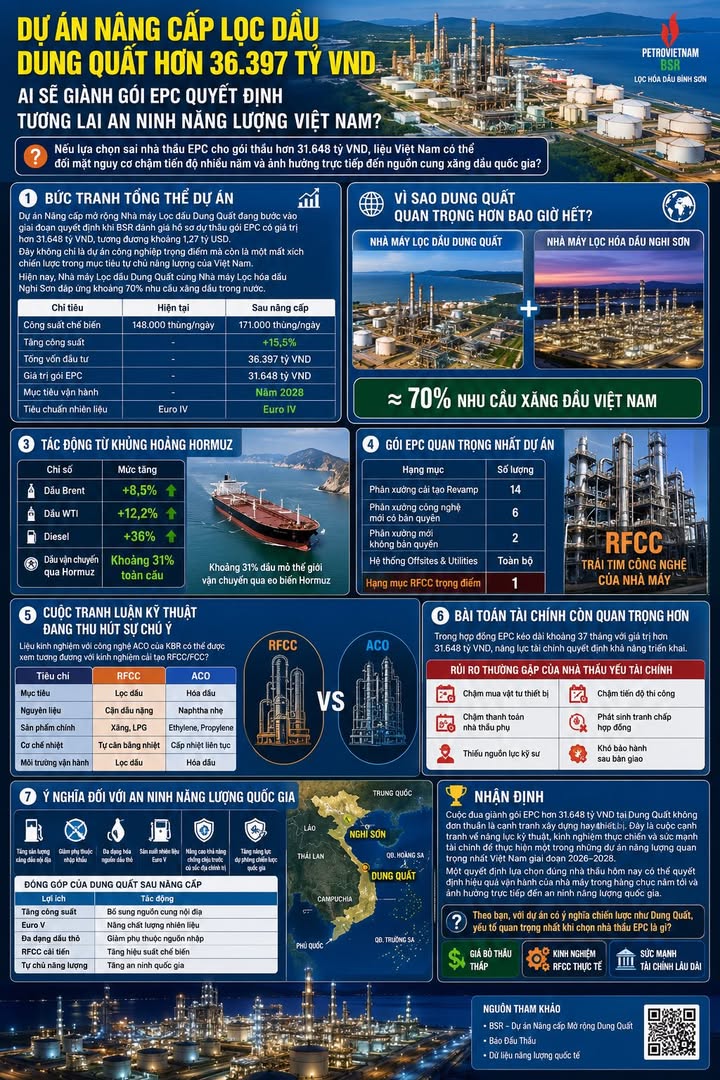
Strategic Dung Quat Oil Refinery Expansion: A 1.27 Billion USD Decision for Vietnam's Energy Security
The Dung Quat Oil Refinery Expansion Project stands at a critical juncture as BSR evaluates bids for an EPC (Engineering, Procurement, and Construction) contract valued at over 31.648 trillion VND (approximately 1.27 billion USD). This project represents not merely an industrial upgrade but a pivotal element in Vietnam's quest for energy independence.
Project Overview: Scaling Up National Refining Capacity
The Dung Quat Refinery Expansion Project is one of Vietnam's most significant industrial undertakings, designed to substantially increase the nation's refining capacity and reduce dependence on imported fuel products. The expansion aims to enhance the refinery's processing capability while meeting higher environmental standards.
| Dung Quat Refinery Expansion Project Summary | |
|---|---|
| Current Capacity | 148,000 barrels/day |
| Post-Expansion Capacity | 171,000 barrels/day |
| Capacity Increase | +15.5% |
| Total Project Investment | 36.397 trillion VND |
| EPC Contract Value | 31.648 trillion VND |
| Target Operation Year | 2028 |
| Fuel Standard | Euro V |
Currently, the Dung Quat and Nghi Son refineries collectively satisfy approximately 70% of Vietnam's domestic fuel demand. This expansion project is crucial to meeting growing consumption while reducing the nation's vulnerability to global energy market fluctuations.
Strategic Importance in the Global Energy Landscape
The geopolitical tensions in the Middle East early 2026 sent shockwaves through global energy markets, underscoring the strategic importance of energy self-sufficiency for nations like Vietnam.
| Impact of Middle East Crisis on Energy Markets | |
|---|---|
| Brent Oil | +8.5% |
| WTI Oil | +12.2% |
| Diesel | +36% |
| Global Oil Transit Through Hormuz | Approximately 31% |
Despite having two operational refineries, Vietnam continues to import over 10 million tons of fuel annually against a total demand exceeding 26 million tons. This persistent import dependency highlights the strategic imperative of enhancing domestic refining capabilities.
The Complex EPC Contract: Technical Challenges and Requirements
Unlike conventional construction contracts, the EPC package for Dung Quat represents an extraordinarily complex technical undertaking that requires specialized expertise in refinery operations and advanced processing technologies.
| Major Components of the EPC Package | Quantity |
|---|---|
| Revamp Units | 14 |
| New Units with Proprietary Technology | 6 |
| New Units without Proprietary Technology | 2 |
| Complete Offsites & Utilities Systems | 1 integrated system |
| Key RFCC Unit | 1 |
The RFCC (Residual Fluid Catalytic Cracking) unit stands out as the technological heart of the expansion project. This component represents the highest technical challenge in the entire EPC package and significantly influences the operational efficiency of the entire refinery complex.
The Technical Debate: RFCC vs. ACO Technologies
One of the most closely watched aspects of the bidding process is the evaluation of bidders' experience with RFCC/FCC technologies. Technical experts have raised questions about whether experience with KBR's ACO technology can be considered equivalent to RFCC/FCC experience in refinery contexts.
| Comparative Analysis: RFCC vs. ACO Technologies | ||
|---|---|---|
| Parameter | RFCC | ACO |
| Primary Purpose | Refining | Petrochemical |
| Feedstock | Heavy oil residues | Light naphtha |
| Main Products | Gasoline, LPG | Ethylene, Propylene |
| Heat Mechanism | Self-balancing heat | Continuous heat supply |
| Operating Environment | Refinery | Petrochemical plant |
This technical distinction is critical because it directly impacts the evaluation of bidders' capabilities and could significantly influence the outcome of the EPC contract award process.
Financial Considerations: The Bedrock of Project Success
For an EPC contract spanning approximately 37 months with a value exceeding 31.648 trillion VND, financial capability is nearly as important as technical expertise. History in the global EPC sector demonstrates that many project failures stem not from technological shortcomings but from inadequate financial resources of the contractor.
Common risks associated with financially weak EPC contractors include:
- Delayed procurement of materials and equipment
- Late payments to subcontractors
- Insufficient technical staffing
- Construction schedule delays
- Contract disputes and claims
- Inadequate post-handover warranty support
The financial strength of the selected EPC contractor will be crucial to maintaining project momentum through the entire implementation lifecycle, from initial engineering through final commissioning.
Implications for National Energy Security
Upon completion, the expanded Dung Quat refinery will deliver multiple strategic benefits to Vietnam's energy security framework:
- Increased domestic fuel production capacity
- Reduced dependence on imported refined products
- Diversification of crude oil input sources
- Production of higher-quality Euro V standard fuels
- Enhanced resilience against geopolitical energy shocks
- Strengthened national strategic reserve capacity
| Strategic Benefits of Dung Quat Expansion | National Impact |
|---|---|
| Increased processing capacity | Enhanced domestic fuel supply |
| Euro V standard fuel production | Improved fuel quality standards |
| Crude oil diversification | Reduced import dependency |
| Advanced RFCC technology | Higher processing efficiency |
| Expanded domestic capacity | Strengthened energy security |
Conclusion: A Decision with Long-Term Consequences
The competition for the 31.648 trillion VND EPC contract at Dung Quat transcends conventional construction or equipment procurement. It represents a contest of technical capabilities, proven operational experience, and financial strength necessary to execute one of Vietnam's most critical energy projects for the 2026-2028 period.
The selection of the right contractor today will determine the operational effectiveness of the refinery for decades to come and directly impact Vietnam's energy security landscape. The stakes are exceptionally high, as the success of this expansion project will significantly influence Vietnam's ability to meet its growing energy demand while reducing vulnerability to global market disruptions.
As Vietnam stands at this energy crossroads, the decision regarding the Dung Quat expansion EPC contract will resonate through the nation's economic and security policies for years to come, potentially reshaping the country's position in the regional and global energy markets.