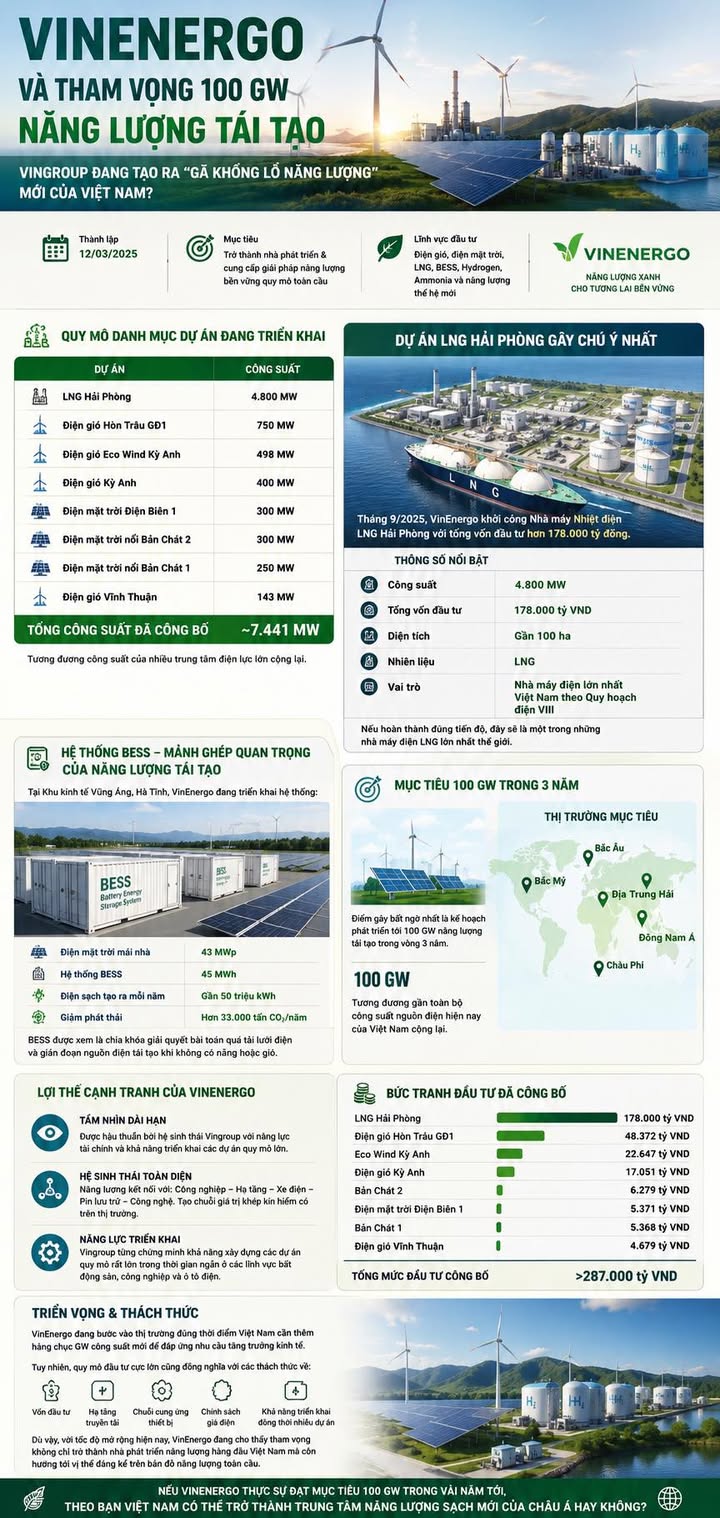
VinEnergo and the Ambition for 100 GW of Renewable Energy: Creating Vietnam's New Energy Giant?
In the rapidly evolving global energy landscape, Vietnam's transition toward sustainable power has gained significant momentum. At the forefront of this transformation stands VinEnergo, a relatively new entity that has quickly emerged as a major player in the country's energy sector. Established in March 2025 as the green energy pillar of Vingroup, Vietnam's largest private conglomerate, VinEnergo has announced an ambitious portfolio of projects worth hundreds of trillions of Vietnamese đồng, positioning itself as a potential game-changer in the nation's pursuit of net-zero emissions by 2050.
The Emergence of VinEnergo
VinEnergo represents Vingroup's strategic entry into the energy sector, coming at a critical time when Vietnam is accelerating its energy transition and committing to achieve net-zero emissions by 2050. The company's establishment reflects a broader global trend of industrial conglomerates diversifying into renewable energy to align with sustainability goals and capitalize on the growing clean energy market.
With a mission to become a global sustainable energy developer and provider, VinEnergo has adopted a comprehensive approach that extends beyond traditional renewable sources. The company's portfolio encompasses solar power, wind energy, Liquefied Natural Gas (LNG), energy storage systems (BESS), and research into emerging technologies like hydrogen and ammonia.
Current Project Portfolio: Building Scale Rapidly
Despite being established only in early 2025, VinEnergo has already announced an impressive portfolio of energy projects across Vietnam. These projects demonstrate the company's commitment to developing a diverse energy mix that balances immediate needs with long-term sustainability goals.
| Project | Capacity (MW) |
|---|---|
| LNG Hai Phong | 4,800 |
| Wind Power Hon Trau Phase 1 | 750 |
| Eco Wind Ky Anh | 498 |
| Wind Power Ky Anh | 400 |
| Solar Power Dien Bien 1 | 300 |
| Floating Solar Power Ban Chat 2 | 300 |
| Floating Solar Power Ban Chat 1 | 250 |
| Wind Power Vinh Thuan | 143 |
| Total | 7,441 |
The combined capacity of these announced projects—approximately 7,441 MW—represents a substantial addition to Vietnam's energy generation capacity. To put this in perspective, this is equivalent to the output of many major power centers combined, demonstrating VinEnergo's rapid scaling and significant impact on the national energy landscape.
The Flagship LNG Hai Phong Project
Among VinEnergo's announced projects, the LNG Hai Phong power plant stands out as particularly ambitious. In September 2025, the company commenced construction of this facility, which is slated to become one of Vietnam's largest power plants and potentially one of the largest LNG facilities globally.
| Parameter | Specification |
|---|---|
| Capacity | 4,800 MW |
| Total Investment | 178,000 trillion VND |
| Land Area | Nearly 100 hectares |
| Fuel Type | LNG |
| Strategic Importance | Designated as one of Vietnam's largest power plants under Electricity Plan VIII |
The LNG Hai Phong project represents a significant investment in transitional energy technology. While natural gas is not a renewable resource, it produces fewer emissions than coal and can serve as a bridge technology as Vietnam transitions toward a more sustainable energy mix. The project's scale underscores VinEnergo's commitment to addressing Vietnam's immediate energy needs while preparing for a cleaner future.
BESS Integration: The Key to Renewable Reliability
One of VinEnergo's distinguishing strategies is its integration of Battery Energy Storage Systems (BESS) developed by VinFast, Vingroup's electric vehicle subsidiary. This vertical integration approach addresses one of the most critical challenges in renewable energy: intermittency.
At the Vung Ang Economic Zone in Ha Tinh province, VinEnergo is implementing a comprehensive energy solution that demonstrates this approach:
| Component | Capacity |
|---|---|
| Rooftop Solar Power | 43 MWp |
| BESS System | 45 MWh |
| Clean Energy Generated Annually | Nearly 50 million kWh |
| Annual CO2 Reduction | Over 33,000 tons |
BESS systems serve as a crucial solution to the challenges of grid overload and the intermittent nature of renewable energy sources when sunlight or wind is unavailable. By pairing renewable generation with storage capacity, VinEnergo can ensure more reliable power delivery while maximizing the utilization of clean energy resources.
The Ambitious 100 GW Goal in Three Years
Perhaps the most striking aspect of VinEnergo's strategy is its ambitious target of developing 100 GW of renewable energy capacity within just three years. This goal positions the company as a major global player in the renewable energy sector.
To put this target in perspective, 100 GW is approximately equivalent to Vietnam's current total electricity generation capacity combined. This extraordinary ambition reflects VinEnergo's confidence in Vietnam's renewable potential and its own implementation capabilities.
The company has identified several key target markets for its renewable energy development:
- North America
- Northern Europe
- Mediterranean region
- Southeast Asia
- Central Asia
- Africa
This global focus indicates VinEnergo's aspirations extend beyond the Vietnamese market, positioning the company as a potential major international energy developer within a remarkably short timeframe.
Competitive Advantages in the Energy Sector
VinEnergo's ambitious plans are underpinned by several key competitive advantages derived from its affiliation with Vingroup:
Long-term Vision
Backed by Vingroup's substantial financial resources and proven ability to execute large-scale projects across various sectors, VinEnergo can pursue long-term energy projects with a level of stability that many independent developers cannot match.
Comprehensive Ecosystem
Unlike many energy companies focused solely on generation, VinEnergo benefits from integration with Vingroup's diverse ecosystem:
- Industrial operations
- Infrastructure development
- Electric vehicles (VinFast)
- Energy storage systems
- Advanced technologies
This integration allows VinEnergo to create a unique closed-loop value chain that is rare in the energy sector, potentially offering cost and efficiency advantages across the entire energy supply chain.
Implementation Capability
Vingroup has demonstrated remarkable ability to execute large-scale projects in compressed timelines across its real estate, industrial, and electric vehicle ventures. This track record suggests VinEnergo may have the project management capabilities necessary to achieve its ambitious development targets.
Investment Overview: Scale and Commitment
The financial commitment behind VinEnergo's expansion is substantial, with announced projects representing investments totaling over 287,000 trillion Vietnamese đồng. The breakdown of these investments highlights the company's strategic focus across different energy technologies:
| Project | Investment (trillion VND) |
|---|---|
| LNG Hai Phong | 178,000 |
| Wind Power Hon Trau Phase 1 | 48,372 |
| Eco Wind Ky Anh | 22,647 |
| Wind Power Ky Anh | 17,051 |
| Ban Chat 2 | 6,279 |
| Solar Power Dien Bien 1 | 5,371 |
| Ban Chat 1 | 5,368 |
| Wind Power Vinh Thuan | 4,679 |
| Total | 287,767 |
This level of investment represents a significant vote of confidence in Vietnam's energy future and underscores the potential scale of VinEnergo's impact on both the national and global energy landscapes.
Challenges and Opportunities
As VinEnergo pursues its ambitious expansion, the company faces both significant opportunities and substantial challenges:
Market Opportunities
VinEnergo is entering the Vietnamese energy market at an opportune time. The country requires additional tens of gigawatts of new capacity to support economic growth, while simultaneously pursuing a transition toward cleaner energy sources. This dual demand for increased capacity and reduced emissions creates a favorable environment for a diversified energy developer like VinEnergo.
Furthermore, Vietnam's strategic location in Southeast Asia positions it as a potential energy hub for the region, with opportunities for both domestic development and cross-border energy trade.
Implementation Challenges
The scale of VinEnergo's ambitions brings with it substantial challenges:
- Capital Requirements: The massive investments required for developing 100 GW of capacity will strain even Vingroup's substantial resources.
- Infrastructure Limitations: Vietnam's transmission and distribution infrastructure may struggle to accommodate the large-scale integration of renewable energy.
- Supply Chain Constraints: The global supply chain for renewable energy equipment faces bottlenecks that could impact development timelines.
- Policy Uncertainty: Energy pricing policies and regulatory frameworks may evolve in ways that impact project economics.
- Simultaneous Execution: Managing the concurrent development of numerous large-scale projects across different technologies and locations presents significant operational challenges.
Strategic Considerations
VinEnergo's approach raises important questions about the future of Vietnam's energy sector:
- How will the company balance its investment in transitional technologies like LNG with its long-term renewable goals?
- Can the company achieve its 100 GW target without compromising on quality, safety, or environmental standards?
- How will VinEnergo's expansion affect the competitive dynamics of Vietnam's energy sector?
- What will be the impact of such rapid development on local communities and ecosystems?
Conclusion: A New Energy Paradigm for Vietnam?
VinEnergo's emergence represents a significant development in Vietnam's energy transition. The company's ambitious plans, substantial financial backing, and comprehensive approach to energy development position it as a potential transformative force in the sector.
If VinEnergo achieves its announced targets, particularly the development of 100 GW of renewable capacity within three years, it could potentially position Vietnam as a new clean energy hub in Asia. The company's success would demonstrate the feasibility of rapid energy transition in developing economies and could influence similar strategies in other emerging markets.
However, the company's ambitious timeline and massive scale also present substantial risks. The execution of such a comprehensive energy transformation will require not only financial resources but also technical expertise, supportive policy frameworks, and careful management of environmental and social considerations.
As VinEnergo moves forward with its development plans, all eyes will be on this new energy giant. Its success or failure will likely have significant implications for Vietnam's energy future, potentially accelerating or complicating the country's path toward net-zero emissions by 2050.
In the rapidly evolving global energy landscape, VinEnergo represents both an ambitious vision for Vietnam's energy future and a test case for the feasibility of rapid, large-scale energy transition in emerging economies. Regardless of the ultimate outcome, the company's entry into the energy sector has already catalyzed important discussions about Vietnam's energy future and the role of private enterprise in achieving national climate goals.