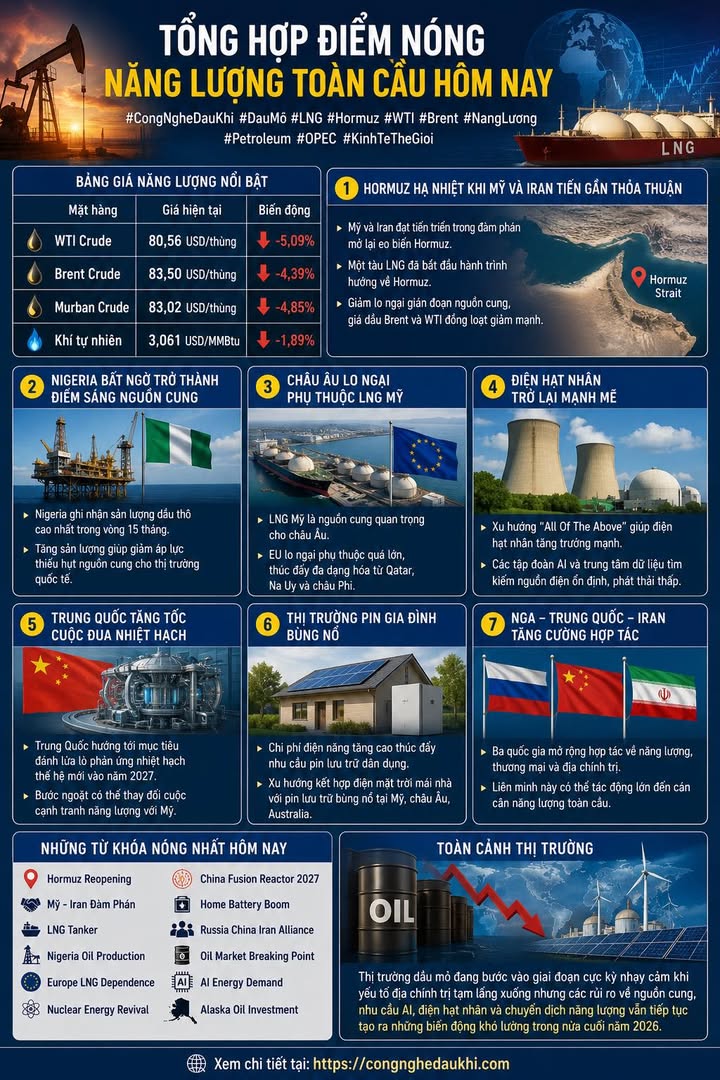
Global Energy Market Highlights: Navigating Geopolitical Shifts and Emerging Trends
The global energy landscape continues to evolve rapidly, with markets reacting to geopolitical developments, technological advancements, and shifting consumption patterns. Today's energy sector is witnessing significant price movements, geopolitical tensions, and groundbreaking developments that could reshape the industry for years to come.
Energy Price Movements
Energy markets experienced notable volatility today, with crude oil prices dropping sharply following diplomatic signals between the United States and Iran. This development has created both uncertainty and opportunities for market participants as they reassess supply projections for the remainder of 2026.
| Commodity | Current Price | Change |
|---|---|---|
| WTI Crude | $80.56/barrel | -5.09% |
| Brent Crude | $83.50/barrel | -4.39% |
| Murban Crude | $83.02/barrel | -4.85% |
| Natural Gas | $3.061/MMBtu | -1.89% |
Geopolitical Developments: Hormuz Strait and US-Iran Relations
The most significant market-moving news today centers on potential progress in negotiations between the United States and Iran regarding the Strait of Hormuz, a critical chokepoint for global oil shipments. This strategic waterway sees approximately one-fifth of global oil consumption passing through it daily.
Market participants reacted swiftly to reports suggesting a possible resolution that could allow for more stable operations in this vital shipping lane. The first LNG tanker has reportedly begun its journey toward Hormuz, signaling potential normalization of this critical route.
The potential reopening of Hormuz comes amid heightened concerns about global supply disruptions. With geopolitical tensions continuing in various regions, any development that could stabilize key shipping routes significantly impacts energy pricing and security.
Nigeria Emerges as Unexpected Supply Source
In a surprising development, Nigeria has reported its highest oil production levels in 15 months. This increase comes at a crucial time when other major producers, including Iran and Russia, face various challenges that could constrain their output.
Nigeria's production boost provides welcome relief for global markets concerned about potential supply shortfalls. As geopolitical risks persist in several traditional oil-producing regions, Nigeria's improved operational capacity has positioned it as a more reliable supplier in the current market environment.
Europe's Growing Concerns About LNG Dependence
While U.S. liquefied natural gas (LNG) has become a critical energy supply source for Europe following the continent's energy crisis, European nations are increasingly expressing concerns about over-reliance on American imports.
Several EU governments are now actively pursuing strategies to diversify their natural gas supplies beyond the United States. Key alternatives being explored include increased imports from Qatar, expanded domestic production in Norway, and developing new supply relationships with African nations.
This diversification effort reflects Europe's broader strategy to enhance energy security while maintaining competitive pricing and supply stability in the face of evolving geopolitical dynamics.
Nuclear Energy Experiencing Strong Revival
The "All of the Above" approach to energy security is driving a significant revival of nuclear power worldwide. Nuclear energy is emerging as one of the fastest-growing sectors in the global energy mix, supported by both governmental policies and private sector initiatives.
Notably, major artificial intelligence companies and data center operators are increasingly seeking stable, low-carbon power sources to meet their rapidly expanding computational demands. Nuclear power plants, with their consistent output and minimal carbon emissions, are becoming attractive partners for these energy-intensive industries.
This convergence of nuclear energy and AI represents a significant development in the energy landscape, potentially creating new business models and partnerships between traditionally separate sectors.
China Accelerates Fusion Energy Development
China has announced significant progress in its fusion energy program, with its next-generation experimental fusion reactor now targeting initial plasma ignition by 2027. If successful, this development could mark a transformative moment in the global energy technology competition between China and the United States.
Fusion energy has long been considered the "holy grail" of clean energy research, offering the potential for virtually limitless power with minimal radioactive waste and no greenhouse gas emissions. China's accelerated timeline reflects the nation's growing technological capabilities and strategic commitment to leading in next-generation energy technologies.
The success of China's fusion program could dramatically reshape global energy markets and geopolitical dynamics, potentially positioning China as a leader in the transition to post-carbon energy systems.
Residential Energy Storage Market Experiencing Explosive Growth
Escalating electricity costs in numerous countries are driving unprecedented demand for residential energy storage systems. The combination of rooftop solar installations with home battery storage is experiencing particularly strong growth in the United States, Europe, and Australia.
This consumer-driven energy transition represents a fundamental shift in how energy is produced, distributed, and consumed at the household level. As energy prices continue to fluctuate and climate concerns grow, more homeowners are investing in energy independence solutions that reduce both costs and environmental impact.
Russia-China-Iran Alliance Strengthens Energy Cooperation
The three nations continue to expand their cooperation across energy, trade, and geopolitical domains, partly in response to Western sanctions and pressure. This emerging alliance represents one of the most significant potential shifts in global energy balances in the coming years.
Collaborative initiatives include energy technology sharing, joint development of energy infrastructure, and coordinated approaches to energy markets. The strengthening of these relationships could significantly alter traditional energy trade flows and market dynamics, particularly in Asia and the Middle East.
Key Energy Market Trends Today
- Hormuz Strait reopening negotiations
- US-Iran diplomatic developments
- LNG tanker movements and trade flows
- Nigeria's oil production recovery
- European LNG diversification strategies
- Nuclear energy's commercial renaissance
- China's fusion energy timeline
- Residential energy storage adoption
- Multi-polar energy alliance formation
- AI-driven electricity demand growth
- Strategic petroleum reserve considerations
Market Outlook: Navigating Uncertainty
The global oil market currently finds itself in an exceptionally sensitive phase as geopolitical tensions temporarily subside, yet fundamental risks regarding supply, AI-driven demand growth, nuclear energy development, and energy transition continue to create unpredictable dynamics for the latter half of 2026.
Market participants will need to carefully monitor multiple simultaneous developments: the trajectory of US-Iran negotiations, the pace of Nigeria's production recovery, Europe's LNG diversification efforts, China's fusion energy progress, and the accelerating adoption of residential energy storage solutions.
These intersecting trends suggest that while short-term price volatility may persist, the medium to long-term trajectory of energy markets will increasingly be shaped by technological innovation, geopolitical realignments, and the accelerating transition toward diversified, sustainable energy systems.