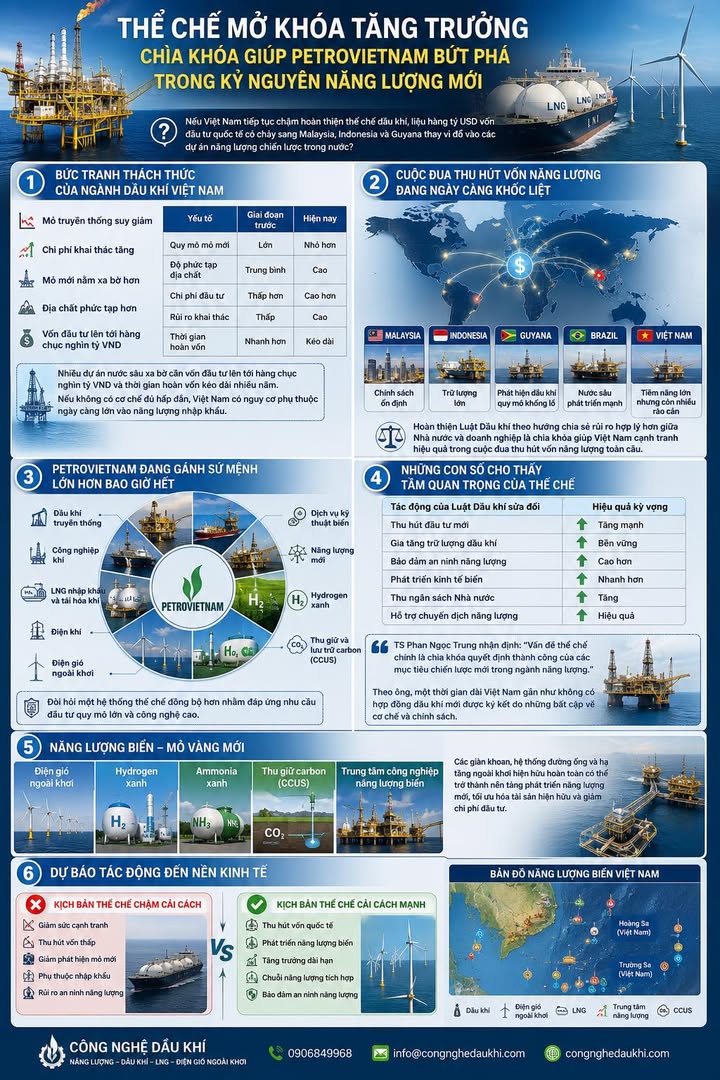
Institutional Reform: The Key to Petrovietnam's Breakthrough in the New Energy Era
As global geopolitical landscapes shift dramatically, energy demands continue to rise, and the transition to clean energy accelerates at an unprecedented pace, Vietnam stands at a crucial crossroads. The revision and refinement of the 2022 Oil and Gas Law has evolved from a purely legal matter into a strategic issue directly linked to national energy security, economic growth, and international competitiveness.
Many experts suggest that a robust legal framework could serve as a "lever" to help Petrovietnam and PVEP expand investments, increase reserves, develop LNG projects, gas-powered electricity, offshore wind power, and participate more deeply in the global energy value chain.
The Challenging Landscape of Vietnam's Oil and Gas Sector
Vietnam's major oil and gas fields are entering natural decline phases, while new discoveries are becoming increasingly difficult to exploit. This creates a significant challenge for the country's energy sector.
| Factor | Previous Era | Current Era |
|---|---|---|
| Scale of new fields | Large | Smaller |
| Geological complexity | Moderate | High |
| Investment costs | Lower | Higher |
| Exploration risks | Low | High |
| Payback period | Faster | Extended |
This situation makes many deep-water offshore projects requiring investments of tens of trillions of VND with extended payback periods increasingly challenging to develop. Without sufficiently attractive mechanisms, Vietnam risks growing dependence on energy imports, increasing pressure on the trade balance and national energy security.
The Intensifying Race to Attract Capital
International investors now have numerous attractive alternatives for energy investment:
| Country | Attractive Features |
|---|---|
| Malaysia | Stable policies |
| Indonesia | Large reserves |
| Guyana | Massive oil and gas discoveries |
| Brazil | Strong deep-water development |
| Vietnam | Significant potential but numerous barriers |
Improving the Oil and Gas Law to create a more reasonable risk-sharing arrangement between the state and enterprises is considered a crucial factor helping Vietnam compete effectively in the global race to attract energy capital.
Petrovietnam's Expanded Mission
Petrovietnam is no longer merely a traditional oil and gas exploration company. The corporation is now strategically expanding into multiple sectors:
- Traditional oil and gas
- Industrial gas
- LNG import and regasification
- Gas-powered electricity
- Offshore wind power
- Marine technical services
- New energy
- Green hydrogen
- Carbon capture, utilization and storage (CCUS)
This diversification requires a more coherent institutional system capable meeting the demands of large-scale, high-technology investments.
The Significance of Institutional Framework
The impact of the revised Oil and Gas Law is expected to be substantial:
| Impact Area | Expected Effectiveness |
|---|---|
| Attracting new investment | Significant increase |
| Increasing oil and gas reserves | Sustainable growth |
| Ensuring energy security | Higher level |
| Developing marine economy | Faster progress |
| Increasing state budget revenue | Growth |
| Supporting energy transition | Greater efficiency |
Dr. Phan Ngọc Trung notes that institutional issues are the key determinant of success for new strategic objectives in the energy sector. According to him, Vietnam has seen nearly no new oil and gas contracts signed for an extended period due to institutional and policy shortcomings.
The Marine Energy Frontier: A New Goldmine
One of the most notable trends is the integration between traditional oil and gas and new energy. Existing offshore infrastructure, including drilling rigs, pipeline systems, and offshore facilities, can serve as a foundation for developing:
- Offshore wind power
- Green hydrogen
- Green ammonia
- Carbon capture, utilization and storage (CCUS)
- Marine energy industrial centers
This is a model that many major global energy corporations are implementing to optimize existing assets and reduce investment costs.
Projected Economic Impact
The potential economic outcomes of different approaches to institutional reform vary significantly:
| Scenario | Economic Impact |
|---|---|
| Slow institutional reform | Reduced competitiveness |
| Low capital attraction | Reduced new field discoveries |
| Energy import dependency | Energy security risks |
| Strong institutional reform | Attraction of international capital |
| Marine energy development | Long-term growth |
| Integrated energy chain | Increased value addition |
Vietnam is targeting double-digit economic growth in the coming years. To achieve this, the economy requires a stable, proactive, and sustainable energy source. Continuing to refine the 2022 Oil and Gas Law is therefore not merely about amending a specialized piece of legislation but represents a strategic decision to protect energy security, open up marine economic space, and create new growth momentum for Petrovietnam and the entire Vietnamese economy for decades to come.