#OilPrice #Oil #WTI #Brent #Iran #Hormuz #OPEC #Energy #WorldEconomy #TimKiemTop
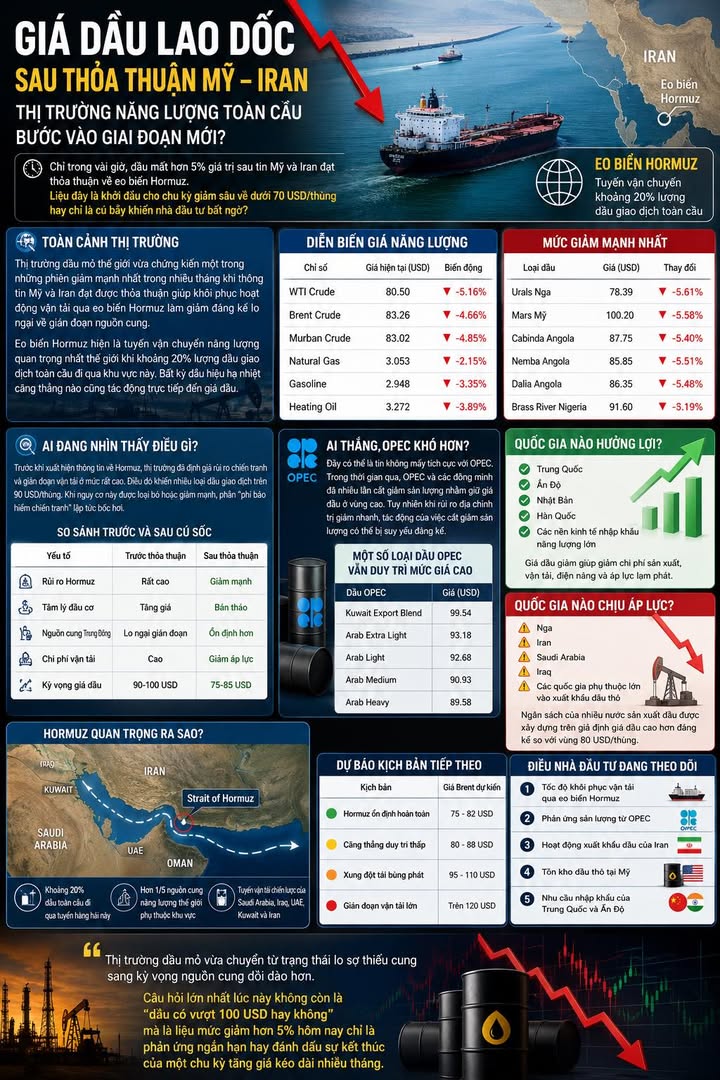
In just a few hours, oil lost more than 5% of its value after news that the US and Iran reached an agreement on the Strait of Hormuz. Is this the beginning of a cycle of deep decline to below 70 USD/barrel or just a trap that surprises investors?
MARKET PANEL
The world oil market has just witnessed one of the sharpest drops in many months when information that the US and Iran reached an agreement to help restore shipping operations through the Strait of Hormuz significantly reduced concerns about supply disruptions.
The Strait of Hormuz is currently the world's most important energy shipping route as about 20% of global oil trade passes through this area. Any sign of easing tensions will directly impact oil prices.
ENERGY PRICE DEVELOPMENTS
Current Price Index USD Volatility
WTI Crude 80.50 -5.16%
Brent Crude 83.26 -4.66%
Murban Crude 83.02 -4.85%
Natural Gas 3,053 -2.15%
Gasoline 2.948 -3.35%
Heating Oil 3.272 -3.89%
Strongest decrease
Type of oil Price USD Change
Russian Urals 78.39 -5.61%
Mars US 100.20 -5.58%
Cabinda Angola 87.75 -5.40%
Nemba Angola 85.85 -5.51%
Dalia Angola 86.35 -5.48%
Brass River Nigeria 91.60 -5.19%
WHO IS SEEING WHAT?
Before news about Hormuz appeared, the market had priced the risks of war and transportation disruption at very high levels. That causes many oils to trade above $90/barrel.
When this risk is eliminated or greatly reduced, the “war insurance premium” immediately evaporates.
Compare before and after the shock
Factor Before the agreement After the agreement
Hormuz Risk Very High Strongly Decrease
Speculative psychology Increase prices Sell off
Middle East supply concerns about disruption More stable
High transportation costs Reduce pressure
Expected oil price 90-100 USD 75-85 USD
WHO WINS, IS OPEC MORE HARD?
This may not be very positive news for OPEC.
In recent times, OPEC and its allies have repeatedly cut production to keep oil prices high. However, as geopolitical risks decline rapidly, the impact of output cuts could be significantly weakened.
Some OPEC oils still maintain high prices:
OPEC Oil Price USD
Kuwait Export Blend 99.54
Arab Extra Light 93.18
Arab Light 92.68
Arabic Medium 90.93
Arab Heavy 89.58
WHICH COUNTRY BENEFITS?
✅ China
✅ India
✅ Japan
✅ Korea
✅ Energy importing economiesbig
Falling oil prices help reduce production, transportation, electricity costs and inflationary pressures.
WHICH COUNTRY IS UNDER PRESSURE?
⚠️ Russia
⚠️ Iran
⚠️ Saudi Arabia
⚠️ Iraq
⚠️ Countries rely heavily on crude oil exports
The budgets of many oil-producing countries are built on the assumption that oil prices are significantly higher than the area of 80 USD/barrel.
FORECASTING THE NEXT SCENARIO
Expected Brent Price Scenario
Hormuz completely stable 75 - 82 USD
Low maintenance tension 80 - 88 USD
Conflict flares up again 95 - 110 USD
Major transport disruption Over 120 USD
WHAT INVESTORS ARE WATCHING
1. Speed of restoration of transport through the Strait of Hormuz
2. Output response from OPEC
3. Iran's oil export activities
4. Crude oil inventories in the US
5. Import demand of China and India
The oil market has just shifted from fear of supply shortage to expectation of more abundant supply. The biggest question now is no longer "will oil surpass $100" but whether today's more than 5% drop is just a short-term reaction or marks the end of a months-long bull run.
#OilPrice #CrudeOil #WTI #Brent #Hormuz #Iran #OPEC #Energy #Economy #OilMarket #TimKiemTop #Middle East #Investment #OilMarket #EnergyNews #DauMoTheGioi