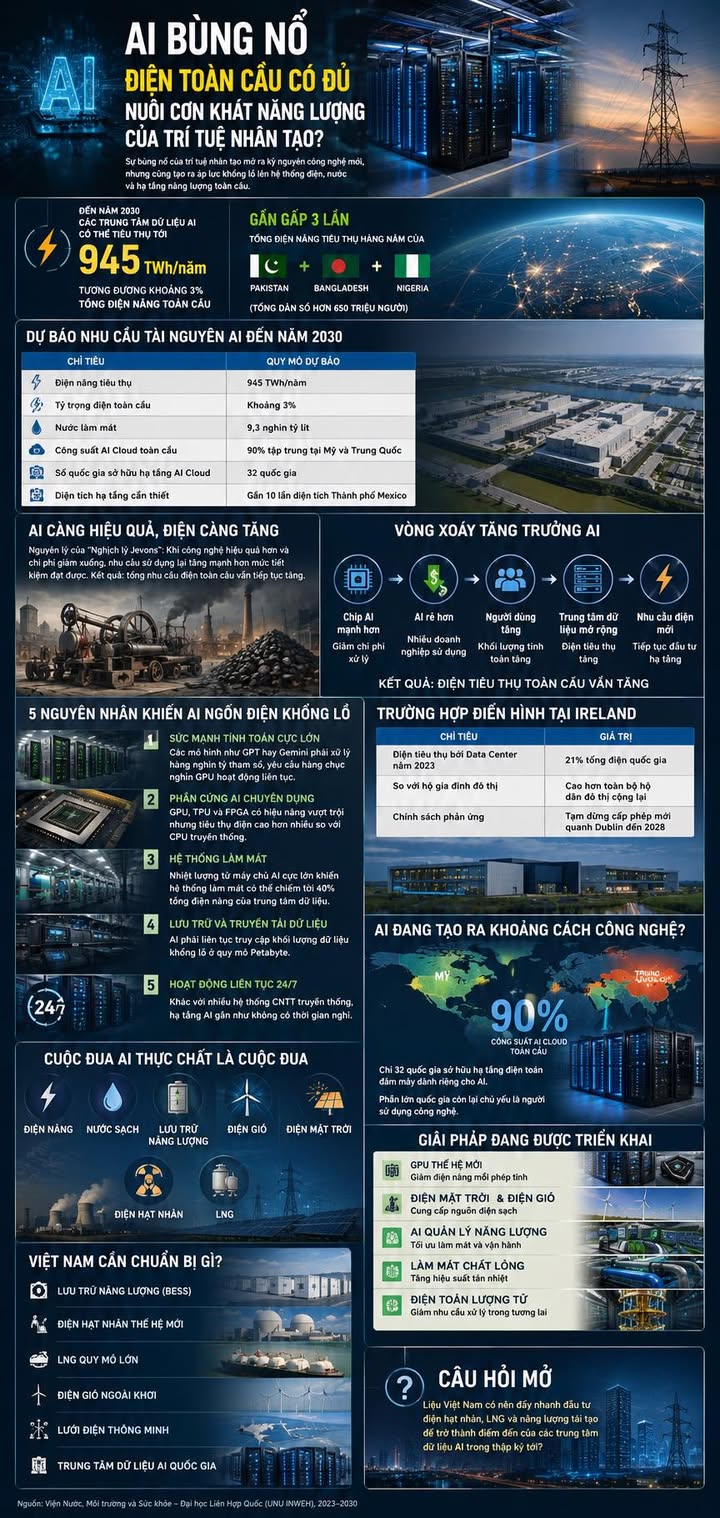
The AI Explosion: Can Global Power Supply Satisfy Artificial Intelligence's Thirst for Energy?
As artificial intelligence continues to develop at its current pace, a critical question emerges: by 2030, will data centers consume more electricity than hundreds of millions of people in many countries combined, potentially creating a new global energy crisis?
The explosion of artificial intelligence is opening a new technological era for humanity. However, behind increasingly intelligent AI models lies a less discussed reality: the unprecedented demand for electricity, cooling water, and infrastructure resources.
According to forecasts from the United Nations University's Institute for Water, Environment and Health, by 2030, data centers serving AI could consume up to 945 TWh of electricity annually, equivalent to approximately 3% of global electricity consumption.
| AI Resource Demand Forecast by 2030 | |
|---|---|
| Electricity Consumption | 945 TWh/year |
| Global Electricity Share | Approximately 3% |
| Cooling Water | 9.3 trillion liters |
| Global AI Cloud Capacity | 90% concentrated in US and China |
| Countries with AI Cloud Infrastructure | 32 countries |
| Required Infrastructure Area | Nearly 10 times the area of Mexico City |
Notably, this amount of electricity is nearly three times the total annual electricity consumption of Pakistan, Bangladesh, and Nigeria combined—countries with a total population of over 650 million people.
More Efficient AI, More Electricity Consumption
Experts are warning about the "Jevons Paradox," a famous economic phenomenon that appeared in the 19th-century coal industry.
The principle is remarkably simple:
When technology becomes more efficient and costs decrease, demand for its use increases more than the savings achieved.
This means that even though AI chips are becoming more energy-efficient, global electricity demand may continue to rise because the number of users and AI applications is growing exponentially.
| The AI Growth Cycle | |
|---|---|
| Stage | Impact |
| More powerful AI chips | Reduced processing costs |
| Cheaper AI | More businesses adopt it |
| Increased users | Higher computational volume |
| Expanding data centers | Increased electricity consumption |
| New electricity demand | Continued infrastructure investment |
5 Factors Making AI Power-Hungry
- Massive Computational Power
Models like GPT or Gemini must process trillions of parameters, requiring tens of thousands of GPUs to operate continuously.
- Specialized AI Hardware
GPUs, TPUs, and FPGAs offer superior performance but consume much more electricity than traditional CPUs.
- Cooling Systems
The extreme heat from AI servers can cause cooling systems to consume up to 40% of a data center's total electricity.
- Data Storage and Transmission
AI must continuously access massive data volumes at the petabyte scale.
- 24/7 Continuous Operation
Unlike many traditional IT systems, AI infrastructure operates almost without downtime.
The Case of Ireland: A Typical Example
| Ireland's Data Center Situation (2023) | |
|---|---|
| Electricity Consumption by Data Centers | 21% of national electricity |
| Comparison to Urban Households | Higher than all urban households combined |
| Policy Response | Moratorium on new permits around Dublin until 2028 |
Is AI Creating a Technology Rich-Poor Divide?
Reports show that only 32 countries possess cloud computing infrastructure dedicated specifically to AI.
Of these, approximately 90% of capacity is concentrated in the United States and China.
This raises concerns that developing countries will become technology consumers rather than creators, while still bearing environmental pressures from mineral extraction, e-waste, and increasing energy demands.
Solutions Being Implemented
| Current Solutions to AI's Energy Challenge | |
|---|---|
| New GPU Generations | Reducing energy per computation |
| Solar and Wind Power | Providing clean energy sources |
| Energy-Management AI | Optimizing cooling and operations |
| Liquid Cooling | Improving heat dissipation efficiency |
| Quantum Computing | Potentially reducing future processing needs |
AI Is More Than Just a Technology Story
For many years, the world has viewed AI as a race about algorithms and data. However, the real competition is gradually shifting to energy, clean water, and electrical infrastructure.
Countries with stable, low-cost electricity supply, modern grid systems, and large-scale renewable energy will have a significant advantage in the global AI race.
Vietnam is no exception to this trend. As AI data centers become increasingly common, the challenges of energy supply, energy storage, and digital infrastructure development will become important components of the national growth strategy.
Should Vietnam prioritize significant investment in nuclear power, LNG, and renewable energy now to prepare for the AI wave?