#AI #TriTueNhanTao #DonaldTrump #BernieSanders #OpenAI #Anthropic #Google #Microsoft #CongNghe #KinhTe #TimKiemTop
If the US government truly becomes a shareholder of the world's largest AI corporations, will this be a fair way to share wealth with the people or the beginning of a technology control model unprecedented in history?
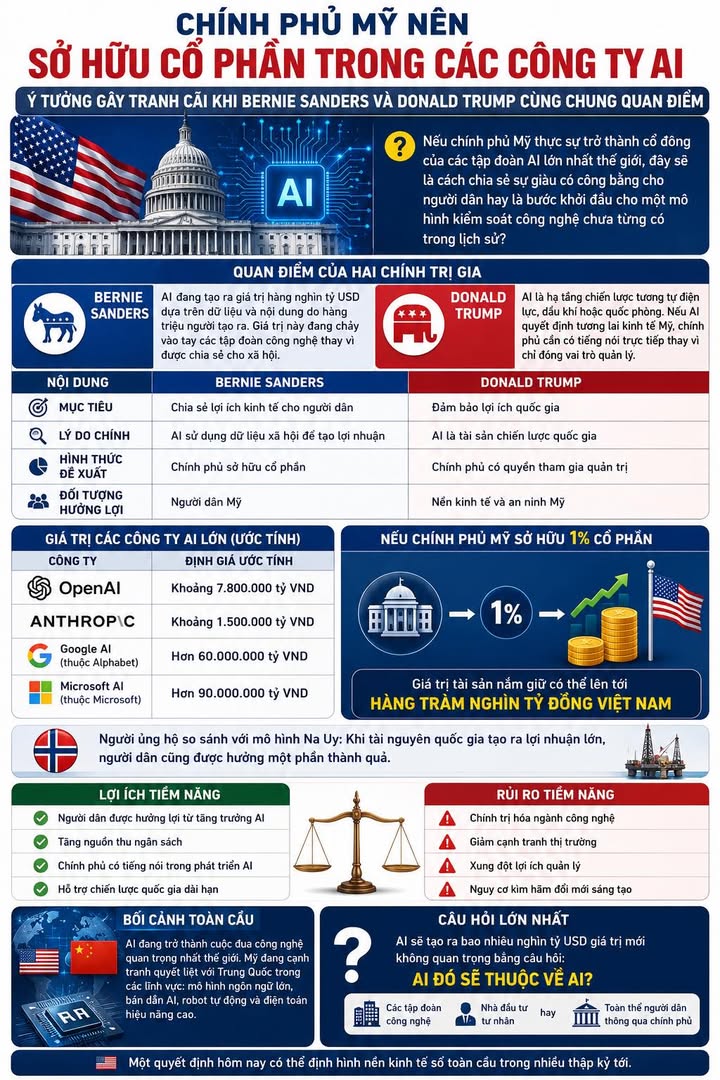
One of the rarest things in American politics is for Bernie Sanders and Donald Trump to be on the same side on a major issue. However, that is happening in the artificial intelligence sector as both have expressed interest in the idea of the federal government having ownership stakes in leading AI companies.
Although stemming from completely different reasons, the intersection of these two politicians' views is creating a major debate about the future of the digital economy.
For Bernie Sanders, AI is creating trillions of dollars in value based on data, artwork, articles, images, videos and content created by millions of people. He thinks much of this value is flowing inhands of technology corporations instead of being shared widely with society.
Meanwhile, Donald Trump and many populists believe that AI is becoming a strategic infrastructure similar to electricity, oil and gas or defense. If AI really determines the future of the US economy, the government needs to have a direct say instead of just playing a management role.
Summary table of opinions
Content Bernie Sanders Donald Trump
Objectives: Share economic benefits for the people, ensure national benefits
The main reason AI uses social data to generate profit AI is a national strategic asset
Proposed form The Government owns shares The Government has the right to participate in governance
Beneficiaries American people US economy and security
Currently, the value of large AI companies has increased to enormous levels
Estimated Valuation Company
OpenAI About 7,800,000 billion VND
Anthropic About 1,500,000 billion VND
Google AI belongs to the Alphabet ecosystem worth more than 60,000,000 billion VND
Microsoft AI Belongs to Microsoft and is worth more than 90,000,000 billion VND
If the US government owned just 1% of shares in leading AI businesses, the value of assets held could reach hundreds of trillions of Vietnamese dong.
Supporters say this is similar to Na Uy build a national wealth fund from oil and gas. When national resources create great profits, people also enjoy a part of the results.
However, opponents warn that AI is not oil. The value of AI comes from innovation and market competition. If the government becomes a major shareholder, the risk of political interference in business operations could slow down the pace of technological development.
Some experts are also concerned about conflict of interest situations. When the government is both a regulator and a shareholder, legal decisions related to AI may have their objectivity questioned.
Benefits and risks table
Potential benefits Potential risks
Citizens benefit from AI growth Politicization of the technology industry
Increase budget revenue Reduce market competition
Government has a voice in AI development Conflict of interest in management
Support long-term national strategy Risk of stifling innovation
It is worth noting that this debate appears at a time when AI is becoming the most important technology race in the world. The US is competing fiercely with China in the fields of large language modeling, AI semiconductors, autonomous robotics and high-performance computing.
If Washington is realthe move toward equity ownership models in AI businesses, which could turn out to be one of the biggest changes to American capitalism since World War II.
The biggest question today is not how many trillions of dollars of new value AI will create, but who will own that value. Technology corporations, private investors or the entire people through the government?
The answer could shape the global digital economy for decades to come.
#AI #OpenAI #Anthropic #DonaldTrump #BernieSanders #TriTueNhanTao #CongNghe #KinhTeSo #My #DauTu #TimKiemTop