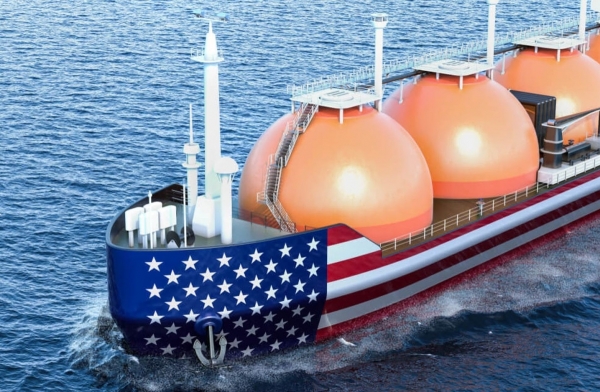
US Natural Gas to Maintain Market Dominance for Decades to Come
According to the latest Short-Term Energy Outlook (STO) report from the US Energy Information Administration (EIA), America's shale revolution is not slowing down but rather accelerating, ensuring the continued dominance of US natural gas in the global energy market for decades to come.
The report presents crucial forecasts about the development trajectory of the US energy sector, particularly in the natural gas field, which is experiencing remarkable growth thanks to shale extraction technologies.
EIA Report: Positive Signs for the US Natural Gas Industry
The latest EIA Short-Term Energy Outlook, published earlier this month, indicates that US natural gas production is expected to continue growing steadily in the coming years. Specifically, US gas production is forecast to reach new record levels in 2024 before maintaining stable, albeit slower, growth through 2025.
The EIA reports that US natural gas production increased by 3% in 2023 compared to 2022, reaching an average of 104.3 billion cubic feet per day (Bcf/d). This figure is projected to rise to 107.8 Bcf/d in 2024 and 109.1 Bcf/d in 2025.
The Shale Revolution: Primary Growth Driver
The impressive growth of the US natural gas sector primarily comes from the Permian Basin region in Texas and New Mexico, where energy companies are intensifying extraction from shale formations. Hydraulic fracturing (fracking) technology combined with horizontal drilling has enabled the US to efficiently tap previously inaccessible shale gas resources.
According to the report, US shale gas production increased by 5% in 2023 and is expected to grow by another 4% in 2024. This increase is primarily coming from key regions such as:
- Permian Basin (Texas/New Mexico)
- Appalachia (Pennsylvania/West Virginia/Ohio)
- Haynesville (Texas/Louisiana)
- Eagle Ford (Texas)
The EIA notes that US energy companies are making substantial investments in new technologies to enhance extraction efficiency and reduce costs, helping maintain their competitive edge in the global marketplace.
Impact on Global Energy Markets
The increasing production of US natural gas is having a profound impact on global energy markets. US natural gas, in the form of Liquefied Natural Gas (LNG), is increasingly gaining market share in major energy-importing regions like Europe and Asia.
Specifically, US LNG exports increased by 12% in 2023 compared to 2022, reaching an average of 10.2 Bcf/day. This figure is projected to continue rising to 11.9 Bcf/day in 2024 and 12.8 Bcf/day in 2025.
The growing LNG exports from the US are helping diversify global energy supplies, reducing dependence on traditional suppliers such as Russia and the Middle East. This is particularly significant following the European energy crisis triggered by the Ukraine conflict.
Future Outlook: Long-Term Dominance
According to analyses from the EIA, with abundant shale gas reserves and advancing extraction technologies, the US is positioned to maintain its status as the world's leading producer and exporter of natural gas for decades to come.
The following table summarizes the EIA's forecasts for US natural gas production through 2025:
| Year | Total Production (Bcf/day) | Shale Production (Bcf/day) | LNG Exports (Bcf/day) |
|---|---|---|---|
| 2023 | 104.3 | 83.5 | 10.2 |
| 2024 | 107.8 | 87.0 | 11.9 |
| 2025 | 109.1 | 88.5 | 12.8 |
The report also indicates that natural gas will continue to play a crucial role in America's energy transition strategy, serving as a bridging energy source while renewable energy technologies are still developing. Natural gas offers advantages in flexible power generation that can complement solar and wind power, which are dependent on weather conditions.
Challenges and Opportunities
Despite the positive outlook, the US natural gas industry faces numerous challenges. Environmental concerns, particularly regarding methane emissions from extraction and transportation, are receiving increasing attention. The Biden administration has implemented stricter regulations to reduce methane emissions, which could increase production costs.
Additionally, growing competition from renewable energy sources presents another challenge. However, many experts believe natural gas will maintain its competitive edge due to its stability and higher storage capacity compared to variable renewable energy.
In terms of opportunities, global demand for natural gas, particularly in developing markets in Asia and Africa, is expected to continue growing in the coming decades. The US has significant opportunities to expand its market share in these regions, especially as countries seek to reduce their dependence on coal.
Conclusion
The EIA report affirms that with abundant reserves, advanced technology, and expanding export markets, US natural gas will continue to maintain its dominant position for decades to come. The development of the natural gas sector not only brings economic benefits to the US but also contributes to stabilizing global energy markets and supporting the sustainable energy transition.
America's shale revolution has completely transformed the global energy landscape, and with the positive forecasts from the EIA, it can be affirmed that the US's position as an energy superpower will be further strengthened in the near future.