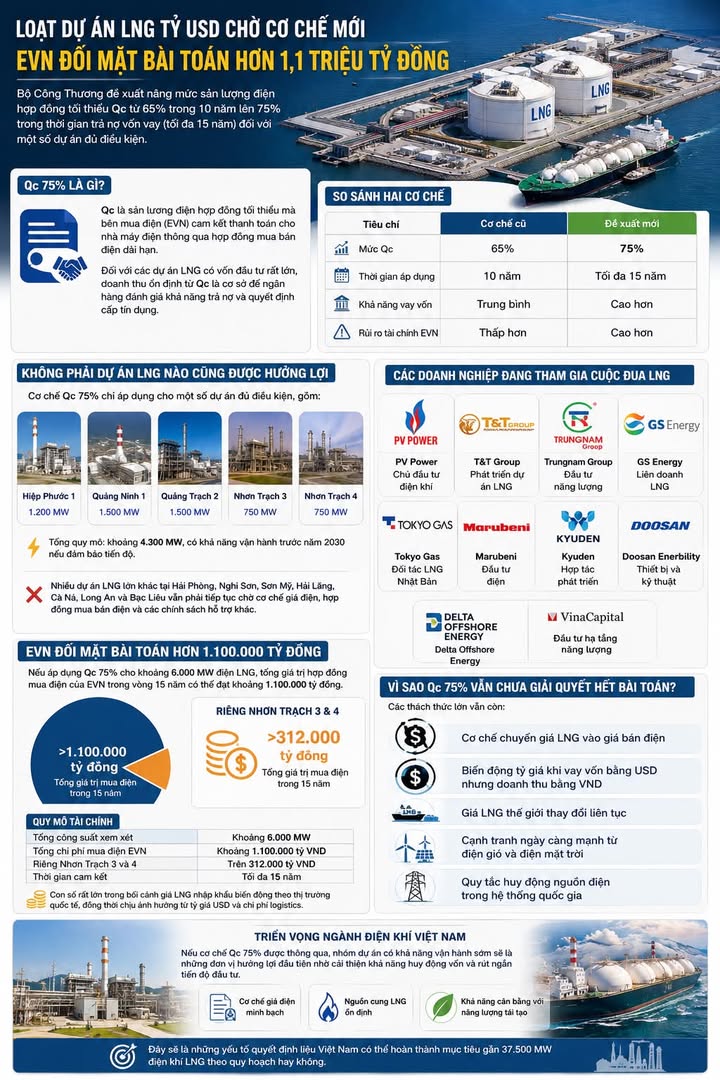
Billion-Dollar LNG Projects Await New Mechanism as EVN Faces Trillion-Dollar Financial Challenge
As Vietnam accelerates its energy transition, the nation's liquefied natural gas (LNG) power sector stands at a critical juncture. The Ministry of Industry and Trade has proposed a new mechanism that could unlock billions in investment while simultaneously creating significant financial obligations for the state-owned Vietnam Electricity (EVN) corporation.
The Proposed 75% Qc Mechanism
The Ministry of Industry and Trade has put forward a proposal to increase the minimum contracted electricity quantity (Qc) from 65% over 10 years to 75% over a maximum period of 15 years—covering the loan repayment period—for eligible LNG power projects.
Qc represents the minimum electricity volume that power purchasers commit to buying from power plants through long-term power purchase agreements. For massive LNG projects with enormous capital investments, this stable revenue base serves as the foundation for banks to assess debt repayment capabilities and make financing decisions.
Comparing the Old and Proposed Mechanisms
| Criteria | Current Mechanism | Proposed Mechanism |
|---|---|---|
| Qc Level | 65% | 75% |
| Application Period | 10 years | Up to 15 years |
| Financing Capability | Moderate | Higher |
| Financial Risk to EVN | Lower | Higher |
Targeted Projects Under the New Mechanism
Notably, the proposed 75% Qc mechanism would not apply to all LNG projects nationwide. The targeted group includes:
- Hiệp Phước 1 Power Plant
- Quảng Ninh 1 Power Plant
- Quảng Trạch 2 Power Plant
- Nhơn Trạch 3 Power Plant
- Nhơn Trạch 4 Power Plant
These projects collectively represent approximately 4,300 MW of capacity and could potentially be operational before 2030 if development schedules are maintained.
In contrast, numerous other large-scale LNG projects in locations such as Hai Phong, Nghi Son, Son My, Hai Lang, Ca Na, Long An, and Bac Lieu continue to await supportive policies on electricity pricing, power purchase agreements, and other regulatory frameworks before effective implementation.
Key Players in Vietnam's LNG Development
| Company | Role in LNG Sector |
|---|---|
| PV Power | Power investor, developing gas-fired power projects |
| T&T Group | Developing LNG projects |
| Trungnam Group | Energy investor |
| GS Energy | Joint venture developing LNG projects |
| Tokyo Gas | Japanese LNG partner |
| Marubeni | Power investment |
| Kyuden | Development cooperation |
| Doosan Enerbility | Equipment and technology |
| Delta Offshore Energy | LNG importer |
| VinaCapital | Energy infrastructure investment |
EVN's Trillion-Dollar Financial Commitment
According to policy documents, applying the 75% Qc mechanism for approximately 6,000 MW of LNG capacity could result in EVN's total electricity purchase contracts reaching around 1,100,000 billion VND (approximately $46 billion USD) over 15 years.
Specifically, the Nhơn Trạch 3 and Nhơn Trạch 4 power plants alone are estimated to have a total electricity purchase value exceeding 312,000 billion VND during the same period.
Financial Scale of the Commitment
| Financial Parameter | Value |
|---|---|
| Total capacity under consideration | Approximately 6,000 MW |
| Total EVN electricity purchase cost | Approximately 1,100,000 billion VND |
| Nhơn Trạch 3 & 4 alone | Over 312,000 billion VND |
| Commitment period | Maximum 15 years |
These figures are substantial given the context of constantly fluctuating international LNG import prices, exchange rate volatility (particularly with USD-denominated loans but VND-denominated revenues), and rising logistics costs.
Unresolved Challenges Despite the New Mechanism
While the 75% Qc mechanism improves financing capabilities, it does not comprehensively address the core challenges facing Vietnam's LNG sector:
- Price transmission mechanisms for LNG costs into electricity tariffs
- Exchange rate risks from USD-denominated loans versus VND-denominated revenues
- Continuously changing global LNG prices
- Intensifying competition from wind and solar power
- Dispatch rules for power sources in the national electricity system
Consequently, many LNG projects will continue to await a complete legal framework before achieving the expected financial viability.
Prospects for Vietnam's Gas Power Sector
If the 75% Qc mechanism is approved, the group of projects with potential early operational benefits will be the first to gain advantages through improved financing capabilities and accelerated investment schedules.
However, the sustainable development of Vietnam's LNG sector in the long term depends on three critical factors:
- Transparent electricity pricing mechanisms
- Stable LNG supply sources
- Balance with renewable energy in the national power system
These factors will determine whether Vietnam can achieve its target of approximately 37,500 MW of LNG capacity as outlined in the national power development plan.
Implications for Electricity Consumers
The central question remains: If EVN must commit to expenditures exceeding 1,100,000 billion VND to guarantee off-take for LNG power, will future electricity prices maintain stability, or will consumers ultimately bear the full cost burden?
As Vietnam navigates this complex transition in its energy mix, the balance between attracting essential investment, ensuring financial sustainability for the national power utility, and maintaining affordable electricity prices for consumers presents a significant policy challenge.
The government's approach to implementing the proposed mechanism will likely have far-reaching implications for Vietnam's energy security, economic competitiveness, and climate commitments in the decades ahead.