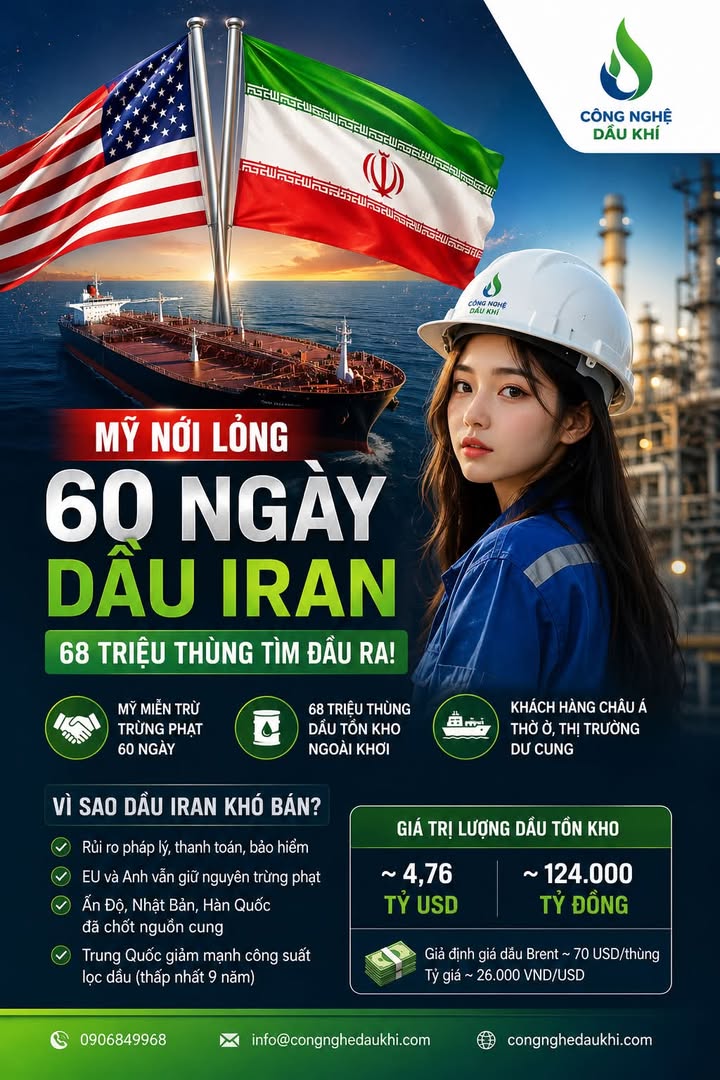
US Opens 60-Day Window for Iranian Oil: Will 68 Million Barrels Find Buyers?
In a surprising development that has sent ripples through global energy markets, the United States government has issued a 60-day waiver on sanctions against Iranian oil exports, effective June 25-26, 2026. This temporary reprieve presents Tehran with a critical opportunity to offload an estimated 68 million barrels of crude oil currently floating offshore on tankers. As the clock ticks, a fundamental question emerges: Is the world truly experiencing an oil shortage, or has the market entered a glut phase where even discounted crude struggles to find buyers?
The US Waiver: A Strategic Calculated Move
The US decision to temporarily lift sanctions on Iranian oil exports represents a nuanced geopolitical maneuver. According to information compiled by VnEconomy, this 60-day period, while seemingly brief, provides Tehran with a crucial window to reestablish commercial relationships with traditional Asian customers. The move comes amid heightened tensions in the Strait of Hormuz, a vital chokepoint through which a significant portion of global oil shipments pass.
Iran's primary objectives extend beyond merely increasing export volumes. The regime aims to reduce its heavy dependence on the Chinese market, which has absorbed Iranian crude at significant discounts for many years. This diversification strategy seeks to create more balanced trade relationships and potentially secure better pricing terms from a broader customer base.
The Offshore Oil Glut: 68 Million Barriers to Sale
Despite the temporary sanctions relief, Iran faces a significant challenge: approximately 68 million barrels of crude oil remain stranded on tankers awaiting buyers. This substantial inventory represents a considerable financial stake, with an estimated market value of approximately $4.76 billion at current Brent crude prices of around $70 per barrel (equivalent to approximately 124,000 trillion Vietnamese dong at an exchange rate of 26,000 VND/USD).
The urgency stems from the temporary nature of the US waiver, which creates a finite window for transactions before the sanctions potentially snap back into place. This time pressure has created a complex scenario where Iran must find willing buyers despite various market and logistical challenges.
Why Iranian Oil Faces Resistance in the Market
Despite the temporary lifting of US sanctions, the market response has not met Iranian expectations. Several factors contribute to this unexpected resistance:
- Buyer Preparedness: Refineries in India, Japan, and South Korea had proactively secured alternative supply sources months in advance of heightened tensions in the Strait of Hormuz. During periods of potential transport disruption, these nations established long-term contracts with other suppliers to ensure energy security.
- Market Saturation: With alternative arrangements already in place, Iranian oil is no longer a necessity for these key consumers.
- Legal and Financial Complexities: The US waiver applies only for 60 days, while EU and UK sanctions remain fully intact. This legal patchwork creates uncertainty that makes international banks hesitant to process payments and marine insurance companies reluctant to cover shipments.
- Shifting Demand Patterns: Notably, demand from China's private refineries has declined, with operating levels at a nine-year low, reducing even Iran's traditional customer base.
- India's Position: Despite geographical advantages (Iranian ports to India's west coast require only 2-3 days transit), Indian refineries have already secured their import needs through August 2026, limiting immediate opportunities for Iranian crude.
Comparative Advantage of Global Oil Suppliers
The current market dynamics highlight how Iran's position has been eroded by the advantages offered by other major suppliers:
| Source | Market Attractiveness | Key Advantages |
|---|---|---|
| United States | High | |
| Russia | High | |
| Saudi Arabia | Very High | |
| UAE | High | |
| Iraq | High | |
| Iran | Moderate to Low |
The 60-Day Window: Critical Factors for Success
The temporary nature of the US waiver creates both urgency and opportunity for Iran. Several factors will determine Tehran's ability to successfully market its offshore inventory:
- Geopolitical Developments: Any shifts in US-Iran relations during the 60-day period could significantly impact buyer confidence.
- Payment Mechanisms: Iran's ability to establish alternative financial channels that bypass traditional banking systems will be crucial.
- Insurance Solutions: Securing marine insurance coverage despite the patchwork of sanctions remains a major hurdle.
- Price Flexibility: Iran may need to offer substantial discounts to compensate for the additional risks associated with purchasing its crude.
- Customer Diversification: Expanding beyond traditional markets to include smaller or less risk-averse buyers could provide alternative outlets.
The Strategic Implications
The situation with Iranian oil exports highlights a fundamental shift in global energy markets. Iran's challenges are increasingly less about production capabilities and more about the legal and financial environment in which it must operate. The temporary US waiver may provide short-term relief, but sustainable market reintegration likely requires broader sanctions relief and the rebuilding of international trust.
For consuming nations, this episode reinforces the importance of diversifying energy supplies and maintaining strategic reserves. The ability to quickly secure alternative sources when traditional suppliers face disruptions has proven crucial for energy security.
Market Outlook
As the 60-day window progresses, all eyes will be on whether Iran can successfully offload its 68 million barrels of offshore crude. The outcome will provide valuable insights into current market dynamics, the effectiveness of sanctions regimes, and the evolving global energy landscape.
If Iran fails to find buyers for this substantial inventory, it would suggest a market characterized by oversupply and cautious risk-taking. Success, however limited, could indicate that discounted Iranian crude still holds appeal despite the challenges.
Regardless of the outcome, this situation underscores the complex interplay between geopolitics, energy markets, and international law in shaping global oil flows. The temporary reprieve for Iranian oil exports represents merely one chapter in the ongoing story of global energy diplomacy and market evolution.