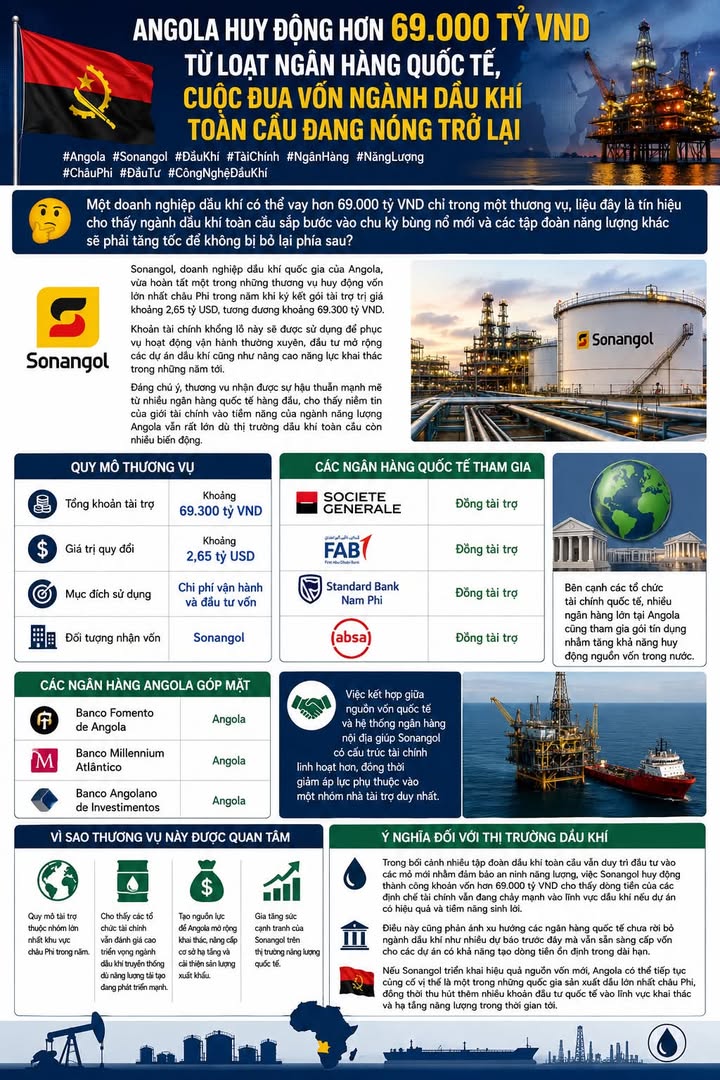
Angola Raises Over $2.65 Billion in International Financing, Signaling Renewed Global Oil & Gas Investment Race
In a move that underscores the continued vitality of the traditional energy sector, Sonangol, Angola's national oil and gas company, has successfully secured one of Africa's largest financing deals of the year, raising approximately $2.65 billion (equivalent to about 69,300 billion Vietnamese Dong). This substantial funding round not only provides crucial capital for Angola's energy ambitions but also signals a renewed global race for investment in the oil and gas industry.
Historic Financing Deal for Africa's Energy Sector
The financing package, which represents a significant vote of confidence in Angola's energy future, was finalized through a consortium of international and domestic financial institutions. This deal comes at a time when many energy companies worldwide are navigating market uncertainties and the global transition toward renewable energy sources.
Sonangol plans to utilize these substantial funds for multiple purposes, including ongoing operational activities, expansion of existing oil and gas projects, and enhancement of extraction capabilities in the coming years. The strategic deployment of this capital is expected to position Angola more competitively in the global energy market while supporting the country's economic development goals.
Key Details of the Financing Package
| Category | Details |
|---|---|
| Total Financing | Approximately 69,300 billion VND |
| USD Equivalent | Approximately $2.65 billion |
| Primary Purpose | Operational costs and capital investments |
| Recipient | Sonangol (Angola's national oil company) |
International Financial Institutions Back the Deal
The financing package received strong backing from several prominent international banks, indicating continued confidence in the oil and gas sector despite global market fluctuations. This international support is particularly significant as it demonstrates that financial institutions maintain a positive outlook on Angola's energy potential.
International Participating Banks
| Bank | Role |
|---|---|
| Société Générale | Joint Lead Arranger |
| First Abu Dhabi Bank | Joint Lead Arranger |
| Standard Bank South Africa | Joint Lead Arranger |
| Absa | Joint Lead Arranger |
Domestic Financial Institutions Join the Consortium
In addition to international financial heavyweights, several major Angolan banks also participated in the financing package. This blended approach combining international and domestic capital sources provides Sonangol with greater financial flexibility while reducing dependency on any single group of financiers.
Angolan Participating Banks
| Bank | Country |
|---|---|
| Banco Nacional de Angola | Angola |
| Banco Fomento de Angola | Angola |
| Banco Millennium Atlântico | Angola |
| Banco Angolano de Investimentos | Angola |
Significance of the Financing Deal
This financing package stands out for several reasons, making it particularly noteworthy in the current global energy landscape:
- Regional Significance: The deal ranks among the largest financing transactions in Africa this year, highlighting Angola's continued importance in the continent's energy sector.
- Market Confidence: The participation of multiple international financial institutions demonstrates continued confidence in traditional oil and gas projects despite the rapid growth of renewable energy alternatives.
- Strategic Development: The funding will enable Angola to expand extraction operations, upgrade critical infrastructure, and increase export volumes.
- Competitive Positioning: This financial injection will enhance Sonangol's competitiveness in the international energy market.
Implications for the Global Oil and Gas Industry
In an era when many global energy corporations are maintaining investments in new oil fields to ensure energy security, Sonangol's successful fundraising of over $2.65 billion indicates that financial capital continues to flow into the oil and gas sector when projects demonstrate effectiveness and long-term profit potential.
This trend reflects a nuanced approach by international financial institutions, who are not abandoning the oil and gas sector as some previous forecasts suggested. Instead, they remain willing to finance projects that can generate stable cash flows over extended periods.
If Sonangol effectively implements this new capital, Angola is poised to further solidify its position as one of Africa's largest oil-producing nations. Additionally, this success may attract further international investments in Angola's extraction and energy infrastructure sectors in the coming years.
The Future of Angola's Energy Sector
The successful financing deal comes as Angola continues to develop its energy resources while navigating the global energy transition. The country possesses significant offshore oil reserves and has been gradually increasing its production capabilities in recent years.
With this substantial financial backing, Sonangol is well-positioned to advance several key projects, including deep-water exploration initiatives and the development of associated natural gas resources that have historically been flared rather than utilized.
As global energy demands continue to evolve, Angola's ability to attract significant international financing suggests that traditional oil and gas will remain an important component of the global energy mix for the foreseeable future, particularly in regions with proven reserves and established infrastructure.
Conclusion
Sonangol's remarkable financing achievement represents more than just a successful fundraising effort; it signals a broader trend of continued investment in traditional energy resources. The international financial community's willingness to commit substantial capital to this project indicates that despite the global push toward renewable energy, oil and gas projects with strong fundamentals remain attractive investment opportunities.
For Angola, this financing provides the necessary resources to develop its energy sector, strengthen its economy, and enhance its position in the global energy market. As other energy companies observe this success, it may prompt increased competition for similar financing opportunities, potentially accelerating development projects across the industry.
In a rapidly changing global energy landscape, Sonangol's achievement demonstrates that traditional oil and gas financing remains robust when backed by sound economic fundamentals and effective project management. This development may well mark the beginning of a new investment cycle in the global oil and gas sector, with significant implications for energy production, consumption, and investment strategies worldwide.