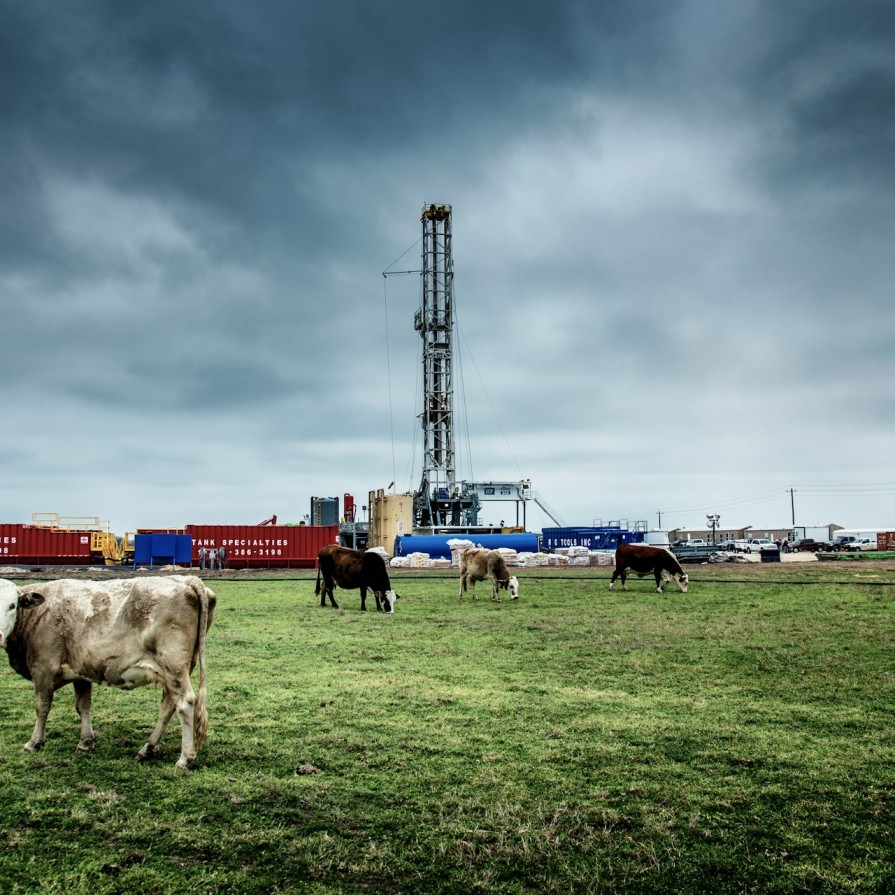
Eagle Ford: Stability in Oil Production and Natural Gas Growth
The Eagle Ford Valley has shown notable stability in crude oil production and increased natural gas production in recent years. While a geological layer beneath the Eagle Ford has been productive for nearly a century, its remaining resources are now nearly depleted.
Analysis of the Buda Limestone Bed
According to the latest analysis by the United States Geological Survey (USGS) released this week, the Buda Limestone, which underlies the Eagle Ford Group, has limited remaining oil and natural gas resources.
Technically recoverable resources at Buda Limestone are estimated at 184 billion cubic feet of natural gas and 12 million barrels of oil. This is only a small fraction of the total output this layer has produced since around 1930, when oil and gas exploitation at this layer began.
| Historical data on Buda Limestone production (since 1930) | |
|---|---|
| Produced crude oil | 204 million barrels |
| Produced natural gas | 287 billion cubic feet |
| Equivalent to crude oil | 10 days of US consumption (2025 rate) |
| Equivalent to natural gas | 3 days of current US consumption |
The Eagle Ford Group located above Buda is the main source of undiscovered oil and gas in this geological layer, USGS said.
“The U.S. economy and our way of life depend on energy, and USGS oil and gas assessments point to resources that industry has not yet discovered,” USGS Director Ned Mamula said in a statement.
"In this case, the Buda Limestone has very little remaining undiscovered oil or gas, indicating a need for new resources," the official added.
Eagle Ford: New manufacturing pillar
With Buda almost out of technically recoverable resources, miners are betting on the Eagle Ford and other shale plays in the United States to boost output.
According to valuation and consulting firm Mercer Capital, oil and gas production at the Eagle Ford increased 2.2% in crude oil equivalent (boe) terms in the 12 months ending March 2026, compared to the same period a year ago. The basin's growth closely matches that of other major US shale basins, including the Permian, Haynesville and Appalachians.
| Eagle Ford output (12 months to March 2026) | |
|---|---|
| Output range | 2.36 - 2.46 million barrels of oil equivalent/day |
| Growth | 2.2% in crude oil equivalent units |
| Crude oil output | Stable at about 1.1 million barrels/day |
| Natural gas output | Growth |
“Eagle Ford has shown modest production growth over the past year, broadly in line with other major basins, as production remained within a relatively narrow range,” said J. David Smith, Senior Vice President at Mercer Capital.
"This stability reflects the maturity of the basin, with limited fluctuations in production despite the reduced rig count and continued capital discipline among operators."
Output and market trends
Crude oil production at the Eagle Ford has remained relatively stable while natural gas production is growing, with major companies like EOG Resources focusing on the gas portion of this shale play.
Crude oil production remains at about 1.1 million barrels per day, while natural gas production is increasing, thanks to advantageous access to the US Gulf Coast market. Thanks to its proximity to the Gulf of Mexico, Eagle Ford natural gas has an advantage in wellbore price dynamics compared to other regions, according to Energy Advisors analysis.
The Dorado gas operation, led by EOG, is the primary driver of natural gas production at Eagle Ford, with production expected to reach 1 billion cubic feet/day in 2026, up 33% year-over-year and with a low break-even point.
Exciting M&A activities
The Eagle Ford has also become a hotbed for mergers and acquisitions (M&A), especially for developed and in production (PDP) assets. In recent months, Stone Ridge acquired the Eagle Ford assets from Baytex Energy for $2.3 billion.
"Eagle Ford is evolving into a hybrid region, combining steady oil production with advantaged gas growth and continued M&A activity," Energy Advisors noted.
Conclude
The transition from the nearly depleted Buda Limestone to the Eagle Ford is reshaping the regional energy landscape. While Eagle Ford maintains impressive stability in crude oil production, its natural gas portion is showing strong growth potential, especially thanks to its strategic location near export markets and Gulf of Mexico infrastructure.
The combination of steady oil production, advantaged gas growth and vibrant M&A activity is making the Eagle Ford one of the most important and attractive energy producing regions in the United States, despite the depletion of older geologic formations such as Buda.
#EagleFord #DauKhan #WhenTuNhien #NangLuong #M&A #USGS #BudaLimestone