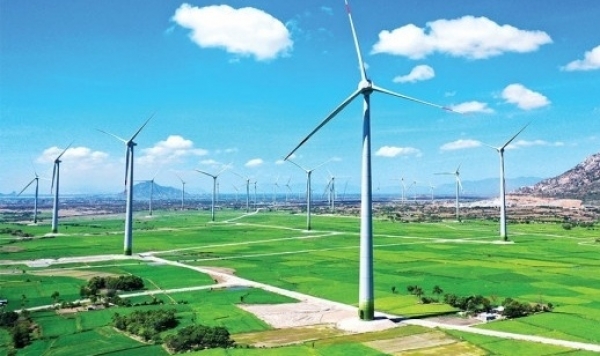
Gia Lai Adds 80 MW of Renewable Energy to Enhance National Energy Security
The People's Committee of Gia Lai Province has recently approved the investment policy for two large-scale renewable energy projects: the Ia Hla Wind Power Plant and the Ea Dreh Floating Solar Power Plant, with a total investment of over 2,600 billion VND. The simultaneous implementation of these projects is expected to supplement the national power system with clean energy sources while creating momentum for the province's socio-economic development.
Details of the Two Renewable Energy Projects in Gia Lai
Ia Hla Wind Power Plant
The Ia Hla Wind Power Plant has a designed capacity of 30 MW, invested by Gia Lai Energy Investment Joint Stock Company in the Ia Hla commune, Chư Păh district. The project has a total investment capital of approximately 1,500 billion VND, utilizing modern wind turbine technology from European countries.
According to the plan, the plant will be equipped with 10 wind turbines, each with a capacity of 3 MW. Upon completion and operation, the plant is expected to supply about 100 million kWh of electricity annually, contributing to a reduction of approximately 80,000 tons of CO2 emissions per year.
Ea Dreh Floating Solar Power Plant
The Ea Dreh Floating Solar Power Plant has a designed capacity of 50 MW, invested by a Chinese corporation in the Ea Dreh lake area, Ia Grai district. The project has a total investment capital of approximately 1,100 billion VND, applying new-generation solar panel technology with high efficiency.
The project will use a floating system on the lake surface with an area of about 50 hectares. This advanced technology maximizes the use of water surface area, reduces water evaporation, and simultaneously generates clean energy. The plant is expected to supply about 160 million kWh of electricity annually, reducing CO2 emissions by approximately 130,000 tons per year.
Overview of the Renewable Energy Situation in Gia Lai
Gia Lai is evaluated as one of the provinces with great potential for renewable energy development, particularly wind and solar power. With its favorable geographical location, mountainous terrain, and numerous coastal areas, the province has been attracting many investors in the clean energy sector.
Currently, the total capacity of renewable energy projects in the province has reached approximately 500 MW, accounting for about 15% of the total power capacity in the Central Highlands region. The implementation of the additional Ia Hla and Ea Dreh projects will increase the province's renewable energy capacity to approximately 580 MW.
Impact on National Energy Security
The addition of 80 MW of renewable energy from the two projects in Gia Lai will contribute to diversifying the energy supply for the national power system, reducing dependence on fossil fuel sources such as coal and oil.
According to the Ministry of Industry and Trade, by 2030, Vietnam aims to achieve a renewable energy share of about 30-35% in the energy mix. The operation of projects like Ia Hla and Ea Dreh will help achieve this target while contributing to the implementation of commitments made at COP26 regarding greenhouse gas emission reduction.
Socio-Economic Impact on the Local Area
The two renewable energy projects in Gia Lai will not only contribute to ensuring national energy security but also bring many socio-economic benefits to the locality.
- Create direct employment for about 300 workers during the construction phase and about 50 workers during operation
- Contribute to the local budget through various taxes and fees
- Develop technical infrastructure and transportation in the project areas
- Contribute to shifting the economic structure from agriculture to industry and services
- Increase income for local people through cooperative programs and joint ventures
Challenges and Solutions
Despite the great potential, the development of renewable energy in Gia Lai also faces several challenges:
- Transmission infrastructure has not yet met the demand for connecting power plants
- Administrative procedures are still cumbersome and prolong project implementation time
- Lack of high-quality human resources in the renewable energy sector
- Issues related to land allocation for large-scale projects
To overcome these challenges, the Gia Lai Provincial People's Committee has proposed solutions such as reviewing and simplifying investment procedures, accelerating the construction of transmission infrastructure, enhancing human resource training, and implementing appropriate support policies to attract investment.
Technical Parameter Comparison of the Two Projects
| Parameter | Ia Hla Wind Power Plant | Ea Dreh Floating Solar Power Plant |
|---|---|---|
| Designed Capacity | 30 MW | 50 MW |
| Investment Capital | 1,500 billion VND | 1,100 billion VND |
| Annual Energy Production | 100 million kWh | 160 million kWh |
| Annual CO2 Reduction | 80,000 tons | 130,000 tons |
| Land Use Area | Approximately 20 hectares | Approximately 50 hectares of water surface |
| Investor | Gia Lai Energy Investment Joint Stock Company | Chinese Corporation |
Conclusion
The implementation of both the Ia Hla wind power plant and the Ea Dreh floating solar power plant with a total capacity of 80 MW marks a new development in the renewable energy sector in Gia Lai. This is not only a practical solution to ensure national energy security but also an important driving force for the sustainable socio-economic development of the locality.
Looking ahead, Gia Lai will continue to attract investment in renewable energy projects with the goal of reaching a total project capacity of approximately 1,000 MW by 2030, becoming a renewable energy center in the Central Highlands region.
#GiaLai #RenewableEnergy #WindPower #SolarPower #EnergySecurity #SocioEconomic