BIDV Officially Launches Carbon Trading System in Vietnam
Leading Bank Approved by State Securities Commission as Payment Institution for National Carbon Market
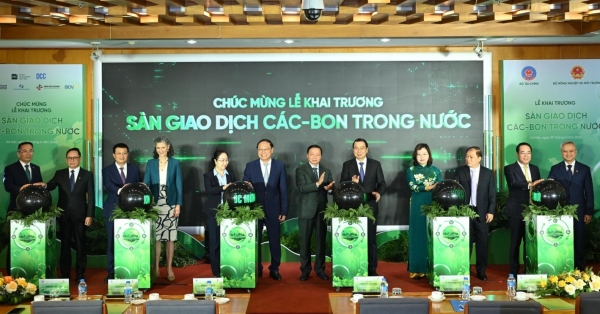
On June 29, 2026, in Hanoi, the Bank for Investment and Development of Vietnam (BIDV) collaborated with regulatory authorities to officially launch the domestic carbon trading system. This significant milestone marks a crucial step in establishing and developing Vietnam's carbon market, contributing to the country's commitment to reducing greenhouse gas emissions.
Prior to this event, BIDV received formal approval from the State Securities Commission of Vietnam (SSC) to serve as the Payment Bank for greenhouse gas emission quota transactions and carbon credits on Vietnam's carbon exchange. This decision reaffirms BIDV's position and capabilities in supporting the development of green financial markets, while also demonstrating the regulatory authority's confidence in the institution.
Carbon Trading System - A Solution for Promoting Green Economy
The carbon trading system operated by BIDV is a market mechanism designed to price and trade greenhouse gas emission quotas as well as carbon credits. Through this system, enterprises can buy and sell emission quotas or carbon credits, creating economic incentives to reduce greenhouse gas emissions.
The system operates on a "cap-and-trade" mechanism, where the government sets a total emission cap for the entire economy or specific sectors, and then allocates these quotas to enterprises. Companies that emit below their allocated quotas can sell their excess allowances, while those that exceed their quotas must purchase additional allowances from the market.
BIDV's Role in the Carbon Market
Being approved by the SSC as the Payment Bank for the carbon market is a significant honor for BIDV. In this role, BIDV will provide payment services, ensuring safety and transparency for transactions on the carbon exchange.
BIDV will undertake the following key functions:
- Serve as the payment intermediary for all carbon transactions
- Manage accounts and ensure capital safety for all participating parties
- Provide trade finance and project financing for emission reduction activities
- Develop green financial products related to carbon
Context for Vietnam's Carbon Market Development
Vietnam committed to achieving net-zero emissions by 2050 at COP26. To fulfill this commitment, Vietnam needs to establish a carbon market as an important tool for economically effective emission reduction.
Vietnam's carbon market is being developed with a hybrid approach combining market mechanisms and supportive policies. The government has established a legal framework for the carbon market, including the amended Environmental Protection Law and various guiding decrees and circulars.
The following table summarizes the development roadmap for Vietnam's carbon market:
| Phase | Timeline | Main Objectives | Implementation Activities | ||
|---|---|---|---|---|---|
| Pilot Phase | 2023-2025 | Establish legal framework, infrastructure, and capacity | Complete legal framework, build exchange platform, train human resources | ||
| Implementation Phase | 2026-2030 | National implementation of carbon market | Expand application scope, diversify products, attract investors | ||
| Development Phase | 2031-2050 | Integrate carbon market with regional and international markets | Connect with regional carbon markets | Develop voluntary carbon market | Apply blockchain and AI to enhance transparency |
Significance of BIDV's Participation in the Carbon Market
BIDV's entry into the carbon market holds significant importance for both the banking system and the national economy:
- For BIDV: Expands green banking services, enhances competitiveness in sustainable finance, and improves brand image in sustainable development.
- For the banking system: Creates a reference model for other banks to develop green financial services, promoting industry-wide transformation toward a circular economy.
- For businesses: Creates financial mechanisms for effective emission reduction, increases transparency in emission reporting, and provides competitive advantages when exporting to carbon-regulated markets.
- For the nation: Contributes to fulfilling emission reduction commitments at COP26, promotes energy transition, attracts investment in green projects, and drives sustainable economic development.
Future Vision
According to plan, Vietnam's carbon market will expand and develop strongly in the coming years. BIDV is preparing advanced technological solutions to support carbon trading operations, including blockchain application to enhance transparency and efficiency, and artificial intelligence for emission data analysis.
In addition, BIDV is researching new green financial products related to carbon, such as green bonds, investment funds in emission reduction projects, and carbon transition consulting services for enterprises.
Mr. Tran Quang Hung, Deputy General Director of BIDV, shared: "Participating in the carbon market is a strategic step for BIDV in its journey toward becoming a green bank. We commit to utilizing our capabilities and experience to support the healthy development of the carbon market, contributing to the country's sustainable development goals."
Conclusion
The official operation of BIDV's carbon trading system marks a significant milestone in the process of building Vietnam's carbon market. As the payment bank, BIDV will make important contributions to developing this market, creating an effective economic mechanism to reduce greenhouse gas emissions, while promoting the transition to a green economy.
In the context of Vietnam's commitment to achieving net-zero emissions by 2050, the carbon market is expected to become a crucial tool for realizing this commitment. The participation of major financial institutions like BIDV will create momentum for market development, attracting more businesses and investors to participate in emission reduction activities.
The future of Vietnam's carbon market is promising, with support from new technologies and strong commitments from the government, businesses, and the banking system. BIDV, as a pioneer in this field, is making significant contributions to the country's sustainable development.