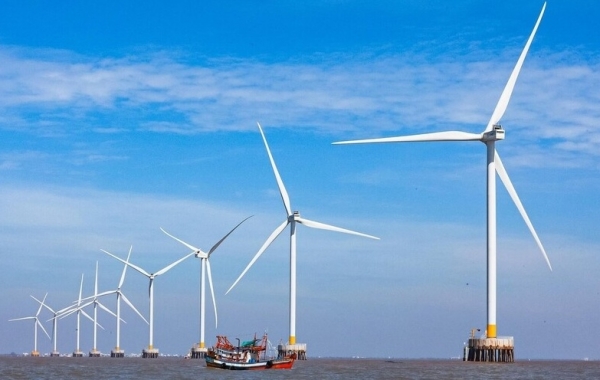
Vietnam's Renewable Energy Expansion: Ca Mau Launches 150 MW Wind Power Projects
June 30, 2023 - Vietnam's commitment to renewable energy advancement took a significant step forward as the southern province of Ca Mau officially launched two major wind power projects with a combined capacity of 150 megawatts. This development represents a crucial component in Vietnam's broader strategy to diversify its energy portfolio and reduce carbon emissions. Alongside this renewable energy milestone, several other important economic policy updates were announced, including modifications to personal income tax regulations, implementation of a new industry classification system, and enhanced penalties for fisheries violations.
Ca Mau's Wind Power Expansion: A Regional Energy Transformation
The launch of two wind power projects in Ca Mau province marks a pivotal moment in Vietnam's renewable energy development, particularly in the Mekong Delta region. These projects, each with 75 MW capacity, are strategically positioned to harness the area's substantial wind resources while contributing to national energy security goals.
The development of wind power in Ca Mau aligns with Vietnam's ambitious target of achieving 1,000 MW of offshore wind capacity by 2030 as outlined in its Power Development Plan VIII. These projects not only address energy demands but also stimulate economic growth in one of Vietnam's economically disadvantaged regions.
When fully operational in 2024, these installations will significantly elevate Ca Mau's status as a wind energy hub, increasing the province's total wind power capacity to over 500 MW. This expansion positions Ca Mau as a leader in renewable energy production within the Mekong Delta, setting a precedent for other coastal provinces to follow.
| Project Name | Capacity (MW) | Location | Investor | Expected Completion |
|---|---|---|---|---|
| Ca Mau Wind Power Project 1 | 75 | Song Doc Town, Dam Doi District | PetroVietnam Power Corporation (PVC) | 2024 |
| Ca Mau Wind Power Project 2 | 75 | Khanh An Town, U Minh Thuong District | PetroVietnam Power Corporation (PVC) | 2024 |
The economic impact of these wind power projects extends beyond energy production. They are expected to create approximately 300-400 direct jobs during the construction phase and 50-100 permanent positions once operational. Additionally, the projects will stimulate ancillary industries including equipment maintenance, technical services, and local logistics, generating substantial indirect employment opportunities.
Environmentally, these wind power installations will significantly reduce carbon emissions by displacing fossil fuel-based electricity generation. The 150 MW capacity is projected to prevent approximately 250,000 tons of CO2 emissions annually, contributing to Vietnam's climate change mitigation commitments under the Paris Agreement.
Personal Income Tax Reforms: Ten New Taxable Income Categories Effective July 1
Beginning July 1, 2023, Vietnam's amended Personal Income Tax Law introduces ten new categories of taxable income, representing a comprehensive overhaul of the country's taxation system. These reforms aim to modernize tax administration, broaden the tax base, and ensure equitable contribution from various income sources.
The implementation of these new tax categories comes as Vietnam continues to refine its tax framework to align with international standards and accommodate the evolving nature of work and income generation in the digital economy.
| Category | Description | Implications |
|---|---|---|
| Real Estate Transfer Income | Proceeds from selling property, land use rights | Increased transparency in property transactions |
| Copyright and Author's Rights Income | Royalties from intellectual property | Encourages creative industries development |
| Lottery and Prize Winnings | Money from games of chance and contests | Regulates gambling-related income |
| Capital Transfer Income | Proceeds from selling stocks, bonds, securities | Modernizes investment taxation |
| Salary and Wages | Compensation for employment | Standardizes employment income taxation |
The additional five categories include income from business production and services, investment and asset rental income, commercial franchising income, invention and patent royalties, and other miscellaneous income not covered by existing categories. This comprehensive approach ensures that virtually all forms of economic activity are appropriately taxed, reducing opportunities for tax avoidance.
Tax authorities have emphasized that these reforms will be accompanied by enhanced digital tax administration systems, including improved electronic tax filing and real-time monitoring mechanisms. The Ministry of Finance has also announced taxpayer education initiatives to ensure compliance and understanding of the new regulations.
Implementation of Seven-Tier Vietnam Product Industry Classification System
The Ministry of Planning and Investment has officially introduced the Vietnam Product Industry Classification System (VPICS) with seven hierarchical levels, replacing the previous Vietnam Economic Industry Classification System. This new classification represents a significant advancement in Vietnam's statistical infrastructure and economic measurement capabilities.
The VPICS has been developed with extensive technical assistance from international organizations, including the United Nations Statistics Division and the World Bank. It incorporates elements from the International Standard Industrial Classification of All Economic Activities (ISIC Rev. 4), ensuring compatibility with global statistical frameworks while maintaining specificity to Vietnam's economic structure.
Seven-Tier Classification Structure:
- Major Sector Level (2 digits): Broad economic sectors (Agriculture, Industry, Services)
- Sector Level (3 digits): Specific economic sectors within major sectors
- Industry Group Level (4 digits): Groups of related industries
- Sub-Industry Group Level (5 digits): Further细分 of industry groups
- Small Industry Level (6 digits): Individual industries
- Small Industry Group Level (7 digits): Subdivisions of small industries
- Product Form Level (8 digits): Specific products and services
The implementation of VPICS will enhance Vietnam's statistical capacity in several key areas. It will improve the accuracy and comparability of economic data, support evidence-based policymaking, and facilitate Vietnam's participation in international statistical initiatives. The system will also provide businesses with a standardized framework for industry classification, simplifying regulatory compliance and market analysis.
Transition to the new system will be gradual, with a three-phase implementation plan extending through 2024. During this period, both old and new classification systems will operate in parallel to ensure continuity in data collection and reporting.
Enhanced Penalties for Fisheries Violations: Maximum Fine of VND 1 Billion
The Ministry of Agriculture and Rural Development has announced significantly increased penalties for violations in fisheries exploitation, with maximum fines reaching VND 1 billion (approximately US$43,000). This enforcement measure reflects Vietnam's commitment to sustainable fisheries management and compliance with international trade agreements.
The new penalty structure targets particularly damaging practices that threaten marine ecosystems and long-term fisheries sustainability. These enhanced penalties are part of Vietnam's broader efforts to reform its fisheries sector, improve compliance with international standards, and ensure access to key export markets.
Key violations subject to maximum penalties include:
- Use of prohibited fishing methods (explosives, poisons, electricity)
- Exceeding allocated quotas or fishing in restricted areas
- Operating vessels inconsistent with fishing permits
- Exploiting prohibited aquatic species
- Failure to implement conservation and resource development measures
The enforcement of these penalties will be supported by enhanced monitoring capabilities, including increased patrols, satellite surveillance, and community reporting mechanisms. The ministry has also announced plans to modernize inspection vessels and equipment to improve enforcement effectiveness.
This regulatory tightening responds to international concerns about illegal, unreported, and unregulated (IUU) fishing. Vietnam has made significant progress in addressing IUU fishing concerns in recent years, with these enhanced penalties representing the latest step in ongoing fisheries reform efforts.
Economic Policy Developments: Strategic Alignment for Vietnam's Future
The policy announcements of June 30, 2023, collectively reflect Vietnam's strategic approach to economic development in the post-pandemic era. The wind power expansion, tax modernization, industry classification reform, and fisheries enforcement all contribute to a coherent framework for sustainable growth.
These developments align with Vietnam's broader economic priorities: transitioning to cleaner energy sources, modernizing administrative systems, integrating with global value chains, and ensuring natural resource sustainability. The coordinated implementation of these policies suggests a holistic approach to economic governance that balances development goals with environmental and social considerations.
The wind power projects in Ca Mau exemplify Vietnam's commitment to renewable energy development while the tax reforms demonstrate efforts to modernize fiscal administration. The industry classification system enhances Vietnam's statistical infrastructure, and the fisheries penalties reflect growing environmental awareness.
As Vietnam continues its economic development trajectory, these policy initiatives will likely serve as models for other regions and sectors. The successful implementation of these measures will be critical to achieving Vietnam's ambitious economic targets while addressing global challenges such as climate change and sustainable development.
Looking ahead, Vietnam appears poised to leverage these policy frameworks to attract investment, improve competitiveness, and enhance quality of life for its citizens. The convergence of energy transition, fiscal modernization, statistical improvement, and environmental protection suggests a forward-thinking approach to economic management that positions Vietnam favorably in the global economy.