Petrovietnam Charts New Course in Global Energy Transition at 2026 Oil and Energy Forum
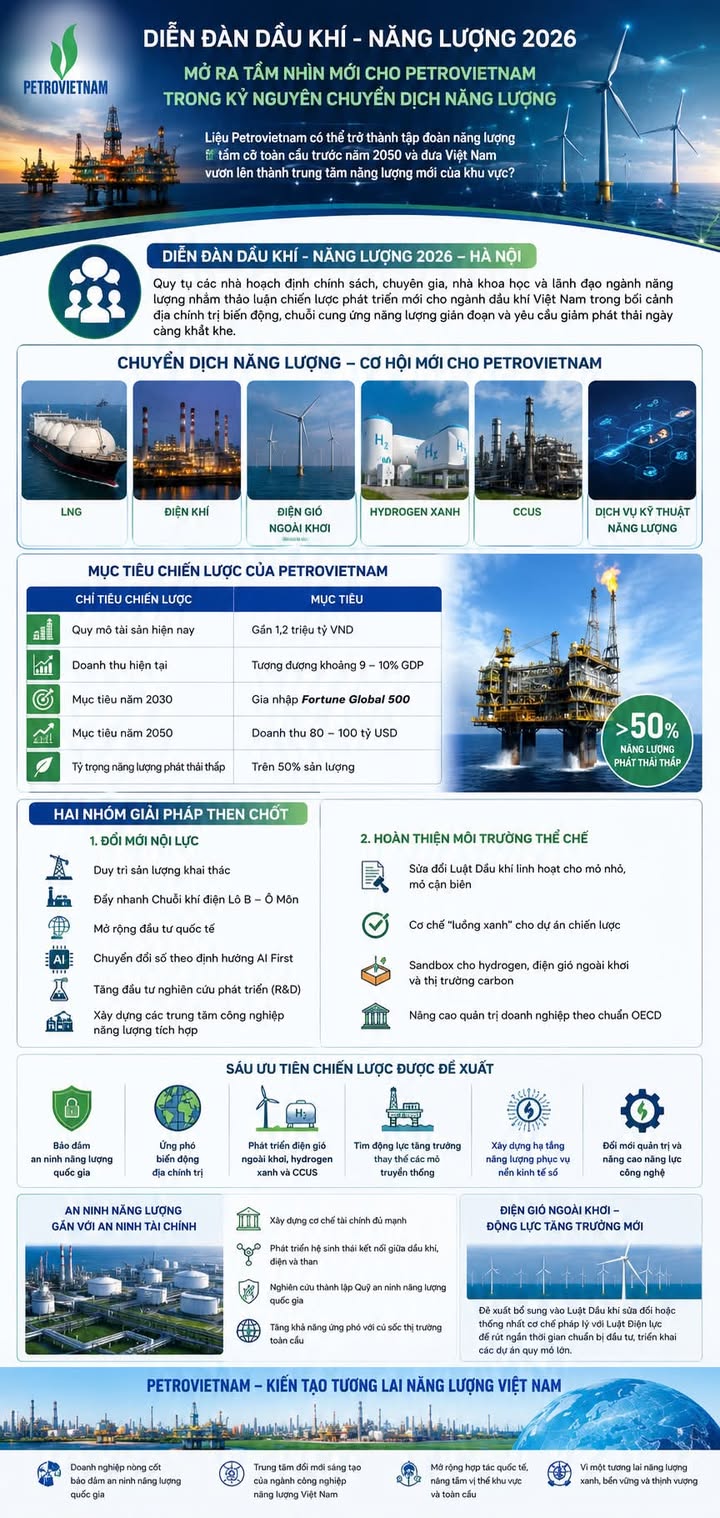
The 2026 Oil and Energy Forum held in Hanoi has provided a strategic roadmap for Petrovietnam's transformation into a global energy powerhouse by 2050, positioning Vietnam as a new energy hub in the region. The forum brought together policymakers, economic experts, scientists, and energy industry leaders to discuss new development strategies for Vietnam's oil and gas sector amid global geopolitical shifts, disrupted energy supply chains, and increasingly stringent emission reduction requirements.
Strategic Vision Amidst Global Energy Transformation
As traditional oil fields in Vietnam face declining production rates while new projects demand advanced technology, substantial investment, and longer implementation periods, Petrovietnam stands at a critical juncture. The forum highlighted this challenge as an opportunity to expand into emerging energy sectors including Liquefied Natural Gas (LNG), gas power generation, offshore wind energy, green hydrogen, Carbon Capture, Utilization, and Storage (CCUS), and high-quality energy technical services.
"The question before us is whether Petrovietnam can become a global-scale energy corporation before 2050 and elevate Vietnam to become a new regional energy center," stated Dr. Nguyen Thanh Son, lead energy strategist at the forum.
Ambitious Targets and Strategic Framework
Petrovietnam has set ambitious long-term goals that reflect its commitment to both national energy security and global leadership in the energy transition. The corporation aims to join the prestigious Fortune Global 500 by 2030 and achieve annual revenues between $80-100 billion by 2050, with over 50% of its production coming from low-emission energy sources.
| Petrovietnam Strategic Goals | |
|---|---|
| Current Asset Scale | Nearly 1.2 million trillion VND |
| Current Revenue | Equivalent to approximately 9-10% of GDP |
| 2030 Target | Join Fortune Global 500 |
| 2050 Target | Revenue of $80-100 billion |
| Low-Emission Energy Ratio | Over 50% of total production |
Two Pillars of Strategic Implementation
To achieve these ambitious targets, Petrovietnam has identified two strategic pillars. The first focuses on internal renewal through maintaining extraction levels, accelerating the Lô B Ô Môn gas power chain, expanding international investment, implementing digital transformation with an "AI First" approach, increasing investment in research and development, and establishing integrated energy industrial centers.
The second pillar involves improving the institutional environment to create long-term growth momentum. Experts recommend amending the Petroleum Law to provide more flexibility for small and marginal fields, applying a green mechanism for strategic projects, implementing regulatory sandboxes for hydrogen, offshore wind, and carbon markets, and enhancing corporate governance according to OECD standards.
Six Strategic Priorities for the Energy Transition
The forum outlined six strategic priorities that will guide Petrovietnam's development in the coming decades:
| Strategic Priority | Key Focus Areas |
|---|---|
| National Energy Security | Ensuring stable energy supply for domestic consumption |
| Geopolitical Response | Adapting to global energy market volatility and international relations |
| New Energy Development | Offshore wind, green hydrogen, and CCUS technologies |
| Growth Diversification | Developing alternatives to traditional oil fields |
| Digital Infrastructure | Energy infrastructure supporting the digital economy |
| Corporate Innovation | Enhanced governance and technological capabilities |
Balancing Energy Security and Financial Stability
A significant focus of the forum was the relationship between energy security and financial security. Experts emphasized that sustainable development requires robust financial mechanisms, development of an ecosystem connecting oil, gas, electricity, and coal sectors, and research into establishing a national energy security fund to enhance response capabilities to global market shocks.
"Energy security cannot be achieved without financial security," explained Dr. Tran Minh Chau, financial economist at Vietnam National University. "We need innovative financial instruments that can weather the volatility of energy markets while supporting the transition to cleaner energy sources."
Offshore Wind as a Key Growth Driver
Offshore wind energy emerged as one of the most significant growth drivers for the coming decade. Many experts proposed incorporating this sector into the amended Petroleum Law or unifying its legal framework with the Electricity Law to shorten investment preparation time and enable Petrovietnam to implement large-scale projects more efficiently.
"Vietnam has exceptional offshore wind potential with over 3,000 km of coastline and average wind speeds of 7-8 m/s in many areas," said Professor Le Van Truong, energy technology specialist at Hanoi University of Science and Technology. "With the right policies and infrastructure, offshore wind could generate up to 40% of our electricity needs by 2040."
Consensus on Petrovietnam's Central Role
The forum revealed a strong consensus among government agencies, experts, and enterprises that Petrovietnam should continue to serve as the backbone of national energy security while becoming the innovation center of Vietnam's energy industry. With its substantial financial foundation, decades of experience in the oil and gas sector, and strategy of expanding into new energy sources, Petrovietnam stands at a pivotal moment to shape its new position both domestically and in regional and international energy markets.
"Petrovietnam's transformation is not just about corporate evolution; it's about positioning Vietnam as a significant player in the global energy landscape," concluded Minister of Industry and Trade Nguyen Hong Dien. "The strategies discussed here will not only ensure our energy security but also contribute to global climate goals and sustainable development."
As the energy transition accelerates globally, Petrovietnam's strategic vision outlined at the 2026 Oil and Energy Forum represents a comprehensive roadmap for maintaining competitiveness while embracing sustainable energy solutions. The corporation's ambitious targets and clear implementation strategies signal Vietnam's commitment to playing a significant role in shaping the future of global energy.