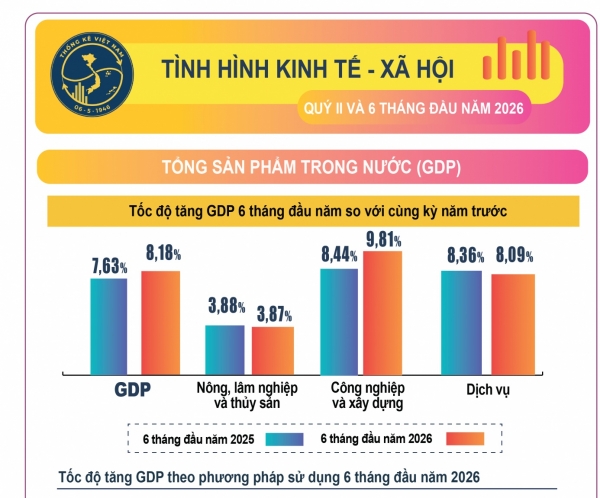
Impressive Q2 GDP Growth Nears 8.4%, Driven by Four Key Industrial and Construction Forces
In the context of continuing complex developments in both the global and domestic economies, Vietnam has achieved remarkable results with an estimated GDP growth rate of 8.39% in Q2/2026 compared to the same period last year. This achievement is particularly noteworthy as the domestic economy continues to face numerous difficulties and challenges from external factors.
Economic Context for the First Half of 2026
The first six months of 2026 have witnessed significant fluctuations in both global and domestic economies. Factors such as geopolitical tensions, increasing inflation, and the slowdown in major economies have substantially impacted Vietnam's production activities and exports.
However, with flexibility in policy management and the efforts of the business community, the Vietnamese economy has demonstrated its resilience and superior growth capacity. Despite facing numerous challenges, macroeconomic indicators have been maintained at stable levels, creating momentum for growth in subsequent quarters.
Q2/2026 GDP Growth: Impressive Figures
According to the latest released data, Vietnam's GDP in Q2/2026 is estimated at 8.39% compared to the same period in 2025, a high growth rate that exceeded the expectations of many economists. This figure has contributed to raising the GDP growth rate for the first half of 2026 to approximately 6.5%, higher than the same period last year.
All major industries and sectors showed positive growth, with industrial processing, manufacturing, and construction continuing as the primary drivers of economic growth. Services and agriculture also maintained stable growth rates, making significant contributions to the overall performance of the economy.
Four Main Drivers from Industry and Construction
Industry and construction have played pivotal roles in driving Q2/2026 GDP growth. Specifically, four main forces have contributed to this success:
- Significant Increase in Public Investment: Key infrastructure projects have accelerated disbursement rates, creating widespread ripple effects throughout the economy.
- Recovery in Industrial Production: The processing and manufacturing industry achieved high growth rates, particularly in electronics, textiles, and footwear production.
- Real Estate and Civil Construction: Housing projects and new urban areas have been widely implemented, attracting investment and creating employment opportunities.
- Basic Construction: Transportation, energy, and urban infrastructure systems have been strongly invested in, creating a foundation for long-term economic development.
Economic Outlook for the Second Half of 2026
To achieve the full-year growth target of approximately 7-7.5%, Vietnam needs to continue its efforts in the second half of 2026. Economic experts forecast that with the strong Q2/2026 growth trajectory, the opportunity to meet and exceed the set targets is very high.
However, challenges remain that require attention, including pressure from import inflation, fluctuations in raw material prices, and global economic uncertainties. The government and ministries need to continue implementing measures to support businesses, promote public investment, and improve the business environment.
Comparison of GDP Growth Across Quarters and Years
| Period | GDP Growth (%) | Characteristics |
|---|---|---|
| Q1/2026 | 5.2 | Started the year with moderate growth |
| Q2/2026 | 8.39 | Strong growth, exceeding expectations |
| Q3/2025 | 7.8 | Good growth rate |
| Q4/2025 | 7.5 | Ended the year with stable growth |
| 6 months/2026 | 6.5 | Higher than the same period in 2025 |
Conclusion
Despite facing numerous external challenges, the Vietnamese economy has demonstrated remarkable resilience and recovery capabilities with a Q2/2026 GDP growth rate of 8.39%. The significant contributions from industry and construction have created strong momentum for economic growth.
To maintain this growth trajectory and achieve the full-year target, it is necessary to continue accelerating the implementation of public investment projects, addressing difficulties for businesses, and improving the investment environment. With these efforts, Vietnam's economic outlook for 2026 remains positive.