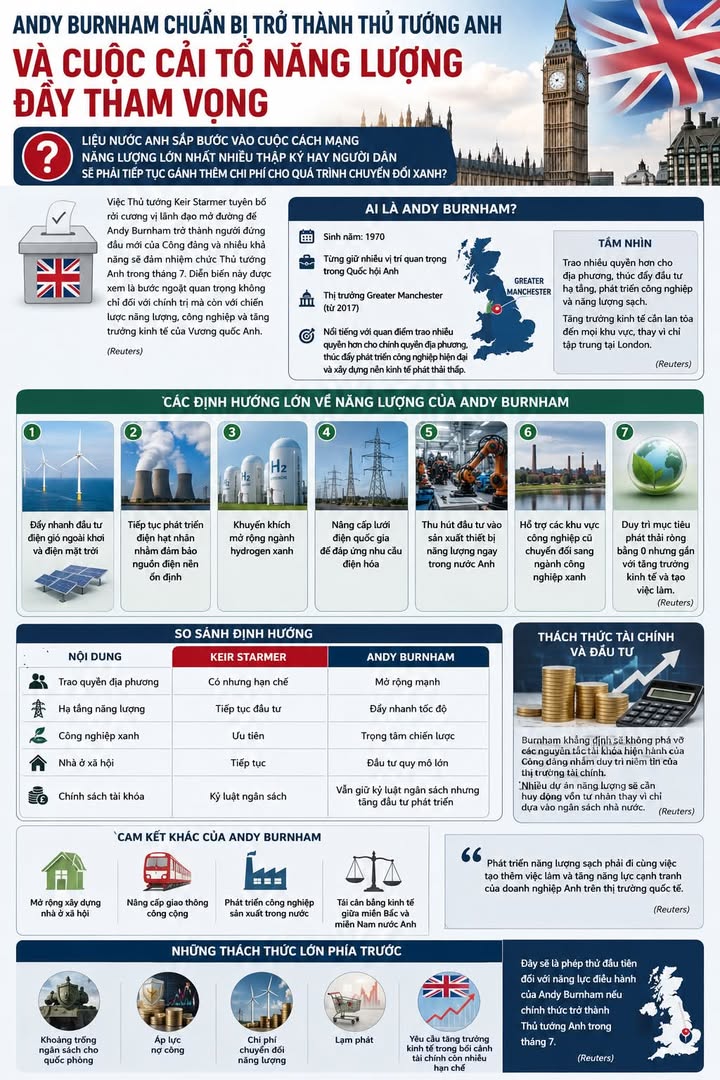
Is Britain about to enter its biggest energy revolution in decades or will people continue to shoulder the costs of the green transition?
Prime Minister Keir Starmer's announcement to leave the leadership position opens the way for Andy Burnham to become the new head of the Labor Party and will likely take over as Prime Minister of the UK in July. This development is considered an important turning point not only for politics but also for the UK's energy, industrial and economic growth strategies. (Reuters)
Andy Burnham is not a strange face in British politics. He held many important positions in Parliament before becoming Mayor of Greater Manchester. Over the years, he has been famous for his views on giving more powers to local governments, promoting modern industrial development and building a low-emission economy.
Unlike the approach that focuses heavily on the central government, Burnham wants localities to be more proactive in energy development.clean environment, invest in infrastructure and manage essential public services. He believes that economic growth needs to spread to all regions instead of focusing only on London. (Reuters)
Andy Burnham's major energy directions include:
• Accelerate investment in offshore wind power and solar power
• Continue to develop nuclear power to ensure a stable power source
• Encourage expansion of the green hydrogen industry
• Upgrade the national power grid to meet electrification needs
• Attract investment in energy equipment production right in the UK
• Support old industrial areas to convert to green industry
• Maintain a net zero emissions target but tie it to economic growth and job creation. (Reuters)
Orientation comparison table
Contents Keir Starmer Andy Burnham
Local empowerment Yes but limited Strong expansion
Energy infrastructure Continue to invest Speed up
Green Industry Priority Strategic Focus
Social Housing Continues Large-Scale Investment
Fiscal policy Budget discipline Maintain budget discipline but increase development investment
One of Burnham's biggest challenges is balancing large-scale investments with financial discipline. He repeatedly affirmed that he would not break the principlesLabour's current fiscal rules aim to maintain financial market confidence. This means that many energy projects will need to mobilize private capital instead of relying solely on the state budget. (Reuters)
In addition to the energy sector, Burnham is also committed to expanding social housing construction, upgrading public transport, developing the manufacturing industry and rebalancing the economy between the North and the South of England. He said that clean energy development must go along with creating more jobs and increasing the competitiveness of British businesses in the international market. (Reuters)
However, the road ahead is not easy. The new government will have to deal with budget gaps for defense, public debt pressure, energy transition costs, inflation and economic growth requirements in a limited financial context. This will be the first test of Andy Burnham's executive ability if he officially becomes British Prime Minister in July. (Reuters)