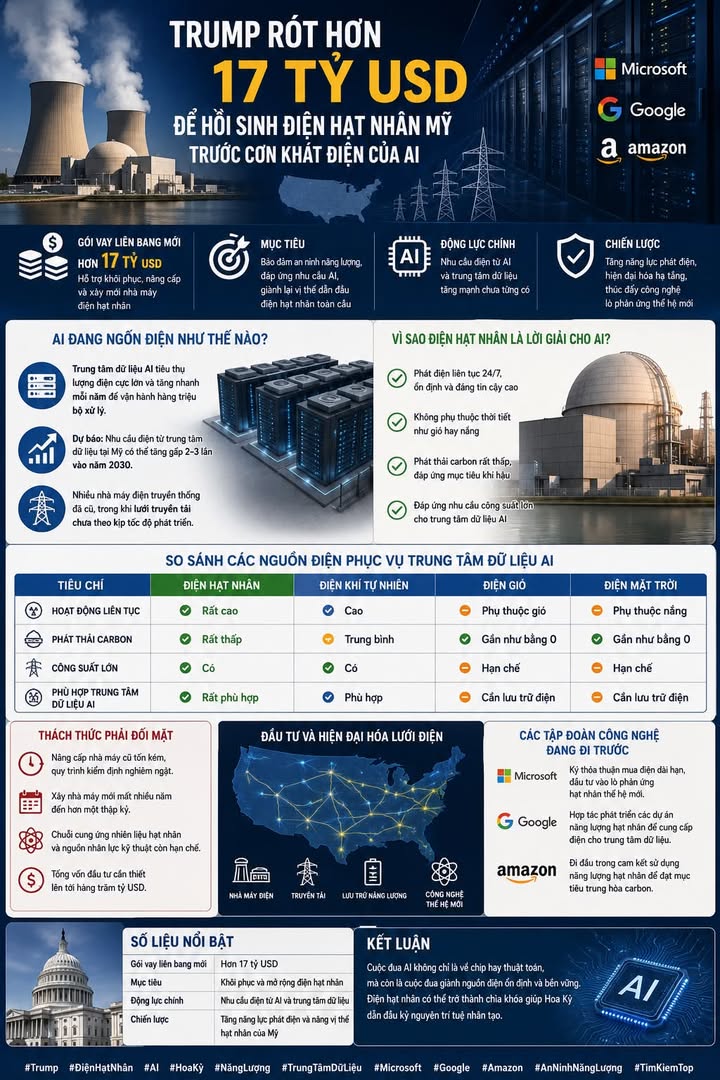
Trump's $17 Billion Nuclear Power Revival Plan Addresses America's Growing AI Electricity Crisis
The Intersection of Artificial Intelligence and Energy Security
The rapid expansion of artificial intelligence is creating unprecedented pressure on America's electrical grid system. As data centers for AI continue to proliferate at an astonishing rate, electricity demand is soaring while traditional power plants age and transmission infrastructure struggles to keep pace. In response to this looming energy crisis, the Donald Trump administration has announced a comprehensive initiative to revitalize nuclear power in the United States, committing over $17 billion in federal loans to support the restoration and expansion of nuclear facilities.
This ambitious plan represents not only a critical step toward ensuring energy security but also a strategic move to reclaim America's leadership position in the global nuclear energy market. The timing couldn't be more crucial, as major technology companies face increasing challenges in securing reliable power sources for their AI operations.
The AI Electricity Demand Challenge
Artificial intelligence systems, particularly large language models and neural networks, require immense computational power that translates directly to massive electricity consumption. Tech giants like Microsoft, Google, and Amazon are racing to build data centers equipped with millions of AI processors, each facility consuming electricity equivalent to small cities.
According to industry estimates, the electricity demand from AI data centers could increase by 160% over the next five years, placing significant strain on an already fragile grid system. Traditional power sources are struggling to meet this demand, especially considering the retirement of numerous coal plants and the intermittent nature of many renewable energy sources.
The Growing Power Requirements of AI
- Training advanced AI models can consume millions of kilowatt-hours of electricity
- Large-scale AI data centers require continuous, reliable power 24/7
- The cooling systems for these facilities alone account for up to 40% of total energy consumption
- Projections suggest AI could account for 3.2% of global electricity consumption by 2030
Trump's Nuclear Power Revival Initiative
The cornerstone of the administration's energy strategy is a substantial financial commitment to nuclear power. The $17 billion federal loan program aims to support both the rehabilitation of existing nuclear facilities and the development of new projects. This initiative represents one of the most significant investments in nuclear energy in American history.
The program will focus on several key objectives:
- Extending the operational lifespans of existing nuclear plants through modernization
- Supporting the development of advanced small modular reactors (SMRs)
- Enhancing nuclear fuel cycle capabilities
- Building a skilled workforce for the nuclear industry
- Strengthening America's position in the global nuclear technology market
Why Nuclear Power for AI?
Nuclear energy offers unique advantages that make it particularly suitable for powering AI data centers:
- Continuous Operation: Nuclear plants can generate electricity 24/7, regardless of weather conditions or time of day
- High Power Density: Nuclear facilities produce enormous amounts of electricity from a small physical footprint
- Reliability: Nuclear plants maintain capacity factors above 90%, far exceeding other energy sources
- Low Carbon Emissions: Nuclear power produces virtually no greenhouse gases during operation
Comparing Power Sources for AI Data Centers
The following table provides a detailed comparison of different energy sources for powering AI data centers, highlighting why nuclear power emerges as a particularly attractive solution:
| Criteria | Nuclear Power | Natural Gas | Wind Power | Solar Power |
|---|---|---|---|---|
| Continuous Operation | Very High | High | Wind-dependent | Sunlight-dependent |
| Carbon Emissions | Very Low | Moderate | Near Zero | Near Zero |
| Large-scale Capacity | Yes | Yes | Limited | Limited |
| Suitability for AI Data Centers | Excellent | Good | Requires Energy Storage | Requires Energy Storage |
| Land Use Efficiency | Very High | Moderate | Low | Low |
| Upfront Capital Cost | Very High | High | Moderate | Moderate |
Challenges to Nuclear Power Revival
Despite its advantages, the nuclear power revival initiative faces significant obstacles that must be overcome:
Technical and Regulatory Hurdles
- Aging Infrastructure: Many existing nuclear plants have operated for decades, requiring extensive upgrades to meet modern safety standards
- Regulatory Approval: The licensing process for nuclear facilities is notoriously lengthy and complex, often taking 10-15 years for new projects
- Supply Chain Limitations: The domestic supply chain for nuclear components has atrophied over the past few decades
- Waste Management: Long-term solutions for nuclear waste disposal remain politically challenging
Economic Considerations
Nuclear power projects require enormous upfront investment, with costs often exceeding $10 billion for a single large-scale plant. While operational costs are relatively low, the initial capital outlay presents a significant barrier to entry. The federal loan program aims to address this financial challenge, but experts suggest that hundreds of billions in additional investment may be needed to fully revitalize America's nuclear industry.
Workforce Development
The nuclear industry faces a critical shortage of skilled workers, including engineers, technicians, and specialized operators. Over the past two decades, reduced investment in nuclear education and training has created a talent gap that will take years to address. The administration's plan includes provisions for workforce development, but the scale of the challenge remains daunting.
Corporate Involvement in Nuclear Power
Major technology companies have recognized the critical importance of reliable energy for their AI operations and are increasingly turning to nuclear power as a solution:
Microsoft's Nuclear Strategy
Microsoft has been particularly aggressive in pursuing nuclear partnerships, announcing agreements with several energy providers to secure electricity from nuclear sources. The company has also invested in developing small modular reactor technology, viewing nuclear power as essential to meeting its ambitious sustainability goals while powering its expanding AI infrastructure.
Google's Energy Diversification
Google has taken a diversified approach to energy procurement, including investments in both traditional nuclear and advanced reactor technologies. The company has publicly stated that reliable, carbon-free energy is critical to its AI development strategy, with nuclear power playing an increasingly important role in its energy portfolio.
Amazon's Nuclear Investments
Amazon Web Services (AWS) has pursued direct investments in nuclear energy projects, recognizing that stable, long-term power contracts are essential for its data center expansion. The company has explored partnerships with nuclear utilities and has expressed interest in next-generation reactor designs that could provide power more flexibly than traditional nuclear plants.
Future Outlook: Beyond the $17 Billion
While the $17 billion federal loan program represents a significant step forward, energy analysts suggest that this is merely the beginning of what will likely be a multi-decade investment cycle. To fully address the electricity demands of the AI revolution and ensure energy independence, the United States may need to invest hundreds of billions of dollars in nuclear power, grid modernization, energy storage, and advanced reactor technologies.
The Evolving Nuclear Landscape
The nuclear industry is undergoing a transformation with several promising developments:
- Small Modular Reactors (SMRs): These compact, factory-built reactors offer lower upfront costs and greater flexibility than traditional nuclear plants
- Advanced Reactor Designs: Generation IV reactors promise improved safety, efficiency, and waste management
- Nuclear-Hydrogen Integration: Emerging technologies that use nuclear energy to produce clean hydrogen
- Microreactors: Ultra-small nuclear facilities suitable for specific applications like remote data centers
The Geopolitical Dimension
The nuclear power revival also carries significant geopolitical implications. As the United States seeks to reestablish its leadership in nuclear technology, it faces increasing competition from China, Russia, and other nations that have continued to invest heavily in nuclear capabilities. The AI electricity race has effectively become a parallel competition in nuclear energy technology and deployment.
Conclusion: The Energy Foundation of AI Leadership
The Trump administration's $17 billion nuclear power initiative reflects a growing recognition that artificial intelligence leadership and energy security are inextricably linked. As AI systems become increasingly sophisticated and power-hungry, the availability of reliable, affordable electricity will determine which nations and companies lead in the AI revolution.
Nuclear power offers a compelling solution to the electricity demands of AI, providing continuous, large-scale power with minimal carbon emissions. However, the technical, economic, and regulatory challenges remain substantial. Success will require sustained commitment from government, industry, and research institutions working in concert.
The competition in artificial intelligence is no longer solely about the power of language models or processing chips. It has evolved into a race for control of stable, sustainable energy resources—the foundation upon which the AI future will be built. In this new landscape, nuclear power may prove to be not just an energy source, but a strategic imperative for national competitiveness and technological leadership.
Key Statistics at a Glance
| Parameter | Value |
|---|---|
| Federal Loan Package | $17+ Billion |
| Projected AI Electricity Demand Growth | 160% (next 5 years) |
| Nuclear Plant Capacity Factor | 90%+ |
| Average Nuclear Plant Construction Time | 10-15 years |
| Estimated Additional Investment Needed | Hundreds of Billions |