#IMF #WorldEconomy #Recession #Iran #OilPrice #AI #Inflation #Investment #Economy #TimKiemTop
Is the world approaching a new economic crisis when even the AI wave is not enough to compensate for damage from war and skyrocketing energy prices?
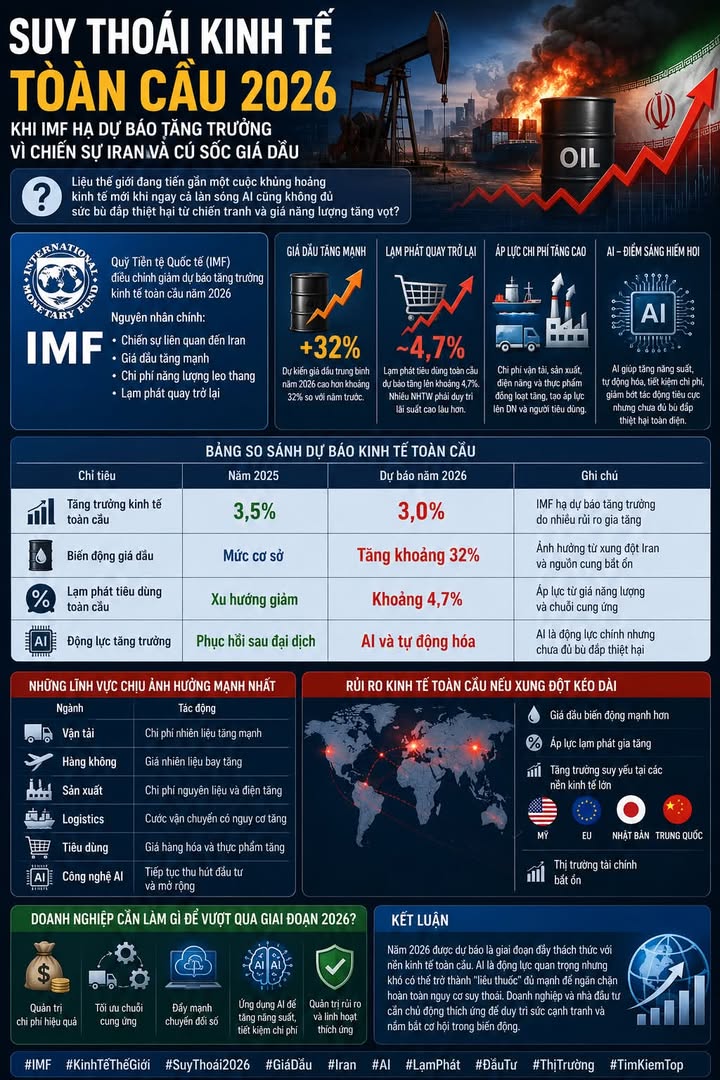
The International Monetary Fund (IMF) has just revised down its forecast for global economic growth in 2026 to 3 percent, lower than 3.5 percent in 2025. The main reason comes from the impact of hostilities related to Iran, sharp increases in oil prices, escalating energy costs and the return of inflation after two years of gradually being controlled.
According to IMF assessments, the average oil price in 2026 is expected to be about 32 percent higher than the previous year. This results in increased costs of transportation, production, electricity and food, putting pressure on both businesses and consumers around the world.
In addition, global consumer inflation is forecast to increase to about 4.7 percent. This is large enough to cause many central banks to maintain high interest rates longer, reducing investment, consumption and the speed of economic recovery.
A rare bright spot comes from the wavesInvesting in artificial intelligence. The IMF believes that AI is helping many businesses increase productivity, automate processes and save costs, thereby somewhat reducing the negative impact of energy prices and geopolitical conflicts. However, this benefit is not large enough to compensate for all the losses that the global economy is facing.
Comparison table of global economic forecasts
Target 2025 Forecast for 2026
Global economic growth 3.5 percent 3 percent
Oil Price Volatility Base Level Up about 32 percent
Global consumer inflation Downward trend Around 4.7 percent
Growth drivers Recovery from the pandemic AI and automation
The areas most strongly affected
Impact Industry
Transportation Fuel costs increased sharply
Aviation Aviation fuel prices increased
Production Raw material and electricity costs increase
Logistics Freight charges are at risk of increasing
Consumption Prices of goods and food increased
AI Technology Continues to Attract Investment and Expansion
If tensions in the Middle East continue, oil prices may become even more volatile, leading to inflationary pressure and the risk of weakened growth in many large economies such as the US, European Union, Japan and China. In that context, AI is considered dynamicthe most important growth force, but it is unlikely to be a "drug" strong enough to completely prevent the risk of global economic decline.
Experts say that 2026 will be the period when businesses must focus more on cost management, supply chain optimization, digital transformation and AI applications to maintain competitiveness in a volatile business environment.
#IMF #WorldEconomy #2026 Recession #Oil Prices #Iran #AI #Inflation #Investment #Market #TimKiemTop