The Vanishing Shores: Technology Battles Riverbank Erosion in Vietnam's Mekong Delta
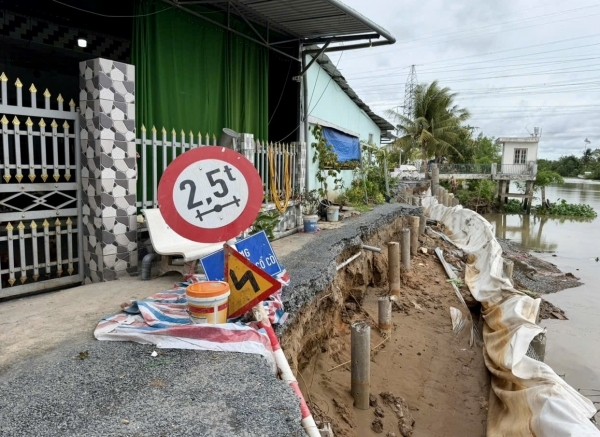
Day by day, concrete houses along the riverbanks slowly tilt toward the water, some collapsing overnight, others requiring self-demolition while still intact. Riverbank erosion isn't just washing away land and valuable property—it's disrupting livelihoods, directly impacting electricity infrastructure, and threatening the way of life for communities across Vietnam's Mekong Delta.
The Escalating Crisis of Riverbank Erosion
The Mekong Delta (MD), Vietnam's rice basket and a critical agricultural and aquaculture production zone, faces a significant challenge from widespread riverbank and canal erosion. According to statistics from relevant authorities, just in the past few years, hundreds of hectares of land have been eroded and carried away by the currents.
In provinces such as An Giang, Dong Thap, Can Tho, Ben Tre, Tra Vinh, and Vinh Long, the erosion situation has grown increasingly severe, particularly during the rainy and stormy seasons. Many national and provincial roads running along rivers have experienced subsidence, threatening transportation safety.
Understanding the Root Causes
Multiple factors contribute to the erosion crisis in the Mekong Delta:
- Climate change phenomena and rising sea levels
- Prolonged heavy rainfall causing flooding and riverbank erosion
- Illegal sand mining disrupting the hydraulic balance
- Construction near riverbanks without proper safety measures
- Shrinking protective forests along river systems
Human Impact and Displacement
The most visible impact of erosion is on the lives of riverside communities. Thousands of families have been forced to relocate and resettle as their homes are either destroyed by erosion or lie in high-risk zones.
"My house has been affected by erosion twice in the past three years," shares Mr. Nguyen Van Tam, a resident of Chor Meo district, An Giang province. "The first time, I spent over VND 100 million to reinforce it. But the second time, the entire house tilted precariously, forcing me to dismantle it myself to prevent a complete collapse."
Infrastructure Vulnerability: The Electricity Crisis
Erosion doesn't just threaten homes—it poses significant dangers to critical infrastructure, particularly electricity systems. Dozens of utility poles, transmission lines, and distribution networks have been undermined and toppled, causing widespread and prolonged power outages across many localities.
According to An Giang Province's Department of Industry and Trade, in 2022 alone, 17 erosion incidents affected the electrical system, causing power outages ranging from several hours to multiple days for thousands of households. Similar situations have become frequent in Dong Thap, Can Tho, and other delta provinces.
Technological Solutions for Erosion Control
In response to this growing crisis, technological solutions have been researched and implemented to monitor, provide early warnings, and prevent erosion:
Remote Monitoring Systems
Many localities have deployed Internet of Things (IoT)-based riverbank monitoring systems equipped with deformation sensors that measure bank inclination in real-time. Collected data is transmitted to monitoring centers for analysis and early warning when erosion risks increase.
Prediction Technologies
The Vietnam Institute of Resources and Environment (under the Ministry of Natural Resources and Environment) is researching the application of Artificial Intelligence (AI) and machine learning to predict erosion risks based on rainfall data, water flow patterns, geological conditions, and historical erosion incidents.
Riverbank Reinforcement Technologies
Several innovative technologies have been applied to reinforce riverbanks, including:
- Geosynthetic materials combined with vegetation
- Reinforced concrete revetments with permeable designs to reduce water pressure
- Biological technologies using microorganisms to stabilize soil
Local Response Strategies
Each province in the Mekong Delta has adopted different approaches to address erosion, yet all face challenges in funding and technological capacity.
| Province | Erosion Points (2022) | Land Affected (hectares) | Households Displaced | Primary Solutions |
|---|---|---|---|---|
| An Giang | 42 | 156 | 1,250 | Concrete revetment, relocation |
| Dong Thap | 38 | 142 | 980 | Geosynthetic reinforcement |
| Can Tho | 25 | 87 | 650 | Revetment with afforestation |
| Ben Tre | 31 | 113 | 820 | Relocation, water hyacinth planting |
International Experience and Lessons for Vietnam
Several countries worldwide, including the Netherlands, Japan, and Thailand, have extensive experience in addressing riverbank erosion and climate change impacts in river deltas. Vietnam can learn from their approaches:
- Implementation of high-precision smart monitoring systems
- Development of effective early warning mechanisms
- Creation of new, environmentally friendly materials for riverbank reinforcement
- Enhanced international cooperation for data and technology sharing
Toward Comprehensive Solutions
To effectively address the erosion crisis in the Mekong Delta, comprehensive and coordinated solutions are needed:
- Improving monitoring and early warning systems using modern technology
- Investing in research for effective erosion prevention technologies
- Developing rational land use planning for riverside areas
- Promoting a circular economy to reduce pressure on natural resources
- Enhancing the response capacity of local communities
The Mekong Delta plays a crucial role in Vietnam's food security and economic development. The application of technology in monitoring, prediction, and erosion prevention is not only an urgent requirement but an inevitable direction to protect this fertile region against the impacts of climate change.
#MekongDeltaErosion #ClimateChange #MonitoringTechnology #DisasterPrevention #IoTTechnology