Government Inspectorate Launches Comprehensive Inspection of Vietnam's Oil Market
In a move signaling significant regulatory scrutiny, Vietnam's Government Inspectorate has initiated a nationwide inspection of the oil market, targeting major industry players and supply chain participants. This unprecedented examination comes as the government seeks to address long-standing challenges in a sector critical to the nation's economy and energy security.
Unprecedented Scale of Inspection
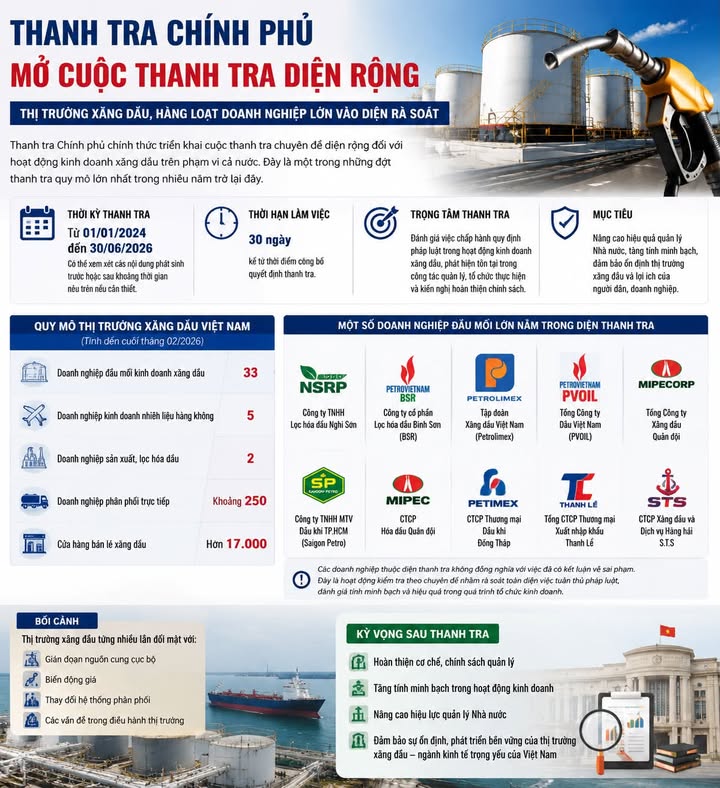
The Government Inspectorate officially launched the comprehensive inspection on July 8, 2026, with Decision No. 686/2026/QD-TTg. This represents one of the largest-scale inspections of the oil sector in recent Vietnamese history, extending its reach across regulatory bodies, wholesale companies, distributors, and all entities within the oil supply chain.
According to the decision, the inspection period spans from January 1, 2024, to June 30, 2026. In exceptional cases, the inspection team may extend its examination to include issues arising before or after this timeframe to ensure a complete and objective assessment. The inspection team has been allocated 30 working days from the decision's announcement to complete its comprehensive review.
Market Landscape and Key Players
As of February 2026, Vietnam's oil market comprises a complex network of enterprises across multiple segments:
| Category | Number of Enterprises |
|---|---|
| Wholesale oil companies | 33 |
| Aviation fuel companies | 5 |
| Oil refining companies | 2 |
| Direct distribution units | Approximately 250 |
| Retail gas stations | Over 17,000 |
Among the wholesale companies under scrutiny are several major players that dominate Vietnam's energy landscape:
- Nghi Son Oil Refinery Company Limited
- BSR (Binh Son Refining and Petrochemical Company)
- Vietnam Oil Group (Petrolimex)
- Vietnam Oil Corporation (PVOIL)
- Military Oil Corporation
- Ho Chi Minh City Oil and Gas Company Limited
- Military Petrochemical Joint Stock Company
- Dong Thap Petrochemical Trading Joint Stock Company
- Thanh Nga Import-Export Trading Joint Stock Company
- S.T.S Maritime Petroleum and Services Joint Stock Company
Inspection Objectives and Scope
The primary focus of this comprehensive inspection is to evaluate compliance with legal regulations in oil business operations. The inspection team will identify shortcomings in management practices and implementation processes, with the ultimate goal of proposing policy improvements to enhance the effectiveness of state management.
Mr. Nguyen Manh Cuong, Head of Department XI and leader of the inspection team, emphasized the sector's critical importance to both the national economy and daily life of Vietnamese citizens. Given the extensive scope of the inspection and limited timeframe, he directed working groups to develop scientific plans, clearly assign responsibilities, and maintain focus on established objectives.
Government agencies, local authorities, and enterprises subject to inspection have been requested to prepare comprehensive documentation and records to facilitate the examination process. The Ministry of Industry and Trade has confirmed its close coordination with the Government Inspectorate, ensuring all subordinate units provide necessary information and create conditions for the inspection to proceed as scheduled.
Significance in Current Context
This inspection arrives at a critical juncture for Vietnam's oil market, which has faced numerous challenges including periodic supply disruptions, price volatility, distribution system restructuring, and ongoing debates about market management effectiveness. The comprehensive nature of this examination suggests a government commitment to addressing systemic issues rather than isolated incidents.
Industry experts view this inspection as potentially transformative for Vietnam's oil market governance. By examining the entire supply chain—from production and wholesale to distribution and retail—the inspection could reveal structural inefficiencies, regulatory gaps, or practices that have contributed to market instability.
Expected Outcomes and Implications
The results of this comprehensive inspection are anticipated to contribute to several key improvements in Vietnam's oil market:
- Enhanced regulatory frameworks addressing identified shortcomings
- Increased transparency in business operations across the supply chain
- Improved state management capabilities for this critical economic sector
- Potential restructuring of market practices to ensure fair competition
- More stable pricing mechanisms benefiting consumers and businesses alike
Notably, the inclusion of major state-owned enterprises in the inspection does not imply pre-determined findings of violations. Rather, it reflects the government's commitment to applying regulatory standards uniformly across all market participants, regardless of their size or influence.
Conclusion
As Vietnam continues its economic development while navigating global energy transitions, this comprehensive inspection of the oil market represents a significant regulatory intervention. The findings and recommendations resulting from this examination could reshape how Vietnam manages one of its most critical economic sectors for years to come.
With the inspection team working against a tight deadline, stakeholders across the industry await the results that may fundamentally alter the landscape of Vietnam's oil market, potentially addressing long-standing concerns while positioning the sector for more stable and transparent operations in the future.