Revolutionary 3D-Printed Thorium Reactor: AMPERA Breakthrough Could Transform Global Energy Landscape
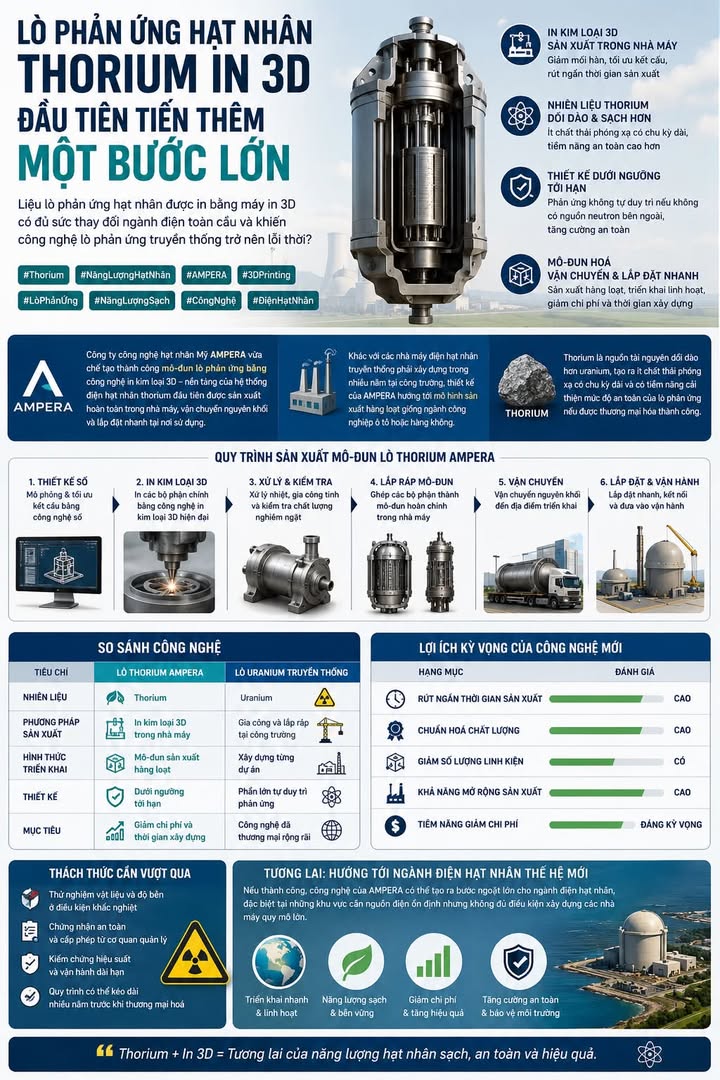
Could 3D-printed nuclear reactors revolutionize the global energy industry and render traditional reactor technology obsolete? American nuclear technology company AMPERA has reached a significant milestone by successfully manufacturing a reactor module using 3D metal printing technology. This development paves the way for the first completely factory-produced thorium nuclear power system, designed for transport as a single unit and rapid installation at the point of use.
Game-Changing Manufacturing Approach
Unlike traditional nuclear power plants that require years of on-site construction, AMPERA's design aims for a mass-production model similar to the automotive or aerospace industries. This approach could significantly reduce deployment time, construction costs, and improve quality through standardized manufacturing processes.
The Significance of Thorium as a Fuel Source
A distinctive feature of the system is its use of thorium as fuel instead of uranium. Thorium is evaluated by many experts as having more abundant resources, producing less long-lived radioactive waste, and having the potential to improve reactor safety levels if successfully commercialized.
Technical Innovation Through 3D Printing
AMPERA reports that the recently manufactured module serves both as the reactor core and pressure vessel. The use of 3D printing technology helps reduce the number of welds, optimize structural shapes, and significantly shorten the production process compared to traditional manufacturing methods.
Another notable aspect is the subcritical design. This means the fission reaction is not self-sustaining without an external neutron source, adding an additional layer of safety to the system. Furthermore, the solid-state structure simplifies operation and maintenance requirements.
Comparative Analysis: Thorium vs. Traditional Reactors
| Criteria | AMPERA Thorium Reactor | Traditional Uranium Reactor |
|---|---|---|
| Fuel Type | Thorium | Uranium |
| Manufacturing Method | 3D metal printing in factory | Traditional fabrication and on-site assembly |
| Deployment Form | Mass-produced modules | Project-by-project construction |
| Design Approach | Subcritical | Largely self-sustaining reactions |
| Primary Objective | Reduce construction time and costs | Established commercial technology |
Expected Benefits of the New Technology
| Benefit Category | Value Assessment |
|---|---|
| Production Time Reduction | High |
| Quality Standardization | High |
| Component Reduction | Yes |
| Scalable Production Capability | High |
| Cost Reduction Potential | Significant |
Challenges on the Path to Commercialization
Despite the promising breakthrough, the project still faces numerous hurdles before commercialization. The reactor must undergo extensive testing of materials, durability, heat resistance, and safety certification. This process could potentially take many years to complete.
Regulatory and Safety Considerations
The nuclear industry operates under some of the most stringent regulatory frameworks globally. Any new reactor technology must demonstrate compliance with rigorous safety standards, including multiple redundant safety systems, containment capabilities, and waste management protocols.
Economic Viability
Beyond technical challenges, the economic viability of 3D-printed thorium reactors must be established. This includes demonstrating cost competitiveness with traditional energy sources and addressing the substantial initial investment required for scaling up production capabilities.
Future Implications for the Energy Sector
If successful, AMPERA's technology could represent a major breakthrough for the nuclear power industry, particularly in regions requiring stable electricity sources but lacking conditions for large-scale plant construction. The combination of thorium energy with 3D printing also opens new pathways for next-generation modular reactor manufacturing, where deployment speed and mass production capabilities will become crucial competitive advantages.
Global Energy Transition
As the world seeks to transition away from fossil fuels while maintaining reliable baseload power, advanced nuclear technologies like AMPERA's could play a critical role. The potential for reduced construction timelines, lower costs, and improved safety profiles might accelerate nuclear energy's contribution to global decarbonization efforts.
Conclusion
The development of the first 3D-printed thorium reactor module by AMPERA represents a potentially transformative advancement in nuclear energy technology. By combining the favorable properties of thorium fuel with the manufacturing efficiencies of 3D printing, this approach addresses several key challenges that have historically limited nuclear power's adoption. While significant technical and regulatory hurdles remain, the potential benefits in terms of cost reduction, safety enhancement, and accelerated deployment could reshape the global energy landscape if successfully brought to market.
The success of this technology would not only demonstrate the viability of additive manufacturing in nuclear applications but also potentially establish thorium as a mainstream alternative to traditional uranium-based fuel cycles, offering a path toward more sustainable and accessible nuclear power generation.