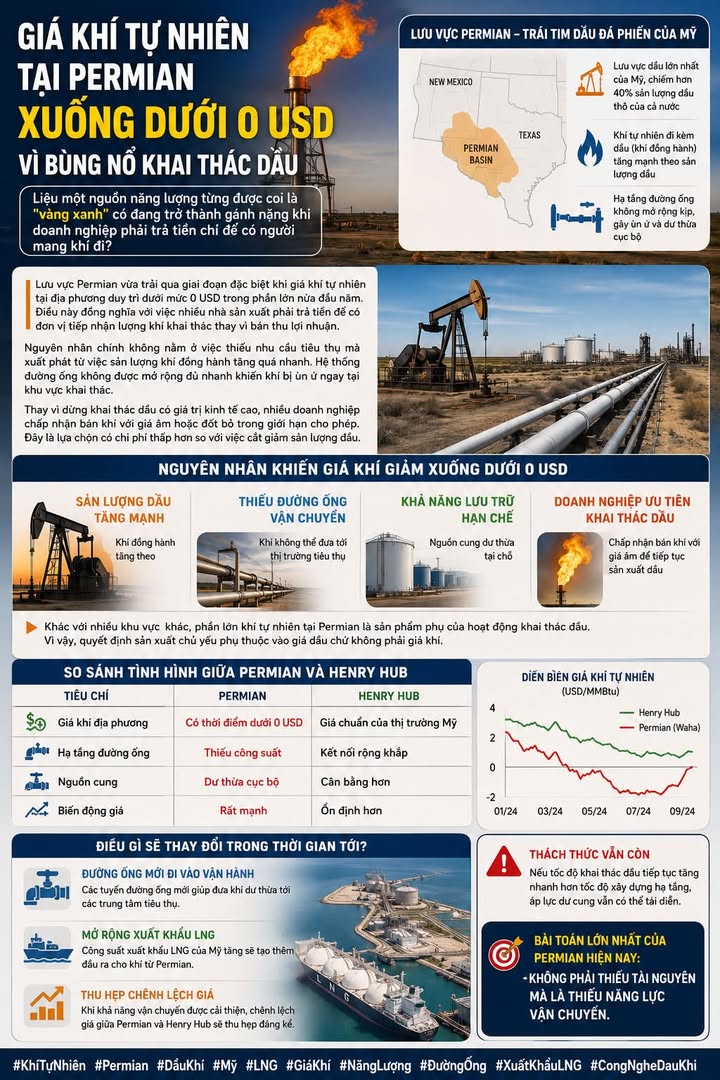
Is an energy source once considered "green gold" becoming a burden when businesses have to pay just to have someone carry the gas away?
The Permian Basin, America's largest oil production region, just went through a unique period when local natural gas prices remained below $0 for much of the first half of the year. This means that many producers have to pay to have a unit receive the exploited gas instead of selling it for profit.
The main reason does not lie in the lack of consumption demand but comes from the rapid increase in associated gas output. When companies focus on exploiting crude oil, the amount of natural gas also increases sharply. However, the transportation pipeline system was not expanded quickly enough, causing gas to stagnate right at the exploitation area.
Instead of stopping exploiting oil with high economic value, many businesses accept to sell gas at negative prices or burn it within allowed limits. This is a lower-cost option than cutting oil production.
The reason why gas prices dropped below 0 USDImpact Factor
Oil production increased sharply. Associated gas also increased
Lack of pipelines Gas cannot be delivered to the consumer market
Limited storage capacity Excess supply on site
Enterprises prioritize oil exploitation. Accept to sell gas at negative prices to continue oil production
Unlike many other regions, most natural gas in the Permian is a byproduct of oil exploitation activities. Therefore, production decisions mainly depend on oil prices, not gas prices.
Compare the situation between the Permian and the Henry Hub
Permian Henry Hub Criteria
Local gas prices are at times below 0 USD Standard price of the US market
Pipeline infrastructure Lack of capacity Extensive connections
Local Excess Supply More Balanced
Price fluctuations Very strong More stable
Henry Hub is the standard trading point for natural gas in the US, so it reflects supply and demand nationwide, while the Permian only reflects oversupply in one area.
What will change in the near future?
Analysts expect this situation will improve when new pipelines come into operation, helping to bring excess gas to consumption centers and LNG export plants along the Gulf of Mexico.
Expansion of US LNG export capacity is also expectedcreating additional output for natural gas from the Permian. As shipping capacity improves, the price differential between the Permian and Henry Hub could narrow significantly.
However, if the rate of oil exploitation continues to increase faster than the rate of infrastructure construction, oversupply pressure may still recur. This shows that the Permian's biggest problem today is not lack of resources but lack of transportation capacity.
#NaturalGas #Permian #OilGas #US #LNG #Pipelines #Energy #LNGExports #GasPrice #CongListDauKhi