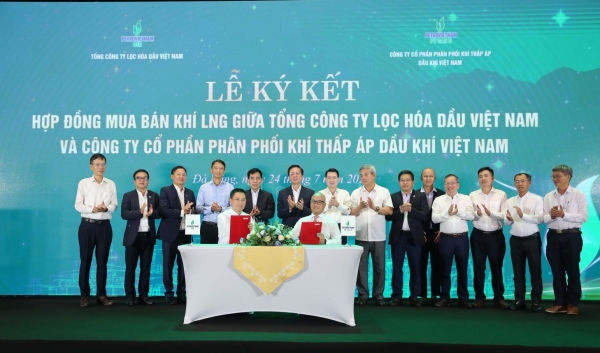
BSR and PV GAS D Sign Natural Gas Purchase Agreement - New Momentum for Vietnam's Energy Market
In the context of global energy transition and Vietnam's Net Zero commitment by 2050, key entities within the Petrovietnam ecosystem have achieved a significant milestone with the signing of a natural gas purchase agreement between Vietnam Oil and Refinery Corporation (BSR) and Vietnam Oil and Gas Distribution Joint Stock Company (PV GAS D), representing Vietnam Gas Corporation (PV GAS).
Introduction to the Participating Entities
Vietnam Oil and Refinery Corporation (BSR)
BSR is a member of Vietnam Oil and Gas Group (Petrovietnam), operating in the oil refining sector with the Dung Quat Oil Refinery - one of the most modern oil refineries in Southeast Asia. BSR not only meets domestic fuel demands but also exports its products to international markets, playing a crucial role in Vietnam's energy security and industrial development.
Vietnam Oil and Gas Distribution Joint Stock Company (PV GAS D)
As a subsidiary of Vietnam Gas Corporation (PV GAS), PV GAS D is responsible for distributing natural gas (including liquefied natural gas LNG and compressed natural gas CNG) to industrial, commercial, and residential customers in southern Vietnam. PV GAS D plays a pivotal role in developing the gas market in Vietnam, contributing to the diversification of the country's energy sources.
Details of the Natural Gas Purchase Agreement
The natural gas purchase agreement between BSR and PV GAS D was signed against the backdrop of increasing demand for clean energy in Vietnam. Natural gas is considered a crucial transitional energy source in Vietnam's roadmap for reducing carbon emissions and achieving the Net Zero target by 2050.
Under the agreement, BSR will purchase natural gas from PV GAS D for use in its production operations at the Dung Quat Oil Refinery. The natural gas will be utilized as fuel for power generation systems and production processes, helping to minimize emissions compared to the use of coal or petroleum.
Significance and Implications of the Agreement
The signing of this agreement marks a significant milestone in BSR's energy transition strategy. The shift from traditional fossil fuels to natural gas not only helps reduce carbon emissions but also enhances production efficiency and reduces long-term energy costs.
For PV GAS D, this agreement expands the market for natural gas consumption, reinforcing the company's position in supplying clean energy to industrial zones and large manufacturing plants.
Benefits for BSR:
- Reduction of greenhouse gas emissions by approximately 30-40% compared to coal usage
- Improved production efficiency through stable combustion temperatures
- Reduced maintenance and equipment保养 costs
- Enhanced corporate image as an environmentally friendly enterprise
Benefits for PV GAS D:
- Ensures stable market demand for natural gas products
- Expansion of industrial customer base
- Contribution to gas market development in southern Vietnam
- Strengthened cooperation with entities within the Petrovietnam ecosystem
Impact on Vietnam's Energy Sector
The agreement between BSR and PV GAS D not only benefits the two parties but also holds significant importance for Vietnam's energy sector. The widespread adoption of natural gas will contribute to:
- Diversification of the national energy structure
- Reduced dependence on imported fuels
- Promotion of gas infrastructure development
- Support for achieving the 2050 Net Zero commitment
Energy Transition Roadmap and Sustainable Development
This agreement signing falls within the framework of Petrovietnam's and the Vietnamese government's energy transition strategy. According to the roadmap, by 2030, the proportion of natural gas in the national energy structure will increase to approximately 15-20%, and continue to rise to 25-30% by 2050.
BSR is committed to investing in clean oil refining technologies, emission reduction, and efficient resource utilization. The transition to natural gas is part of this strategy, helping BSR become a leader in green oil refining in the region.
BSR's Energy Transition Strategy:
| Timeline | Targets | Specific Actions |
|---|---|---|
| 2023-2025 | 15% reduction in carbon emissions | Convert 30% of fuel to natural gas |
| 2026-2030 | 30% reduction in carbon emissions | Convert 60% of fuel to natural gas |
| 2031-2040 | 50% reduction in carbon emissions | Convert 100% of fuel to natural gas and renewable energy |
Future Cooperation Prospects
The natural gas purchase agreement between BSR and PV GAS D is expected to open up broader cooperation opportunities in the future. Both parties could jointly research and develop projects combining natural gas with renewable energy sources such as wind power and solar power.
Additionally, BSR and PV GAS D could collaborate in developing new technologies such as green hydrogen, carbon capture, utilization, and storage (CCUS) technologies, contributing to Vietnam's Net Zero commitment.
Conclusion
The signing of the natural gas purchase agreement between BSR and PV GAS D is a strategic and important step in Petrovietnam's and Vietnam's energy transition roadmap. The agreement not only brings economic benefits to both parties but also contributes to emission reduction, environmental protection, and sustainable development.
In the context of climate change and increasing demand for clean energy, the use of natural gas as a transitional energy source is a reasonable and effective solution. BSR and PV GAS D have demonstrated strategic vision and strong commitment to the sustainable development of Vietnam's energy sector.
This cooperation also opens up broad prospects for the development of Vietnam's gas market, contributing to energy diversification, ensuring national energy security, and fulfilling the 2050 Net Zero commitment.