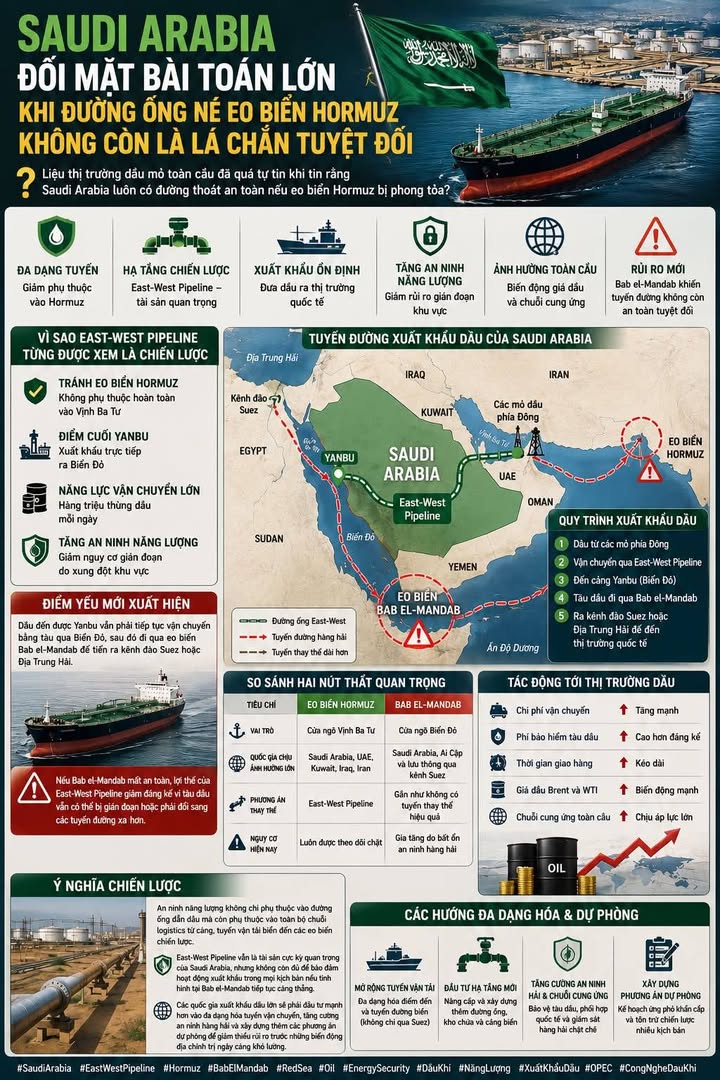
Saudi Arabia Faces Energy Security Challenge as East-West Pipeline Loses Absolute Shield Status
Has the global oil market been overly confident in believing that Saudi Arabia always has a safe escape route if the Strait of Hormuz is blocked? This question has become increasingly relevant as recent developments in the Red Sea, particularly in the Bab el-Mandeb region, have fundamentally changed the perception of Saudi Arabia's energy security strategy.
For years, Saudi Arabia's energy security approach has been considered one of the most effective backup plans in the world. If the Strait of Hormuz faced conflict or disruption, crude oil from eastern fields could be transported via the East-West Pipeline to the Yanbu port on the Red Sea, continuing to international markets without passing through Hormuz.
However, recent developments in the Red Sea, especially in the Bab el-Mandeb region, have completely altered this perspective. The route once considered a "strategic escape" now faces numerous maritime security risks, making Saudi Arabia's oil export capabilities no longer absolutely secure as before.
The Strategic Importance of the East-West Pipeline
The East-West Pipeline represents a monumental engineering achievement in Saudi Arabia's energy infrastructure. Constructed primarily in the 1980s, this 1,200 km pipeline system has the capacity to transport up to 5 million barrels of oil per day from the giant Ghawar and other eastern oil fields to the Red Sea coast.
Strategically, this infrastructure has provided Saudi Arabia with several critical advantages:
| Benefit Factor | Strategic Advantage |
|---|---|
| Hormuz Avoidance | Complete independence from the Strait of Hormuz transit |
| Red Sea Terminus | Direct export access to the Red Sea and beyond |
| Transport Capacity | Millions of barrels daily through multiple parallel lines |
| Energy Security | Reduced risk of disruption from regional conflicts |
Thanks to this system, Saudi Arabia has consistently been rated as the country best prepared to handle a Hormuz crisis. The ability to redirect approximately 60% of its oil exports through an alternative route has provided unparalleled flexibility in global oil markets.
The Emerging Vulnerability
The critical weakness in this strategy has recently come to light. While the East-West Pipeline successfully diverts oil from Hormuz, the oil reaching Yanbu still requires further transportation by tanker through the Red Sea and through the Bab el-Mandeb Strait to reach the Suez Canal or Mediterranean markets.
If Bab el-Mandeb becomes unsafe, the strategic advantage of the East-West Pipeline is significantly diminished. Tankers would face increased risks, potentially requiring longer alternative routes around Africa, adding days to voyages and substantially increasing transportation costs.
This vulnerability has been exposed by recent security incidents in the Red Sea region, including attacks on shipping, piracy concerns, and regional tensions that have made Bab el-Mandeb an increasingly risky passage for oil tankers.
Comparing the Two Critical Choke Points
Both the Strait of Hormuz and the Bab el-Mandeb Strait represent critical vulnerabilities in global oil supply chains, but they differ significantly in their strategic importance and potential alternatives.
| Criteria | Strait of Hormuz | Bab el-Mandeb Strait |
|---|---|---|
| Strategic Role | Gateway to the Persian Gulf | Gateway to the Red Sea |
| Major Affected Nations | Saudi Arabia, UAE, Kuwait, Iraq, Iran | Saudi Arabia, Egypt and traffic through Suez Canal |
| Alternative Routes | East-West Pipeline to Red Sea | Limited effective alternatives |
| Current Risk Level | Constantly monitored | Increasing due to maritime security concerns |
The Strait of Hormuz has long been recognized as a potential flashpoint, with approximately 20% of global oil trade passing through this narrow waterway. Bab el-Mandeb, while carrying less oil traffic, has gained strategic importance due to its proximity to the Suez Canal, through which approximately 9% of global oil and other energy products transit.
Potential Impacts on the Global Oil Market
If both Hormuz and Bab el-Mandab face simultaneous security challenges, the global energy market would witness significant consequences:
| Impact Area | Expected Effect |
|---|---|
| Transportation Costs | Significant increase |
| Insurance Premiums | Markedly higher for oil tankers |
| Delivery Times | Substantial extension |
| Oil Prices | Pot for strong Brent and WTI volatility |
| Global Supply Chain | Significant pressure |
The combined disruption of both strategic choke points could trigger a supply crisis, potentially causing oil prices to spike by 30-50% in the short term. Such a scenario would not only affect Saudi Arabia but also other Gulf oil exporters and international shipping companies.
The economic implications would extend far beyond energy markets, affecting global trade patterns, inflation rates, and economic growth across multiple regions. Industries dependent on stable energy prices, from manufacturing to transportation, would face significant headwinds.
Strategic Implications and Future Considerations
The current developments highlight a crucial lesson: energy security depends not just on oil pipelines but on the entire logistics chain from ports to shipping lanes to strategic straits. The East-West Pipeline remains an extremely valuable asset for Saudi Arabia, but it is no longer sufficient to guarantee exports in all scenarios if the Bab el-Mandab situation remains tense.
For Saudi Arabia and other major oil exporters, this situation necessitates a comprehensive reassessment of energy security strategies. Potential approaches include:
- Diversification of Transport Routes: Developing additional pipeline infrastructure to alternative export points
- Enhanced Maritime Security: Increased investment in naval capabilities and international security cooperation
- Strategic Reserves: Building larger oil reserves to buffer against supply disruptions
- Market Diversification: Reducing dependence on specific markets vulnerable to supply chain disruptions
- Technological Innovation: Investing in more efficient and secure transportation technologies
The changing dynamics in the Red Sea and Persian Gulf regions also underscore the growing importance of geopolitical stability in energy security. As the world transitions toward renewable energy sources, the security of traditional energy infrastructure remains critical during the transition period.
Conclusion
Saudi Arabia's experience with the East-West Pipeline and emerging vulnerabilities in the Red Sea serves as a case study in energy security planning for resource-rich nations worldwide. While physical infrastructure provides a foundation for energy security, it must be complemented by robust diplomatic relations, military capabilities, and adaptive strategies that can respond to an increasingly complex geopolitical landscape.
The evolving situation in the Red Sea demonstrates that energy security is not a static achievement but an ongoing process requiring constant assessment and adaptation. As global energy markets continue to transform, the lessons learned from Saudi Arabia's strategic challenges will inform energy security approaches for decades to come.