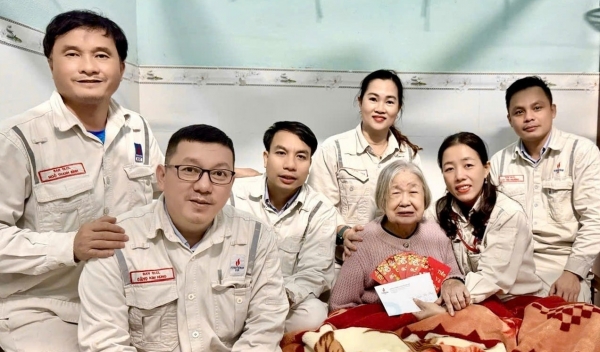
The Children of the Refinery: A Promise to Heroic Vietnamese Mother Phạm Thị Nhung
For over a decade, the small path leading to the home of Heroic Vietnamese Mother Phạm Thị Nhung in Vạn Tường commune, Quảng Ngãi province has been imprinted with the footsteps of children from the Vietnam Oil and Gas Group's BSR (Bình Sơn Refinery) company. These children come not only to fulfill a formal care program but with genuine affection as if visiting their own mother.
A Decade-Long Journey of Care and Respect
The program to care for Heroic Vietnamese Mother Phạm Thị Nhung was initiated by BSR in 2010, with the objective of honoring her significant contributions to the nation's liberation and construction cause. Each year, generations of BSR's management staff and employees take turns visiting Mother, bringing along warm sentiments and practical care.
Specific Activities During Each Visit
Each time they visit Mother, the refinery children prepare thoughtfully:
- Practical gifts for Mother and her family
- Health inquiries and moral encouragement
- Assistance with daily household tasks
- Organization of cultural exchange activities and intimate conversations
- Financial support to improve living conditions
Profound Significance of the Program
The care program represents more than a simple act of gratitude; it serves as a valuable educational lesson on tradition for BSR's younger generation. Through this program, BSR's management staff and employees gain a deeper understanding of the sacrifices made by previous generations, thereby strengthening their willpower and sense of responsibility in both work and life.
Heroic Vietnamese Mother Phạm Thị Nhung shared: "I am deeply moved and grateful for the affection shown by the BSR children. Each time they visit, my heart grows warmer. They come not just as caregivers but as family members."
Genuine Affection from Both Sides
For the refinery children of BSR, each visit to Mother is an opportunity to learn and mature. Mr. Nguyễn Văn Hùng, a management staff member who has participated in the program since its inception, shared: "Having the direct honor of caring for and conversing with Mother is a tremendous privilege. Mother's stories about the resistance period have given us additional motivation to strive in our daily work."
Mother always advises the children: "Live usefully for society, preserve and promote the nation's traditions. That is the best way to honor those who sacrificed for the nation's independence and freedom."
Recognition and Awards
BSR's program of caring for Heroic Vietnamese Mother Phạm Thị Nhung has received recognition and high praise from various levels and sectors. The program not only embodies the spirit of "remembering the source of the water you drink" but also contributes to spreading humanitarian values in the community.
Summary of BSR's Care Activities Over the Years
| Period | Number of Visits | Main Activities | Number of Gifts |
|---|---|---|---|
| 2010-2015 | 6 visits | Visits, gift-giving, financial support | 30 gift sets |
| 2016-2020 | 8 visits | Visits, gift-giving, financial support, home repairs | 50 gift sets |
| 2021-present | 5 visits | Visits, gift-giving, financial support, cultural exchange activities | 40 gift sets |
Commitment to Continuing Humanitarian Value Promotion
Mr. Nguyễn Nam Tiến, BSR's General Director, affirmed: "Caring for Heroic Vietnamese Mother Phạm Thị Nhung is both a responsibility and an honor for all BSR's management staff and employees. We commit to continuing and developing this program, not only for Mother but for many other Heroic Vietnamese Mothers across the country. This is how BSR's younger generation can express their profound gratitude to those who have served the nation."
The journey of caring for Mother Phạm Thị Nhung by BSR's refinery children is not just a beautiful story of gratitude but also a vivid testament to the spirit of "remembering the source of the water you drink" - a fine traditional value of the Vietnamese people.
The program stands as a model for how state-owned enterprises can connect with their historical roots while fostering corporate social responsibility among younger generations, creating a bridge between past sacrifices and present development.