Saigonbank Reports Unexpected Loss in Q2 2026, Marking First Bank to Post Quarterly Deficit
In a surprising development that signals potential challenges facing Vietnam's banking sector, Saigonbank has emerged as the first financial institution to report a loss in the second quarter of 2026. The bank's financial performance reveals a stark contrast to previous periods, raising questions about whether this represents a temporary setback or indicates a new phase of profit pressure within the industry.
Financial Performance: A Sharp Decline
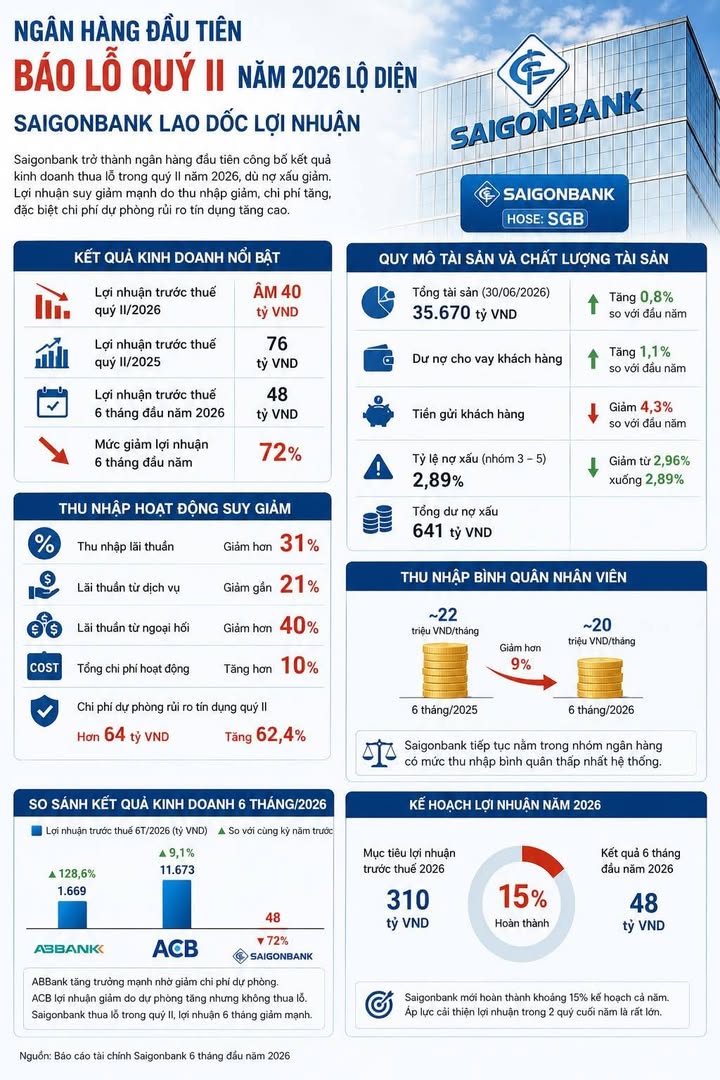
Saigonbank's financial statements for Q2 2026 disclose a pre-tax loss of 40 billion VND, a significant reversal from the 76 billion VND profit recorded in the same period of 2025. The downward trend continues when examining the first half results, with the bank's pre-tax profit for H1 2026 totaling only 48 billion VND—a dramatic 72% decrease compared to the same period last year.
This substantial decline reflects a synchronized reduction across several core business segments, suggesting systemic challenges rather than isolated issues within specific operations.
Factors Behind the Profit Decline
The primary causes of Saigonbank's financial deterioration stem from a combination of reduced income streams and increased operational costs. The bank experienced significant decreases across multiple revenue sources:
- Net interest income decreased by over 31%
- Service income fell by nearly 21%
- Foreign exchange trading income plummeted by more than 40%
Simultaneously, the bank faced mounting operational pressures:
- Total operating costs increased by more than 10%
- Credit risk provision costs surged by over 62%, reaching more than 64 billion VND
The combination of declining revenues and rising provisions ultimately pushed the bank from profitability to a loss position in Q2 2026.
Key Financial Indicators at a Glance
| Financial Indicator | Q2 2026 Result | Comparison |
|---|---|---|
| Pre-tax profit (Q2) | Loss of 40 billion VND | Down from 76 billion VND profit in Q2 2025 |
| Pre-tax profit (H1 2026) | 48 billion VND | Down 72% from H1 2025 |
| Net interest income | Decreased by over 31% | |
| Service income | Decreased by nearly 21% | |
| Foreign exchange income | Decreased by over 40% | |
| Credit risk provisions (Q2) | 64+ billion VND | Increased by 62.4% from Q2 2025 |
Asset Quality: A Silver Lining
Despite the concerning profit decline, Saigonbank's asset quality presented some positive signals as of June 30, 2026:
- Total assets reached 35,670 billion VND, increasing by 0.8% since the beginning of the year
- Customer lending balances grew by 1.1%
- Customer deposits decreased by 4.3%, placing Saigonbank among the rare banks experiencing a reduction in capital mobilization during the first half of 2026
- Non-performing loans (NPLs) from group 3 to group 5 decreased from 2.96% to 2.89%
- Total NPLs amounted to approximately 641 billion VND
Impact on Employees
The financial challenges have also affected Saigonbank's workforce, with employee compensation reflecting the bank's strained performance. Average monthly income decreased from approximately 22 million VND to about 20 million VND—a reduction of over 9%. This decline positions Saigonbank among the banks with the lowest average employee compensation in the Vietnamese banking system.
Industry Comparison: Divergent Trajectories
When compared with other banks that have announced their Q2 2026 results, such as ABBank and ACB, Saigonbank's performance creates a striking contrast:
- ABBank has maintained profit growth, primarily through significant reductions in provision costs
- ACB, while affected by increased provisions, has managed to avoid falling into a loss position
This divergence highlights the growing stratification within Vietnam's banking sector, where the ability to control costs, manage credit growth, and mitigate risks is creating increasingly significant gaps between different financial institutions.
Future Outlook: Mounting Pressure
For the full year 2026, Saigonbank had set an ambitious target of achieving 310 billion VND in pre-tax profit—double the actual result from 2025. However, with only 48 billion VND realized in the first half, the bank has completed approximately just 15% of its annual plan.
This substantial gap indicates intense pressure to improve performance in the third and fourth quarters if Saigonbank hopes to meet its stated objectives. The bank will need to implement significant corrective measures across its business segments to reverse the current downward trajectory.
Conclusion: A Signal of Changing Industry Dynamics?
Saigonbank's unexpected loss in Q2 2026 serves as a potential early indicator of emerging challenges within Vietnam's banking sector. While the bank's asset quality shows resilience, the combination of declining revenues and increasing costs suggests a challenging operating environment.
As other financial institutions release their Q2 results, the industry will be watching closely to determine whether Saigonbank's situation represents an isolated case or part of a broader trend. The coming quarters will be crucial in assessing whether Vietnam's banking sector is entering a new phase of profit pressure that could require strategic adjustments across the industry.