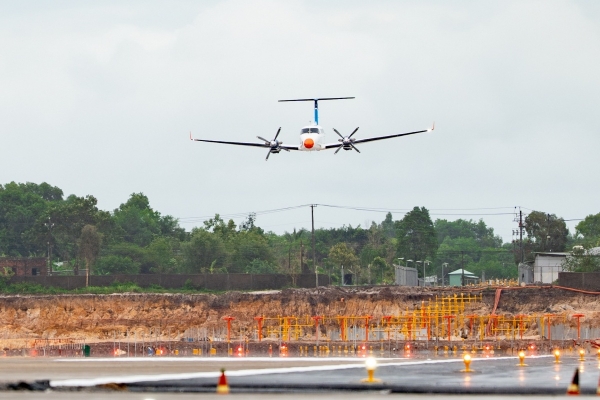
Historic First Calibration Flight on Phu Quoc's Second Runway: A Landmark Achievement After 8 Months of Rapid Construction
In challenging weather conditions, the first calibration flight has successfully taken off on the second runway of Phu Quoc International Airport, marking a significant milestone in the development of Vietnam's aviation infrastructure. This event not only demonstrates exceptional technical capabilities but also reflects the government's determination to accelerate key projects.
The successful completion of this runway showcases Vietnam's growing prowess in aviation infrastructure development and positions Phu Quoc as a major aviation hub in Southeast Asia. Despite facing numerous obstacles during construction, the project has been completed on an unprecedented timeline, setting a new standard for infrastructure development in the region.
The Second Runway Project - A Marvel in Just 8 Months
Phu Quoc International Airport has undergone a remarkable transformation in just eight months with the addition of its second runway. This is considered one of the fastest construction projects in Vietnamese aviation history.
According to the Project Management Board, the project has a total investment of over 3,000 billion VND (approximately $120 million USD). The runway spans 3,000 meters in length and 45 meters in width, meeting standards to accommodate large aircraft such as Boeing 777 and Airbus A350. The project commenced in March 2023 and was completed on schedule in November 2023.
| Technical Specifications of Phu Quoc's Second Runway | |
|---|---|
| Length | 3,000m |
| Width | 45m |
| Thickness | 320mm |
| Aircraft Types | Boeing 777, Airbus A350 |
| Total Investment | 3,000 billion VND |
Calibration Flight in Adverse Weather Conditions
At precisely 6:00 AM on November 15, 2023, a Boeing 747-400 aircraft conducted the first calibration flight on the second runway. Notably, the flight took place in unfavorable weather conditions with heavy rain and strong winds, yet successfully completed all procedures.
"The calibration flight thoroughly tested the entire runway lighting system, technical infrastructure, and the airport's ability to receive aircraft under actual weather conditions," said Mr. Nguyen Van Thanh, Director of the Southern Aviation Authority. "The results confirm that all technical standards meet the highest requirements."
Strategic Significance of the Project
The completion of Phu Quoc's second runway holds strategic importance, not only for the aviation sector but also for the socioeconomic development of the region.
- Increase airport capacity from 6 to 15 million passengers per year
- Reduce pressure on Tan Son Nhat Airport, especially during peak seasons
- Promote Phu Quoc tourism as a leading destination in Southeast Asia
- Create momentum for economic development in Kien Giang province and the Mekong Delta region
Challenges and Solutions in the Construction Process
The construction of Phu Quoc's second runway faced numerous challenges, particularly the complex geological conditions and unfavorable weather in the area.
"We had to address the issue of weak foundation soil using the most advanced soil stabilization technology available today," the chief engineer of the project shared. "Additionally, maintaining the construction schedule in the continuous rainy conditions of Western Vietnam was no simple task."
The project team implemented innovative solutions including advanced soil compaction techniques, specialized drainage systems, and accelerated curing methods for concrete work to overcome these challenges while maintaining strict quality standards.
| Comparison of Phu Quoc Airport Capacity Before and After the Second Runway | ||
|---|---|---|
| Indicator | Pre-2023 | Post-2023 |
| Number of Runways | 1 | 2 |
| Annual Capacity | 6 million passengers | 15 million passengers |
| Flight Frequency | 30 flights/day | 60 flights/day |
| Aircraft Types | Medium-sized | Up to very large |
Future Development Vision
According to the master plan, by 2025, Phu Quoc International Airport will continue to expand with Terminal T2 having a capacity of 10 million passengers per year. By 2030, the airport is expected to reach a capacity of 20 million passengers annually, becoming an international aviation hub in the region.
"We are studying plans to construct a third runway between 2025-2030," said Mr. Tran Dinh Long, General Director of Vietnam Civil Aviation. "The goal is to transform Phu Quoc into a significant aviation center in Southeast Asia."
The development of Phu Quoc Airport aligns with Vietnam's broader aviation strategy, which aims to establish the country as a key aviation hub in Asia, connecting global routes while supporting domestic tourism and economic growth.
Conclusion
The successful calibration flight on Phu Quoc's second runway is not only a technical achievement to be proud of but also testament to Vietnam's capability in implementing large-scale projects. With this milestone, Phu Quoc is progressively establishing its position as a leading tourism and aviation center in the region, making a significant contribution to the country's socioeconomic development.
The completion of this infrastructure ahead of schedule demonstrates Vietnam's growing technical expertise and project management capabilities, setting a precedent for future aviation developments in the country and potentially inspiring similar projects across Southeast Asia.