⸻
1️⃣ Overall picture: Growth is still strong but starting to go out of phase
Data from FiinGroup reveals a notable paradox:
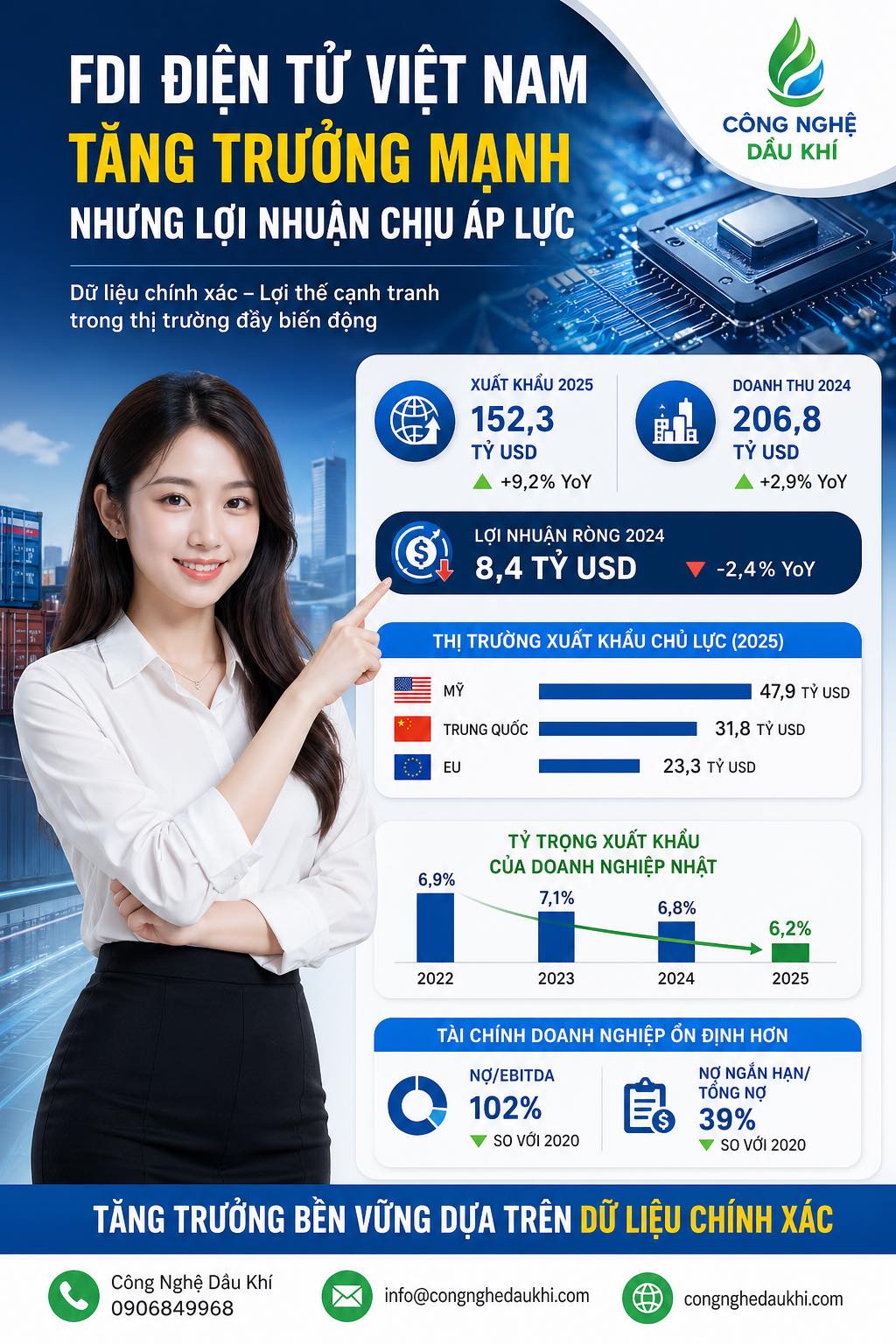
* Exports 2025: 152.3 billion USD (+9.2% YoY)
* Number of FDI enterprises: ~2,100 (+10.4% YoY)
* Revenue 2024: 206.8 billion USD (+2.9%)
* ⚠️ Net profit: 8.4 billion USD (-2.4%)
Core observations:
Growth in scale no longer leads to profit growth → a typical sign of a period of fierce competition.
⸻
2️⃣ Biggest risk: CONCENTRATION OF EXPORT MARKET
Top export markets:
* America: 47.9 billion USD
* China: 31.8 billion USD
* EU: 23.3 billion USD
The two markets, America + China, account for a huge proportion
⚠️ Strategic risks:
* Depends on the global supply chain
* Easily affected by:
* US-China tensions
* Tax policy/technology control
* Fluctuations in consumer demand
If either market "cools down" → Vietnam's exports will be immediately affected
⸻
3️⃣ Reduced profits: Where does the pressure come from?
Although revenue increased steadily over the years (2020–2024), profits were:
* Weak increase
* Even reduced
Main reasons:
1. Input costs increase
* Semiconductor components
* Logistics
* Labor
2. Fierce FDI competition
* Many new businesses join
* Profit margins are squeezed down
3. The role of outsourcing (OEM/ODM) still dominates
* Low added value* Depends on foreign orders
This is the “growth trap”:
Increase revenue but cannot maintain profits
⸻
4️⃣ Japan's influence declines: Signal of shifting capital flows
* Export proportion of Japanese enterprises: 6.2% (down)
* Number of enterprises: 429 (slight increase)
This shows:
* Japan still invests, but its role is no longer dominant
* FDI flows are shifting to:
* Korea
* China
* Taiwan
⚠️ Deep meaning:
* The structure of Vietnam's electronics industry is changing
* Supply chain power shifts
⸻
5️⃣ Corporate finance: A RARE POSITIVE SIGNAL
* Debt/EBITDA: reduced to 102%
* Short-term debt/total debt: reduced to 39%
Japanese businesses:
* Reducing financial leverage
* Increased stability
Insights:
While profits decrease → businesses choose defense instead of expansion
⸻
6️⃣ Strategic perspective: Where is Vietnam in the value chain?
Currently:
* ✔️ Strong in production
* ❌ Weak in:
* Chip design
* R&D
* Global brand
This leads to:
* Depends on order
* Low profit margin
* Easy to replace
⸻
7️⃣ Opportunities hidden behind risks
Despite the great pressure, there are 3 strategic opportunities:
1. Shifting the global supply chain
* “China +1” continues
* Vietnam is a priority destination
2. High technology (AI, semiconductor, IoT)
* If you participate more deeply, your profit margin will increase sharply
3. Localization of the supply chain
* Reduce import dependence
* Increase retention valueg water
⸻
8️⃣ Conclusion: The "smart growth" phase has begun
Vietnam's electronics industry is transitioning from:
* Quantity growth → Quality growth
Which business will win?
* Not the biggest business
* Which is a business:
* Good cost control
* Market diversity
* Has its own technology
⸻
9️⃣ Most important insights
In the current context:
DATA = COMPETITIVE ADVANTAGE
* Businesses no longer rely on "natural" growth
* Which must be based on:
* Market analysis
* Optimize the supply chain
* Risk forecasting
⸻
1 SENTENCE SUMMARY:
Vietnam's electronics FDI industry is growing strongly in scale, but is entering a period of fierce competition - where only businesses that can control data, costs and markets can maintain profits.
⸻
#FDIElectronics #VietnamEconomy #Export2026 #SupplyChain #Economic Analysis #FiinGroup #FDIInvestment #VietnamEnterprise #BusinessStrategy