#Electricity Price #EVN #Enterprise #Manufacturing #Electricity Money #Vietnam's Economy #Factory #LNG #Energy #Operating Costs #Economic Insight
If evening electricity prices continue to increase sharply, will goods from clothing, steel, food to catering services all increase in price, forcing consumers to bear the entire cost?
Summer 2026 is causing many Vietnamese businesses to enter a silent but stressful restructuring. Not because of lack of orders, not because of lack of labor, but because of electricity bills.
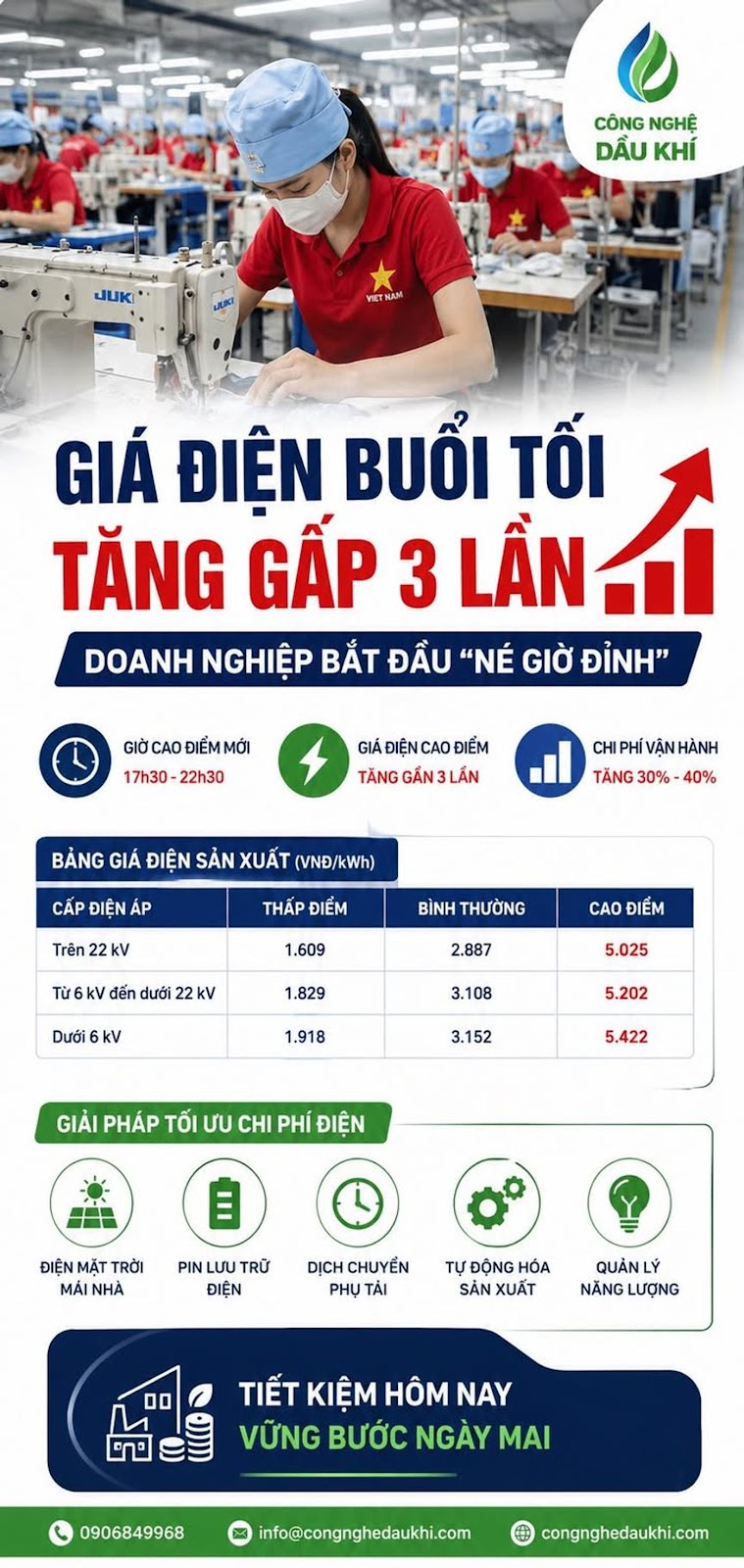
According to new regulations and proposals related to the national electricity time frame, peak hours are placed entirely in the evening from 5:30 p.m. to 10:30 p.m. This is also the time when a series of factories, shopping centers, hotels, restaurants and production areas are most active.
ELECTRICITY HOURS COMPARISON TABLE
Content Old frame New frame
Peak hours 9:30 a.m. - 11:30 a.m. and 5:00 p.m. - 8:00 p.m. 5:30 p.m. - 10:30 p.m.
Off-peak hours are 10pm-4am, 0am-6am
Sundays Not applicable peak hours Not applicable peak hours
Total rush hour 5 hours 5 hours
Source: Ministry of Industry and Trade and documents published in 2026
WHAT IS MAKING BUSINESSES WORRIED
Mr. Doan Quoc Hung, a representative of the garment industry, said businesses often work overtime in the evening to keep up with export schedules. If the entire overtime period falls within the new electricity time frame, electricity costs may increase by 30% to 40%.
What's scarier is not just the electricity bill.
Businesses also have to change work schedules, adjust production shifts, etcNegotiate with workers and even change line operating procedures.
A factory that has been running stably for many years may have to shift part of its operations to daytime or after 10:30 p.m. to reduce cost pressure.
STEEL AND GARMENT INDUSTRY SUFFERING DIRECT IMPACT
Unlike offices that can turn off air conditioning or turn down equipment, the steel industry must operate continuously.
Businesses like VinaSteel or many steel rolling mills use huge amounts of electricity for furnaces, high-power engines and cooling systems.
If multiple lines are operated simultaneously during peak hours, electricity bills can increase by hundreds of millions of VND per month.
The garment industry is no better.
Thousands of industrial sewing machines, lighting systems, air compressors and air conditioners operate throughout, making electricity one of the biggest costs after labor.
NOTABLE BUSINESS ELECTRICITY PRICE LIST
Voltage level Low Peak Normal Peak
Over 22 kV 1,609 VND/kWh 2,887 VND/kWh 5,025 VND/kWh
6 kV to less than 22 kV 1,829 VND/kWh 3,108 VND/kWh 5,202 VND/kWh
Under 6 kV 1,918 VND/kWh 3,152 VND/kWh 5,422 VND/kWh
⚠️ The gap between off-peak hours and peak hours is currently more than 3,500 VND per kWh in some customer groups.
That means a business that consumes 10,000 kWh during peak hours each month can incur tens of millions of VND more just because of operating time.
HOTELS, RESTAURANTS, SUPERMARKETS ARE FACEING CHALLENGES
Unlike factories that can change shifts, it is almost impossible for hotels and restaurants to ask customers to change their shiftsHave dinner at midnight.
Evening is the golden hour for business.
Air conditioners, decorative lights, kitchen systems, cold storage, and elevators all operate at their strongest during the most expensive hours.
Many experts believe that this will be the group most affected if time-of-use electricity prices are widely applied.
BUSINESSES THAT ADAPT FASTEST CAN BE THE WINNERS
Some units have begun to consider:
✅ Move production shift to after 10:30 p.m
✅ Take advantage of Sunday to operate large loads
✅ Invest in rooftop solar power
✅ Install an industrial electricity storage battery system
✅ Automation to reduce machine running time
Energy experts estimate that businesses with reasonable load shifting can save from 15% to 30% on monthly electricity costs.
COST IMPACT ESTIMATE
Type Expected level of impact
Administrative office Low
Garment factory Medium to high
Steel factory Very high
Cao Commercial Center
Cao restaurant and hotel
Cold storage, logistics High
The energy game in Vietnam is changing.
Previously, businesses competed with labor, technology and raw materials.
Nowadays, power management capabilities are becoming a new competitive advantage.
Any business that optimizes operating hours will save billions of VND each year.
Businesses that are slow to adapt could see profits eroded even during this hot season. ⚡
Reference source from announcements on electricity time frame and electricity price schedule in 2026