#Colombia #DauKhi #NangLuong #Ecopetrol #LNG #Fracking #KinhTeColombia #AnNinhNangLuong #GiaDau #ChuyenDoiNangLuong
🤔 If Colombia continues to abandon oil and gas while gas production plummets, could the country become a large-scale energy importer in just a few years?
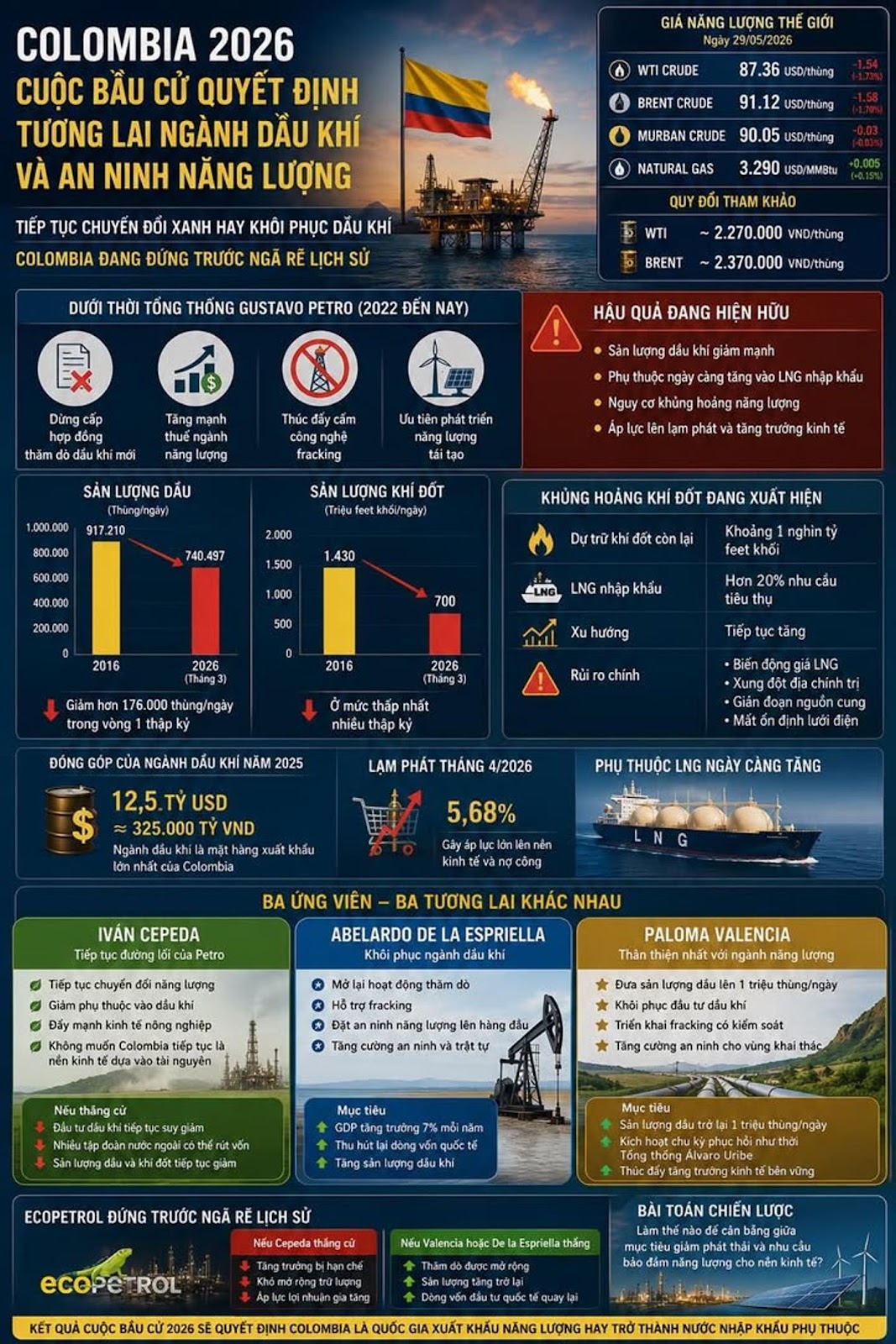
Colombia is entering one of the most important presidential elections in the country's energy industry history. The 2026 outcome will not simply select a new leader, but will also determine whether Colombia continues on President Gustavo Petro's green transition path or returns to oil and gas development to protect economic growth and energy security.
It is worth noting that the debate no longer revolves around politics but focuses on questions of survival
Can a country that was once a strong oil and gas exporter maintain growth when domestic output continues to decline?
Overview of the current energy market
Price Index
WTI Crude 87.36 USD/barrel
Brent Crude 91.12 USD/barrel
Murban Crude 90.05 USD/barrel
Natural Gas 3,290 USD/MMBtu
💰 Reference conversion
🛢️ WTI is about 2,270,000 VND/barrel
🛢️ Brent is about 2,370,000 VND/barrel
This price is still attractive enough for many countries to continue investing in oil and gas exploitation instead of completely giving up fossil fuels.
What happened under Gustavo Petro
After being elected in 2022, President Gustavo Petro implemented a series of policies to reduce dependence on fossil fuels.
Controversial decisions include:
✓ Stop granting new oil and gas exploration contracts
✓ Sharply increase taxes on the energy industry
✓ Promote a ban on fracking mining technology
✓ Prioritize renewable energy
In terms of environment, this policy receives much support. However, in terms of economics, the consequences are becoming increasingly clear.
Oil production dropped sharply
Year Oil Production
2016 917,210 barrels/day
2026 740,497 barrels/day
📉 Reduced by more than 176,000 barrels/day within a decade.
This is an alarming number because oil and gas is Colombia's largest export product.
In 2025 alone, the oil and gas industry brings in about 12.5 billion USD, equivalent to nearly 325,000 billion VND.
A gas crisis is emerging
If falling oil is the big problem, then gas is the real concern.
Condition Indicator
Gas output Lowest in decades
Remaining reserves Approximately 1 trillion cubic feet
Imported LNG More than 20% of consumption demand
Trend Continues to increase
Just about 10 years ago, Colombia was almost self-sufficient in gas.
Today the country has to import LNG regularly and is increasingly dependent on the international market.
This leaves Colombia vulnerable first
🌍 Geopolitical conflict
🌍 LNG price fluctuations
🌍 Disruption of energy supply chains
🌍 Risk of power grid instability
Three candidates – Three different futures
Ivan Cepeda
Iván Cepeda is considered the successor to Petro's path.
Main point of view
• Tiếp tục chuyển đổi năng lượng
• Giảm phụ thuộc vào dầu khí
• Đẩy mạnh kinh tế nông nghiệp
• Không muốn Colombia tiếp tục là nền kinh tế dựa vào tài nguyên
Nếu thắng cử
📉 Đầu tư dầu khí có thể tiếp tục suy giảm
📉 Nhiều tập đoàn năng lượng nước ngoài có thể rút vốn
📉 Sản lượng dầu và khí đốt tiếp tục giảm
Abelardo de la Espriella
Abelardo de la Espriella đang nổi lên như một nhân tố bất ngờ.
Quan điểm chính
✓ Khôi phục ngành dầu khí
✓ Mở lại hoạt động thăm dò
✓ Hỗ trợ fracking
✓ Đặt an ninh năng lượng lên hàng đầu
Mục tiêu
📈 GDP tăng trưởng 7% mỗi năm
📈 Thu hút lại dòng vốn quốc tế
📈 Tăng sản lượng dầu khí
Paloma Valencia
Paloma Valencia được xem là ứng viên thân thiện nhất với ngành năng lượng.
Mục tiêu đáng chú ý
🛢️ Đưa sản lượng dầu trở lại 1 triệu thùng/ngày
🛢️ Khôi phục đầu tư dầu khí
🛢️ Triển khai fracking có kiểm soát
🛢️ Tăng cường an ninh cho các vùng khai thác
Nhiều chuyên gia đánh giá nếu Valencia chiến thắng, ngành dầu khí Colombia có thể bước vào chu kỳ phục hồi tương tự giai đoạn phát triển mạnh dưới thời cựu Tổng thống Álvaro Uribe.
Ecopetrol đang đứng trước ngã rẽ lịch sử
Không doanh nghiệp nào chịu tác động lớn hơn Ecopetrol.
Nếu Cepeda thắng cử
📉 Tăng trưởng bị hạn chế
📉 Khó mở rộng trữ lượng
📉 Áp lực lợi nhuận gia tăng
Nếu Valencia hoặc De la Espriella thắng
📈 Thăm dò được mở rộng
📈 Sản lượng tăng trở lại
📈 Dòng vốn đầu tư quốc tế quay lại
Điều đáng lo nhất không phải dầu mỏ
Nhiều nhà phân tích cho rằng câu chuyện lớn nhất hiện nay không phải dầu thô mà là khí đốt.
Khi sản lượng khí nội địa suy giảm và LNG nhập khẩu ngày càng chiếm tỷ trọng lớn, Colombia đang đối mặt nguy cơ
⚠️ Giá điện tăng
⚠️ Chi phí sản xuất tăng
⚠️ Lạm phát leo thang
⚠️ Mất lợi thế cạnh tranh công nghiệp
Lạm phát tháng 4/2026 đã lên tới 5,68%, mức đủ để tạo áp lực lớn lên nền kinh tế vốn đang mang gánh nặng nợ công.
Góc nhìn chiến lược
Điều nghịch lý là Colombia sở hữu tài nguyên dầu khí đáng kể nhưng lại đang đối mặt nguy cơ thiếu năng lượng.
Cuộc bầu cử năm 2026 thực chất là cuộc bỏ phiếu giữa hai mô hình phát triển
🌿 Chuyển đổi xanh nhanh hơn với rủi ro kinh tế ngắn hạn
🛢️ Khôi phục dầu khí để bảo đảm tăng trưởng và an ninh năng lượng
Dù kết quả thế nào, Colombia đang trở thành ví dụ điển hình cho bài toán mà nhiều quốc gia đang đối mặt
Làm thế nào để cân bằng giữa mục tiêu giảm phát thải và nhu cầu bảo đảm năng lượng cho nền kinh tế?
Đó không chỉ là câu hỏi của Colombia mà còn là bài toán chiến lược của nhiều quốc gia đang phát triển trên toàn thế giới.
#Colombia2026 #GustavoPetro #IvanCepeda #PalomaValencia #AbelardoDeLaEspriella #Ecopetrol #DauMo #KhiDot #LNG #AnNinhNangLuong #KinhTeTheGioi #GiaDau #NangLuongToanCau #ChuyenDoiXanh #TimKiemTop