#Azerbaijan #Georgia #Russia #Gazprom #NangLuong #Caucasus #DauKhi #AnNinhNangLuong #KhiDot #DiaChinhTri
🤔 If Georgia really trades control of gas infrastructure for 20 years to maintain its role as a trade transit, is this country putting itself in a new round of energy dependence from Russia?
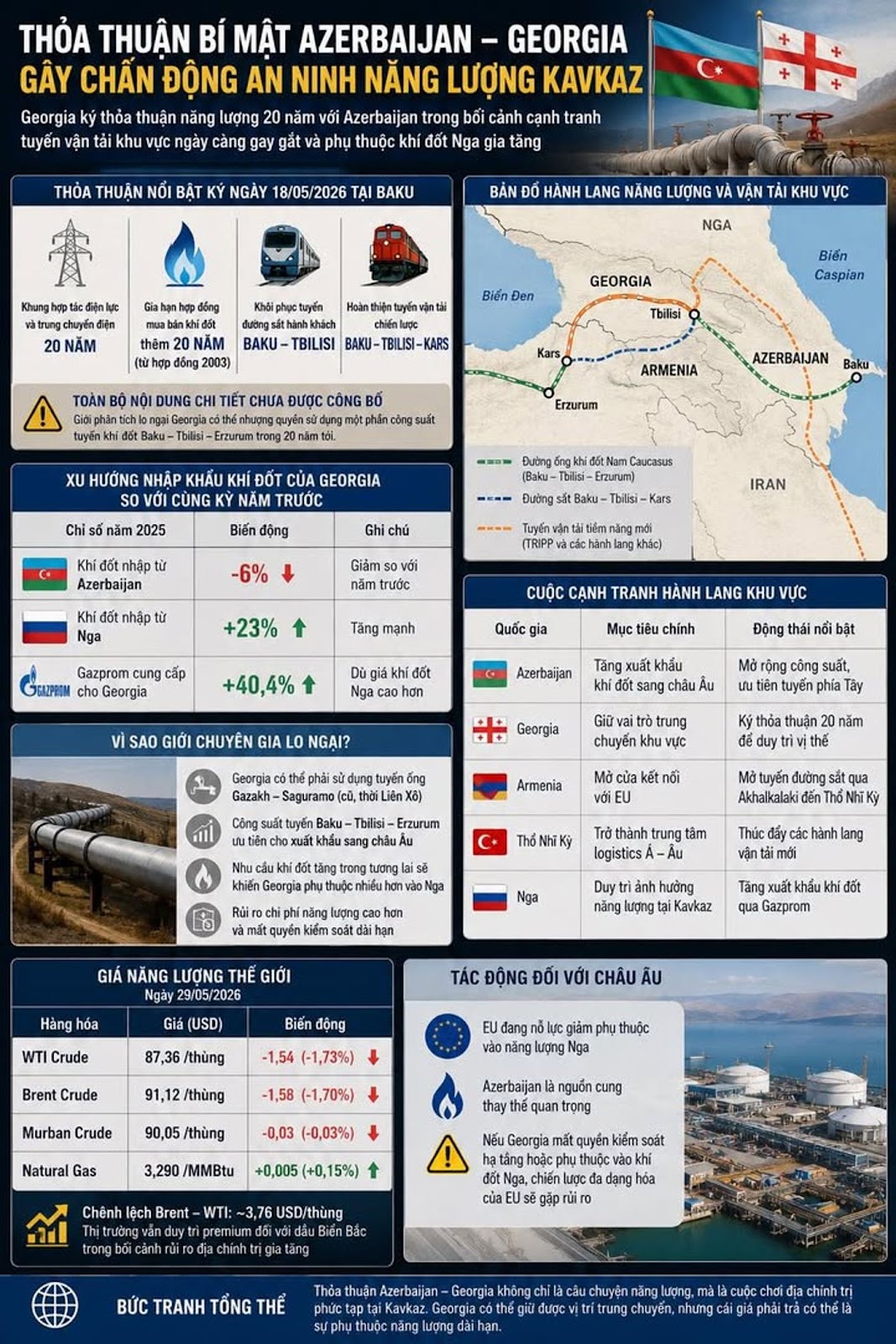
A 20-year energy deal recently signed between Azerbaijan and Georgia is sparking fierce controversy in the Caucasus region. What is notable is not the contract term but the fact that most of the details have not yet been publicly announced.
In the context of increasingly fierce geopolitical competition between Europe, Russia, Türkiye and the Caucasus countries, many experts worry that Georgia may be trading part of its energy independence to maintain its strategic transit position between Asia and Europe.
Current global energy prices
Commodity Price
WTI Crude 87.36 USD/barrel
Brent Crude 91.12 USD/barrel
Murban Crude 90.05 USD/barrel
Natural Gas 3,290 USD/MMBtu
📈 The difference between Brent and WTI is currently about 3.76 USD/barrel, showing that the market still maintains a premium for North Sea oil amid increasing geopolitical risks.
What is making analysts worried?
According to published information, the two sides have signed
✓ The electricity and power transmission cooperation framework lasts 20 years
✓ Extend the gas purchase contract from 2003 for another 20 years
✓ Restore the Baku – Tbilisi passenger railway
✓ Complete the strategic transport route Baku – Tbilisi – Kars
The problem is that the most important provisions have not yet been announced.
Many analysts believe that Georgia may have ceded part of the right to use the capacity of the strategic gas route Baku - Tbilisi - Erzurum to Azerbaijan for the next two decades.
The data is sending worrying signals
2025 Index Volatility
Gas imported from Azerbaijan Reduced by 6%
Gas imported from Russia Increases 23%
Gazprom gas supply to Georgia Increases 40.4%
It is worth noting that Russian gas is priced higher than supplies from Azerbaijan.
Normally countries will prioritize cheaper supplies to reduce national energy costs. However, the trend in Georgia is going in the opposite direction.
Gazprom is back?
Many economic experts in Georgia believe that this is not a coincidence.
If more capacity of the modern Baku – Tbilisi – Erzurum pipeline is devoted to exports to Europe, Georgia may be forced to use an older Soviet-era pipeline system to receive gas.
As energy demand continues to increase in the future, the most viable option may turn out to be to import more gas from Russia through Gazprom.
This is what worries many analysts.
The real war is not about gas
At first glance this is an energy story.
But deeper than that is the battle for control of the Asia-Europe transport corridors.
Currently, Armenia, Azerbaijan and Türkiye are all promoting new trade routes.
Some new transportation corridors risk bypassing Georgia altogether.
If that happens, Tbilisi could lose billions of dollars in revenue from logistics and transit.
That's why many experts believe that the Georgian government is prioritizing geopolitical position over energy security.
New competitive map in the Caucasus
Country Main target
Azerbaijan Increases gas exports to Europe
Georgia Plays a regional transit role
Armenia Opens connection with EU
Türkiye Becomes Asia-Europe logistics center
Russia Maintains Energy Influence in the Caucasus
Impact on Europe
The European Union is trying to reduce dependence on Russian energy from 2022.
Azerbaijan is considered one of the important alternative sources of supply.
Tuy nhiên nếu Georgia mất dần khả năng kiểm soát hạ tầng trung chuyển hoặc phụ thuộc nhiều hơn vào nguồn khí đốt Nga, toàn bộ chiến lược đa dạng hóa nguồn cung của châu Âu có thể đối mặt với những rủi ro mới.
Góc nhìn thị trường năng lượng
🌍 Azerbaijan đang thắng lớn nhờ mở rộng ảnh hưởng xuất khẩu khí đốt.
🌍 Georgia giữ được vị trí trên bản đồ vận tải nhưng đối mặt rủi ro phụ thuộc năng lượng.
🌍 Nga có dấu hiệu lấy lại ảnh hưởng thông qua Gazprom.
🌍 Châu Âu tiếp tục cần khí đốt Kavkaz để giảm phụ thuộc Moscow.
Khi dầu Brent vẫn duy trì trên 91 USD/thùng và nhiều chuyên gia cảnh báo nguy cơ sốc giá năng lượng chưa kết thúc, mọi thỏa thuận khí đốt kéo dài hàng chục năm đều có thể tạo ra tác động vượt xa phạm vi một quốc gia.
Câu hỏi lớn nhất lúc này không phải Georgia nhận được gì từ thỏa thuận với Azerbaijan, mà là họ đã chấp nhận từ bỏ điều gì để có được nó.
#DauMo #KhiDot #Gazprom #Azerbaijan #Georgia #Nga #Kavkaz #AnNinhNangLuong #DiaChinhTri #NangLuongToanCau #WTI #Brent #NaturalGas #OilMarket #EnergySecurity #EuropeEnergy #TransitCorridor #Geopolitics #OilPrice #NangLuong2026