#DauKhi #GiaDau #LNG #Hormuz #China #My #Russia #OPEC #NangLuongTaiTao #AnNinhNangLuong #CongNgheDauKhi
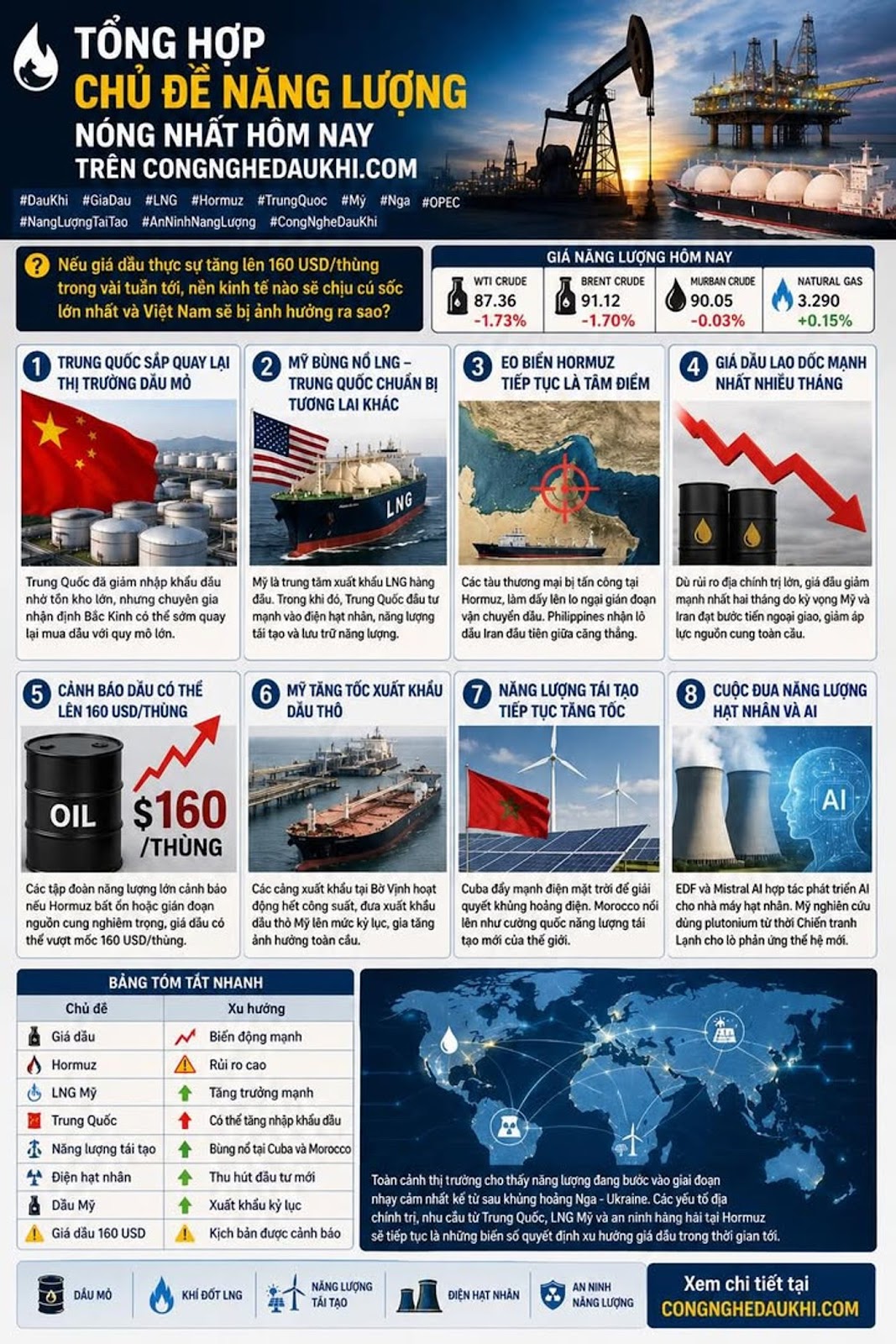
🤔 If oil prices really increase to 160 USD/barrel in the next few weeks, which economy will suffer the biggest shock and how will Vietnam be affected?
The global energy market today continues to fluctuate strongly as investors simultaneously monitor tensions in the Strait of Hormuz, China's oil policy, the wave of LNG exports from the US and the rise of renewable energy in many countries.
1. China is about to return to the oil market
One of the most interesting topics is that China has reduced oil imports for a long time thanks to the use of huge inventories. However, many experts believe that this strategy is unlikely to last much longer and Beijing may soon return to buying oil on a large scale.
If this happens at the same time as supply disruptions in the Middle East, global oil prices could face a new sharp increase.
2. America has an LNG boom but China is preparing for a different future
The US continues to benefit from global LNG demand by becoming one of the world's largest liquefied natural gas export centers.
Meanwhile, China is investing heavily in nuclear power, renewable energy, energy storage and power infrastructure to reduce dependence on imported fuel fluctuations in the long term.
3. The Strait of Hormuz continues to be the focus
Many reports show that commercial ships have been attacked in the Hormuz area, causing the market to worry about the risk of oil transportation disruption.
The Philippines has received its first batch of Iranian crude oil since the shipping route became difficult while many Asian countries are looking for alternative supplies.
4. Oil prices plummeted the most in many months
Although geopolitical risks are still huge, oil prices recorded their strongest weekly decline in two months.
The main reason comes from the expectation that the US and Iran can achieve new diplomatic progress to help reduce global supply pressure.
5. Warning that oil could rise to 160 USD/barrel
Some major energy corporations warn that if Hormuz continues to be unstable or supply is seriously disrupted, oil prices could approach or exceed 160 USD/barrel.
This is considered an extreme scenario but is being closely watched by the market.
6. The US accelerates crude oil exports
Export ports on the Gulf Coast are operating at very high capacity, bringing US crude oil exports to record levels.
This helps Washington increase its influence in the global energy market while reducing pressure from international supply fluctuations.
7. Renewable energy continues to accelerate
Cuba is promoting solar power to solve the prolonged electricity crisis.
Morocco has emerged as a new renewable energy powerhouse with large-scale solar and wind power projects serving both domestic and export markets.
8. The race for nuclear energy and AI
EDF and Mistral AI announced cooperation in developing AI for nuclear power plant operations.
The US is also researching the use of Cold War-era plutonium as fuel for a new generation of nuclear reactors to reduce dependence on imported uranium sources.
QUICK SUMMARY TABLE
Trending Topics
Oil prices fluctuate strongly
Hormuz High Risk
US LNG Growing strongly
China May Increase Oil Imports
Renewable Energy Booms in Cuba and Morocco
Nuclear power Attracts new investment
US Oil Exports Record
Oil price 160 USD Warning scenario
The overall market scene shows that energy is entering the most sensitive period since the Russia-Ukraine crisis. Geopolitical factors, demand from China, US LNG and maritime security at Hormuz will continue to be the variables that determine the oil price trend in the near future.
See details at https://congnghedaukhi.com
(Feed generated with)