#Banking Credit #Vietnam's Economy #Banking #Real Estate #Infrastructure #Energy #Manufacturing #Investment #TheLeader #TimKiemTop
If cash flow is quietly leaving short-term loans to pour into real estate, infrastructure and energy, is Vietnam entering a new growth cycle that most investors have not yet realized?
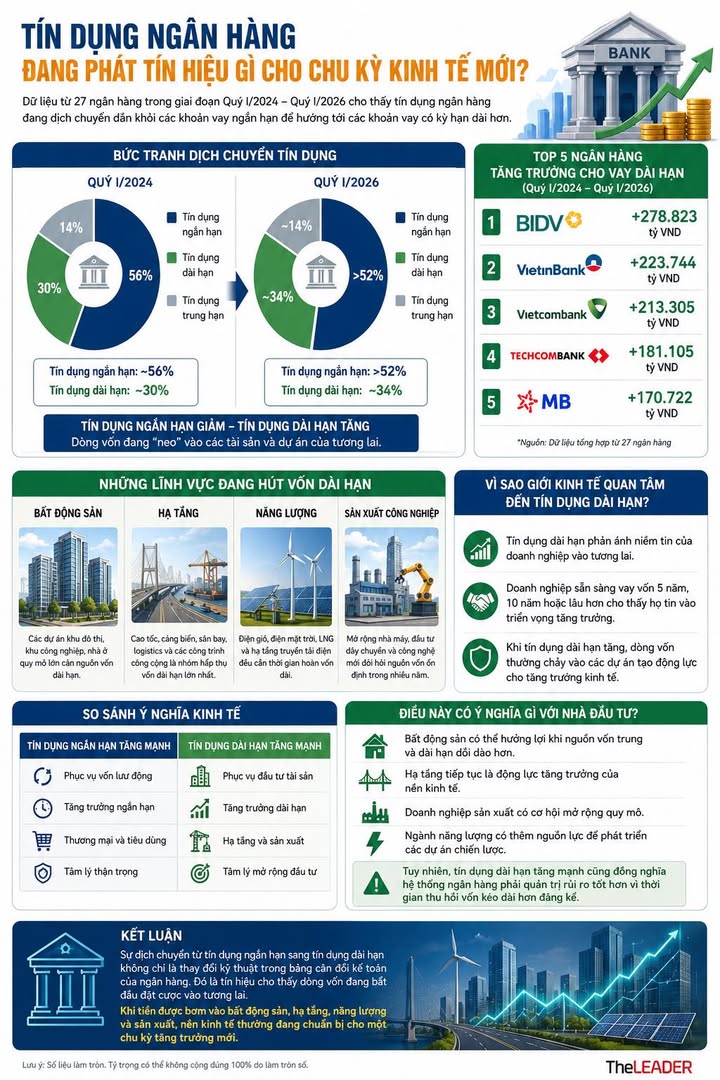
Data from 27 banks from the first quarter of 2024 to the first quarter of 2026 shows a notable change in the credit structure of the Vietnamese financial system.
The proportion of short-term credit has decreased from about 56% to more than 52%.
Meanwhile, long-term credit increased from about 30% to nearly 34%.
This is not simply a change in lending structure. In economics, such shifts often appear when the economy begins to enter a new investment phase.
CREDIT TRANSFER PICTURE
Targets for Quarter I/2024 Quarter I/2026
Short-term credit About 56% More than 52%
Long-term credit About 30% Nearly 34%
Downward Upward Trend
This change shows that capital flows are gradually shifting away from short-term commercial activities towards projects with longer investment life cycles.
AREAS THAT ARE ATTRACTIVE LONG-TERM CAPITAL
️ Real estate
Large-scale urban, industrial and housing projects often require capital that lasts for many years.
Infrastructure
Highways, seaports, airports, logistics and public works are the group that absorbs the largest long-term capital.
⚡ Energy
Wind power, solar power, LNG and power transmission infrastructure all take timen long payback.
Industrial production
Expanding factories, investing in new lines and technology requires stable capital for many years.
WHY ARE ECONOMICS INTERESTED IN LONG-TERM CREDIT
Long-term credit often reflects a business's confidence in the future.
When businesses are willing to borrow capital for 5 years, 10 years or longer, it shows they believe the market will continue to grow.
On the contrary, if a business only borrows short-term to maintain operations, the economy is often in a defensive state.
Comparison table of economic significance
Short-term credit increased sharply. Long-term credit increased strongly
Serving working capital Serving asset investment
Short-term growth Long-term growth
Trade and consumption Infrastructure and production
Cautious psychology The psychology of expanding investment
TOP BANKS ARE STRONGLY INCREASING LONG-TERM LOANS
According to data compiled from published images
Bank Absolute growth
BIDV +278,823 billion VND
VietinBank +223,744 billion VND
Vietcombank +213,305 billion VND
Techcombank +181,105 billion VND
MBBank +170,722 billion VND
These numbers show that large banks are playing a central role in financing large-scale projects in the economy.
WHAT THIS MEANS FOR INVESTORS
Real estate can benefit from more abundant medium and long-term capital
Infrastructure continues to be the growth engine of the economy
Manufacturing enterprises have the opportunity to expand their scale
The energy industry has more resources to develop strategic projects
However, a strong increase in long-term credit also means thatThe banking system must manage risk better because capital recovery time is significantly longer.
CONCLUSION
The shift from short-term to long-term credit is not just a technical change in a bank's balance sheet.
That is a signal that capital flows are starting to bet on the future.
When money is pumped into real estate, infrastructure, energy and manufacturing, the economy is often preparing for a new growth cycle.
The big question now is not whether a new cycle has begun.
It's about who will recognize that opportunity sooner than the rest of the market.
#Banking Credit #Vietnam's Economy #BIDV #VietinBank #Vietcombank #Techcombank #MBBank #Investment #Real Estate #Infrastructure #Energy #Manufacturing #TimKiemTop
: