#NaturalGas #NaturalGas #OilGas #Energy #ShaleGas #TightGas #CoalbedMethane #Petrovietnam #LNG #OilGas Technology
If right under our feet there are "gas treasures" worth millions and billions of dong but humans can only exploit a small part, is the world missing out on the largest energy source of the 21st century?
Natural gas has long been considered a "bridge fuel" between the fossil fuel era and renewable energy. However, not all natural gas is the same. Depending on the geological structure, each type of gas requires completely different exploitation technology, different costs and different levels of risk.
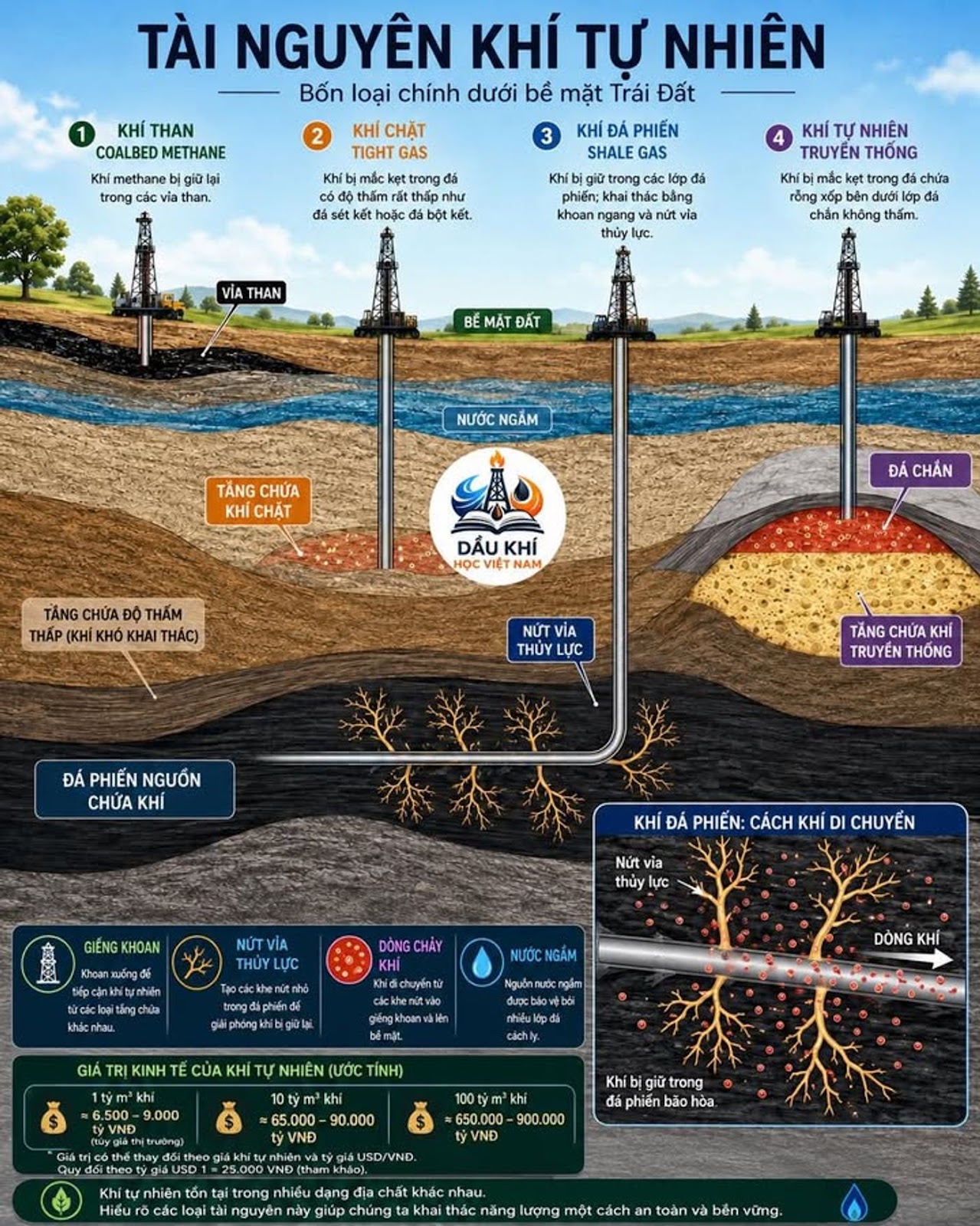
The illustration shows the four most important forms of natural gas resources that power billions of people around the world.
COALBED METHHANE GAS
This is methane gas trapped in coal seams.
Outstanding features
✅ Survive in coal mines
✅ Can be exploited simultaneously with coal mining activities
✅ Reduce the risk of gas explosions in mines
✅ Relatively low operating costs
Strong mining countries
Country Large reserves
China Very big
Australia Very big
Great America
Developing India
TIGHT GAS
This is gas trapped in rock strata with extremely low permeability.
To exploit, we must use modern drilling technology and reservoir stimulation.
Tight Gas Criteria
Mining difficulty High
High investment costs
Very large reserves
High technology requirements
ManyTight Gas mines in North America were once considered worthless until modern drilling technology appeared.
SHALE GAS SHALE GAS
This is an energy revolution that has changed the entire global oil and gas market.
The gas is held in shale layers deep underground.
Main technology
Horizontal drilling
Hydraulic fracturing
Geological analysis using AI
3D flow simulation
Shale Gas Impact Table in the United States
Indicators Before the shale boom After the shale boom
Natural gas prices High Fall sharply
Large LNG Imports Decline Sharply
Limited LNG Exports Leading the World
Energy Security Depends Proactively
It was the Shale Gas revolution that helped the United States go from an energy importer to the world's leading LNG exporting power.
TRADITIONAL NATURAL GAS CONVENTIONAL GAS
This is the most commonly exploited gas in the history of oil and gas.
Gas accumulates in highly porous reservoir rocks and is retained by the overlying barrier rock.
Advantages
✅ Mature mining technology
✅ Low production costs
✅ High recovery efficiency
✅ Less technical risks
Vietnam's large gas fields such as Nam Con Son, Cuu Long, PM3 Ca Mau or Block B all belong to this group.
COMPARE 4 TYPES OF NATURAL GAS
Type of Gas Difficulty of Extraction Cost Potential
Coalbed Methane Low Low Medium
Tight Gas Cao Cao Very large
Shale Gas Very High Very High Huge
Conventional Gas Low Low Has been exploited for many years
HUGE ECONOMIC VALUE
Illustrates the scale of potential revenue
1 billion m³ of natural gas
≈ 6,500 billion to 9,000 billion VND depending on pricemarket
10 billion m³ of natural gas
≈ 65,000 billion to 90,000 billion VND
100 billion m³ of natural gas
≈ 650,000 billion to 900,000 billion VND
That's why countries always compete fiercely to control gas resources.
WHERE IS VIETNAM?
Vietnam currently owns many offshore gas fields with strategic value.
Key projects
Lot B – O Mon
Blue Whale
Nam Con Son
PM3 Ca Mau
Thi Vai LNG Warehouse
Son My LNG warehouse
In the future, natural gas will continue to play an important role as a base power source to help Vietnam ensure energy security while expanding wind and solar power.
It is worth noting that the world has not yet fully exploited Tight Gas and Shale Gas sources. Many experts believe that underground there are still enough energy sources to supply humanity for decades, even centuries.
The future energy war may no longer lie above ground but thousands of meters below rock levels that humans are only just beginning to understand.
#NaturalGas #NaturalGasResources #ShaleGas #TightGas #CoalbedMethane #ConventionalGas #Energy #OilGas #LNG #Petrovietnam #AnNinhNenergy #EconomicsEnergy #OilGas Technology #Energy Market #TimKiemTop #Vietnam #Geology #OilGas Drilling #FutureEnergy