#Petrovietnam #Vietsovpetro #COP26 #NangLuong #DauKhi #CCS #CCUS #LNG #AnNinhNangLuong #KinhTeVietNam
Would many people be surprised if, while the world talks about green energy, Vietnam needs oil and gas more than ever to avoid the risk of dependence on imported energy and protect national security?
Vietnam's oil and gas industry is entering what is considered the most challenging period since the exploitation of the first commercial oil flow at Bach Ho field. The commitment to net zero emissions by 2050 under COP26 is creating huge transformation pressure, but at the same time opens up opportunities for comprehensive restructuring of the national energy sector.
It is worth noting that while many people think that renewable energy will completely replace oil and gas, reality in Vietnam and many developed countries shows that natural gas will still play an extremely important role in the next decades.
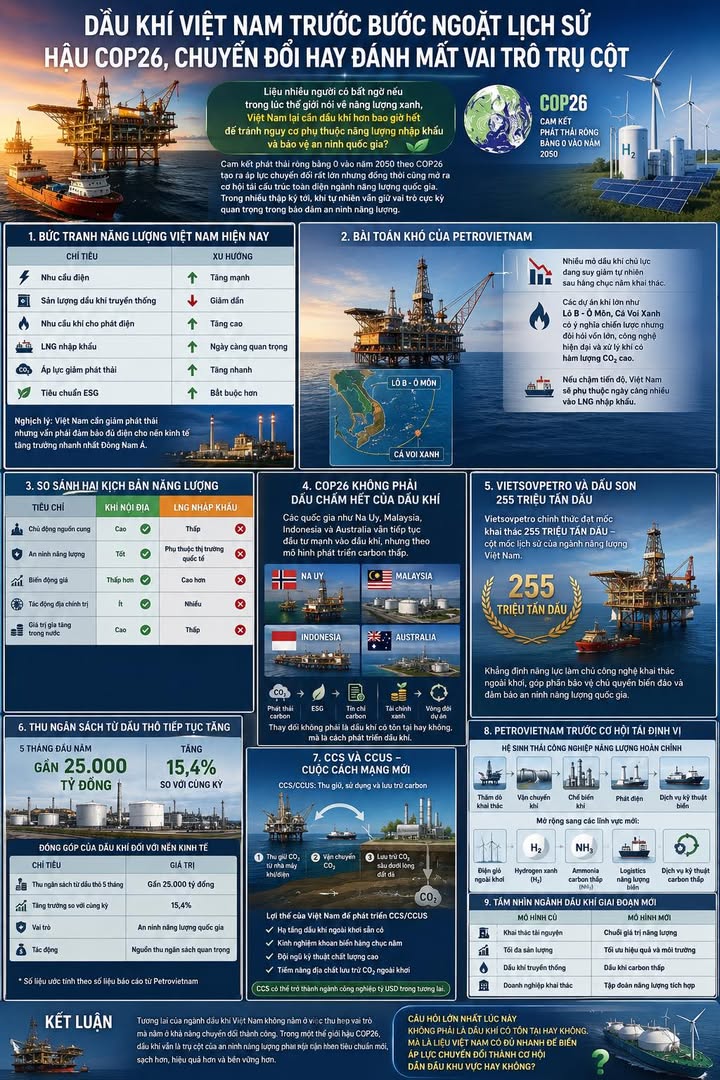
Vietnam's current energy picture
Trend Indicator
Electricity demand increased sharply
Traditional oil and gas production is gradually decreasing
Demand for gas for power generation is increasing
Imported LNG Increasingly important
Pressure to reduce emissions is increasing rapidly
More Mandatory ESG Standards
This creates a huge paradox.
Vietnam needs to reduce emissions but at the same time ensure enough electricity for the fastest growing economy in Southeast Asia.
Petrovietnam's difficult problem
Many key oil and gas fields are entering a period of natural decline after decades of exploitation.
Meanwhile, cLarge gas projects such as Block B - O Mon or Blue Whale have strategic significance but require huge investment capital, modern technology and the ability to process gas containing high CO₂ content.
If these projects fall behind schedule, Vietnam will have to rely more and more on imported LNG.
Compare two energy scenarios
Criteria for imported LNG domestic gas
Actively supply High and Low
Energy security Good Depends on the international market
Price fluctuations Lower Higher
Geopolitical impact More or less
Domestic added value High Low
COP26 is not the end of oil and gas
A common misconception is that COP26 means the oil and gas industry will disappear.
The reality is quite the opposite.
Countries such as Norway, Malaysia, Indonesia and Australia continue to invest heavily in oil and gas, but following a low-carbon development model.
What changes is not whether oil and gas exist or not.
What has changed is the way oil and gas is developed.
Previously, businesses only needed to care about output and profits.
Today, businesses must also consider carbon emissions, ESG, carbon credits, green finance and project lifecycle.
Vietsovpetro and 255 million tons of oil
In the context of challenging transformation, Vietsovpetro officially reaching the milestone of exploiting 255 million tons of oil became a historic milestone of Vietnam's energy industry.
This number not only has economic significance but also reflects the ability to master offshore exploitation technology, contributing to protecting island sovereignty and ensuring national energy security for many years.century.
Budget revenue from crude oil continues to increase
Another notable signal is that budget revenue from crude oil in the first 5 months of the year increased by 15.4%, reaching nearly 25,000 billion VND.
Contribution of oil and gas to the economy
Value Indicator
Budget revenue from crude oil in 5 months Nearly 25,000 billion VND
Growth over the same period of 15.4%
National Energy Security Role
Impact Important source of budget revenue
CCS and CCUS could become the new revolution
One of the most talked about technologies today is CCS and CCUS.
This is a technology that captures, uses and stores carbon.
For gas fields containing high CO₂ content, CCS is no longer an option but can become a mandatory condition for the project to be economically viable.
Vietnam possesses many advantages to develop this field.
✔ Available offshore oil and gas infrastructure
✔ Tens of years of offshore drilling experience
✔ High quality technical team
✔ Geological potential for offshore CO₂ storage
If properly invested, CCS can become a new billion-dollar industry in the future.
Petrovietnam faces the opportunity to reposition
Petrovietnam's biggest advantage lies not only in oil and gas exploitation.
The real strength is the complete energy industry ecosystem including gas exploration, exploitation, transportation, power generation, marine engineering services and industrial infrastructure.
Thanks to that, Petrovietnam has the ability to expand into offshore wind power, green hydrogen, low carbon ammonia, marine energy logistics and low carbon technical services.
Vision of the oil and gas industrynew paragraph
Old model New model
Resource exploitation Energy value chain
Maximize output Optimize efficiency and environment
Traditional Petroleum Low carbon petroleum
Mining enterprise Integrated Energy Group
Conclusion
The future of Vietnam's oil and gas industry does not lie in narrowing its role but in its ability to successfully transform.
In a post-COP26 world, oil and gas remains the pillar of energy security but must operate according to new, cleaner, more efficient and more sustainable standards.
The biggest question right now is not whether oil and gas exists or not.
It's about whether Vietnam is fast enough to turn the pressure of transformation into an opportunity to lead the region.
#DauKhiVietNam #Petrovietnam #Vietsovpetro #COP26 #CCS #CCUS #ESG #LNG #KhiTuNhien #NangLuongTaiTao #AnNinhNangLuong #KinhTeVietNam #BienDong #CongNgheDauKhi #ChuyenDichNangLuong